

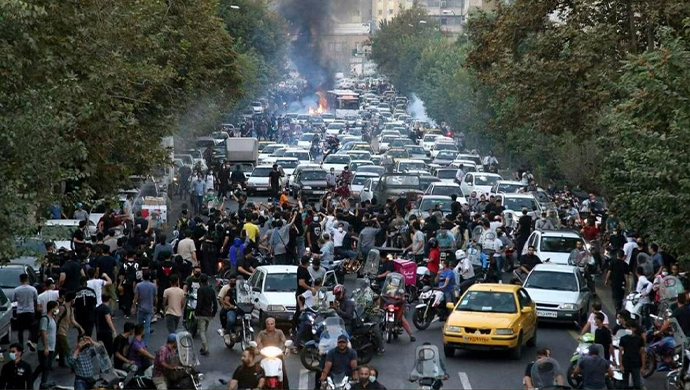

Four years after Iran’s 2022 nationwide uprising, the regime is still trying to evade accountability for its brutal crimes against humanity. Security forces killed hundreds of protesters, injured thousands, and arrested tens of thousands to suppress demonstrations that spread across the country following the death in custody of Mahsa Zhina Amini.
A new investigation by Amnesty International now provides one of the most detailed reconstructions yet of how that crackdown was organized. Published on September 16, 2026, the more than 1,000-page Architects of Atrocities report examines not only what security forces did on the streets, but also the institutions, officials, orders, and command structures behind the repression.
Amnesty concludes that Iranian authorities committed crimes against humanity while suppressing the uprising and identifies 87 officials who it says should face criminal investigation. Its findings are based on years of research, including interviews with 270 people, analysis of more than 2,000 videos, leaked official documents, prosecution orders, court verdicts, and forensic records.
The evidence presented in the report indicates that the violence was not simply the result of individual officers or local commanders exceeding their authority. The lethal repression implemented a state policy and was sustained by a coordinated command structure extending from senior authorities to forces operating on the streets.
From Mahsa Amini’s death to a nationwide uprising
The uprising began after the death in custody of 22-year-old Mahsa Zhina Amini on September 16, 2022, following her detention by Iran’s morality police. Protests that began in Saqqez and Tehran rapidly spread throughout the country and developed into a nationwide challenge to the ruling establishment.
According to reports obtained by the PMOI during the uprising, protests eventually reached more than 282 cities. At least 750 protesters were killed and approximately 30,000 people were arrested.
Amnesty’s new report assembles detailed evidence concerning 377 protesters and bystanders who died during the uprising, including 56 children.
The anatomy of a state-sponsored crackdown
Amnesty’s central finding concerns how the crackdown was organized.
The Islamic Revolutionary Guard Corps (IRGC) and the Police Command, FARAJA, led lethal protest dispersals. But their actions were embedded in a larger system. Amnesty traces security policy through the Supreme National Security Council, State Security Council, and provincial and county security councils.
The evidence includes strategy meetings, binding orders, deployment plans, allocations of personnel, money and weapons, and instructions demanding a “firm and severe” response. One leaked order instructed forces to respond without mercy, including by causing death. Security forces repeatedly used assault rifles, handguns and shotguns loaded with metal pellets, sometimes pursuing fleeing protesters and shooting unarmed people at close range.
Amnesty documented the unlawful killing of 87 people in Zahedan on September 30, 2022, during the crackdown known as “Bloody Friday.” (The PMOI’s assessment puts the death toll at more than 100 people, including children, with hundreds more injured.)
Amnesty identified 62 security-force commanders and 25 Interior Ministry officials among the 87 officials it says should be investigated. The list extends from national authorities to provincial and county officials.
Repression sustained by institutional impunity
The report also explains why accountability inside Iran has repeatedly failed.
Amnesty describes impunity for serious violations as systemic. The regime’s constitutional structure makes the Supreme Leader commander-in-chief of the armed forces while also giving him the power to appoint the head of the judiciary.
Cases involving abuses by security personnel are handled through institutions that lack the independence required to investigate the same security apparatus implicated in the crimes. The regime’s law also permits the use of firearms to disperse protests under circumstances incompatible with international standards.
The 2022 crackdown was not without precedent. During the November 2019 protests, security forces killed more than 1,500 people. The same pattern recurred in the 2025-2026 protests, where regime security forces brutally murdered thousands of unarmed protesters.
The recurrence of mass killings, arrests and efforts to obstruct accountability reinforces Amnesty’s conclusion that the problem extends beyond misconduct by individual officers.
Accountability must reach the command structure
Amnesty argues that accountability must therefore extend beyond the agents who fired on protesters to those who ordered, directed, facilitated and supported the repression.
Amnesty called on the UN Security Council to refer Iran to the International Criminal Court and, given political deadlock at the Security Council, called on the UN General Assembly to establish an international criminal justice mechanism. It also urged prosecutors worldwide to use universal or other forms of extraterritorial jurisdiction where legally available.
Amnesty also wrote to the regime’s senior leadership and security officials and notified the 87 officials identified in the investigation. Predictably, it had received no response when the report was published.
The political significance of Amnesty’s findings
We now have undeniable evidence that the 2022 bloodshed was not simply the result of uncontrolled local security forces but a coordinated campaign implemented through state institutions, formal command structures, official orders, state resources and an institutional system that has repeatedly prevented domestic accountability.
This highlights the role and responsibility of the international community. When a regime can’t and won’t prosecute its own crimes, then international bodies must intervene to hold it to account.
These findings also reinforce a broader political conclusion that the Iranian Resistance has been repeating over the years: repression is inseparable from the structure of clerical rule itself.
The only way this cycle of repression and violence ends is the overthrow of the existing regime by the Iranian people and their organized resistance, and the establishment a democratic republic based on popular sovereignty.