

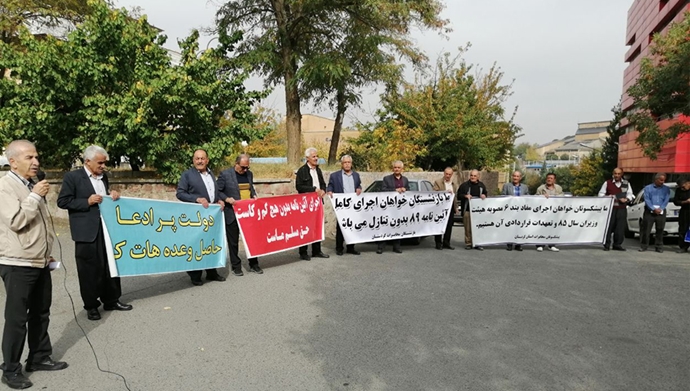

On Monday, November 2, 2026, Iran witnessed a widespread wave of simultaneous protest rallies across occupational, agricultural, and environmental sectors in nine cities and provinces: Tehran, Isfahan, Kurdistan (Sanandaj and Bijar), Lorestan, Kermanshah, Ilam, Zahedan, and Shahroud. Retirees, farmers, and environmental activists took to the streets to denounce the looting of pension rights, the deprivation of winter fuel quotas for agriculture, and the destruction of natural and water resources by economic conglomerates affiliated with the Office of the Supreme Leader and the Iranian regime’s Revolutionary Guards (IRGC).
Coordinated Rallies by Telecom Retirees Across Six Provinces Against Security Cartels
Retirees of the Telecommunication Company of Iran (TCI) held simultaneous protest gatherings in Tehran, Isfahan, Kurdistan (Sanandaj and Bijar), Lorestan, Kermanshah, and Ilam, demanding the payment of overdue benefits and the full implementation of the long-stalled 2010 employment and welfare regulations.
Protesters directed their anger squarely at TCI’s controlling shareholders—the “Execution of the Khomeini’s Order” (Setad) and the “IRGC Cooperative Foundation”—identifying them as the primary culprits behind the plundering of company resources and the freezing of retirees’ entitlements. In Isfahan, demonstrators highlighted the lawlessness of these state-backed entities, chanting: “Iran’s Telecom does not recognize the law,” “The major shareholder stole our rights,” and “We will not rest until we reclaim our rights.” Similar slogans were echoed in Sanandaj, Bijar, and Ilam, where retirees vowed to sustain their street presence until their misappropriated funds are fully restored.
This direct targeting reflects a clear public understanding that these two financial conglomerates, operating under the direct supervision of the supreme leader, have converted national industries into private slush funds to finance foreign terrorism networks and regional warmongering, while stripping retirees of their basic livelihoods and healthcare coverage.
Zahedan: Fuel Crisis Threatens Farmers with Ruin in an Energy-Rich Nation
In southeastern Iran, a group of greenhouse owners and farmers from the counties of Mirjaveh, Khash, and Saravan traveled to Zahedan to stage a protest outside the Sistan and Baluchestan provincial governorate. The demonstrators condemned the authorities’ refusal to allocate winter fuel quotas and the creation of arbitrary bureaucratic hurdles in the distribution process.
Protesters warned that fuel cutoffs and delivery delays at the onset of the cold season place the region’s greenhouse crops at risk of total destruction, threatening farmers with devastating financial losses. The crisis underscores the depth of systemic corruption and mismanagement in a country that holds some of the world’s largest oil and gas reserves, yet deprives its own agricultural producers of basic fuel due to organized smuggling networks and energy monopolies controlled by state-linked mafias.
Shahroud: Defending Mount Shahvar and Mocking the Greed of Ruling Clerics
In Semnan province, residents and environmental activists in Shahroud rallied to protest the ongoing destructive operations at the Tash bauxite mine. Demonstrators emphasized that Mount Shahvar serves as the most vital water-generating ecosystem in the eastern Alborz region, warning that the continued excavation of this habitat poses an existential threat to local water supplies and natural life.
Protesters exposed the collusion between government authorities and mining mafias, noting that the mine continues to operate under a permit issued by the provincial governorate despite explicit opposition from the Department of Environment. During the rally, participants expressed their outrage over the ruling establishment’s wholesale plundering of Iran’s surface and underground wealth.
These protests encapsulate the broader political and economic reality in Iran. Citizens across diverse sectors openly recognize that the regime and its military-financial arms have not only looted oil and gas revenues, embezzled offshore drilling rigs, and drained pension funds, but have also extended their reach to strip-mine vital mountains and water sources—cementing a nationwide conviction that confronting this organized plunder requires sustained resistance in the streets.