

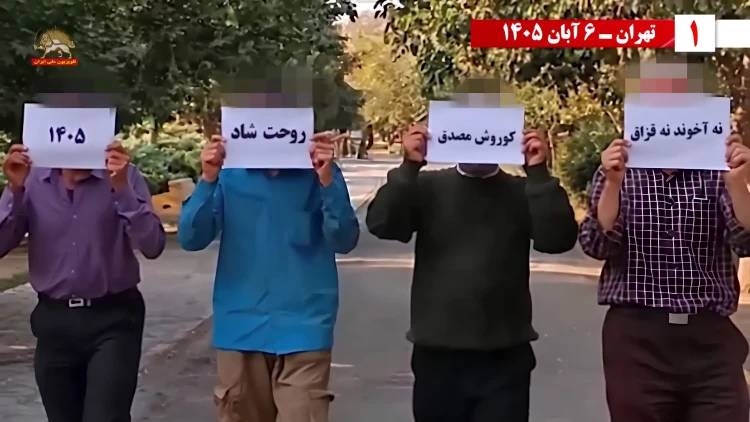

On and around October 29, 2026, Resistance Units affiliated with the People’s Mojahedin Organization of Iran (PMOI/MEK) marked Cyrus the Great Day with a wave of anti-regime activities across Iran. The Resistance Units carried out 110 activities, including displays of placards and posters, small-group actions, and anti-dictatorship graffiti in more than 20 cities and locations.
The recurring slogans—“Death to the oppressor, be it the shah or the supreme leader,” “Neither shah nor mullahs,” and “We are the children of Cyrus; we are the Resistance Units”—turned the commemoration into a rejection of both the former monarchy and the ruling theocracy.
October 29—Iran
PMOI/MEK Resistance Units mark the Cyrus the Great Day with anti-regime activities, rejecting both the mullahs' and the shah's dictatorships. pic.twitter.com/ZdS4gJbOT8— People's Mojahedin Organization of Iran (PMOI/MEK) (@Mojahedineng) October 30, 2026
Cyrus Day and the struggle over Iran’s historical identity
October 29, corresponding to the seventh day of Aban in the Iranian calendar, is a commemoration of Cyrus the Great. His tomb at Pasargadae has become a gathering place for Iranians honoring the country’s ancient heritage.
The occasion also carries contemporary political significance. In October 2025, security forces blocked access to Pasargadae during Cyrus Day observances. Against this history of restrictions, the Resistance Units’ activities presented Cyrus as a symbol of justice rather than a justification for restoring monarchy.
At Pasargadae, members of the Resistance Units displayed handwritten placards in front of Cyrus’s tomb, including one declaring, “Death to the oppressor, be it the shah or the supreme leader.” In recorded messages, participants honored Cyrus and former prime minister Mohammad Mosaddegh while voicing support for the Iranian Resistance.
Shiraz
"Cyrus, Mossaddegh, we will fight, we will die, we will take back Iran" pic.twitter.com/PoVtaAcaK7— People's Mojahedin Organization of Iran (PMOI/MEK) (@Mojahedineng) October 30, 2026
An activity listed under Persepolis featured a placard proclaiming, “Neither Pahlavi nor supreme leader; democracy and equality.”
In Shiraz, participants displayed posters of Cyrus and Mosaddegh near the Quran Gate. At Hafezieh, a participant commemorated the occasion and repeated the slogan against both the shah and the supreme leader. Elsewhere in the city, posters declared, “Cyrus Day reminds us of an Iran without tyranny,” and “Freedom is Cyrus’s legacy.” The message was that honoring Iran’s history need not mean returning to hereditary rule.
Activities from Tehran and Isfahan to other Iranian cities
In Tehran, four-person groups held placards reading “Neither shah nor mullahs” and “Death to the oppressor, be it the shah or the supreme leader.” Other participants displayed posters of Cyrus and Mosaddegh, while roadside placards proclaimed that Iranians rejected both the shah and the clerics.
In Isfahan, a group held signs denouncing the principle of velayat-e faqih, or absolute clerical rule, and voicing support for the Resistance. Two-person actions displayed handwritten messages linking the anniversary to Maryam Rajavi’s Ten-Point Plan for Iran’s future.
Karaj
"The era of any type of dictatorship, whether religious or monarchical, is over" pic.twitter.com/lk6Wd3MPMo— People's Mojahedin Organization of Iran (PMOI/MEK) (@Mojahedineng) October 30, 2026
In Karaj, members displayed posters featuring Maryam Rajavi’s statements rejecting religious and monarchical dictatorship. In Rasht, a placard expressed the determination to reclaim and rebuild Iran.
In Hamedan, two participants held signs declaring that Resistance Units are continuation of Cyrus’s path, while another message written on a wall rejected both shah and mullahs. In Ahvaz and Ilam, activists wrote anti-dictatorship slogans on walls. Activities were also reported in Mashhad, Kermanshah, Bandar Abbas, Tabriz, Kamyaran, Kangavar, and other locations.
A political alternative with a vision for Iran’s future
The campaign went beyond rejecting the current regime. Posters in Shiraz and Karaj carried Maryam Rajavi’s message that the era of every dictatorship, religious or monarchical, has ended. Other placards emphasized that sovereignty belongs to the Iranian people.
In Isfahan, handwritten signs promised a better future for Iran under Maryam Rajavi’s Ten-Point Plan. That plan calls for a republic based on popular sovereignty and free elections, separation of religion and state, gender equality, and abolition of the death penalty.
Shahin Shahr
"Salute to Rajavi. Down with the oppressor, be it the shah or the Supreme Leader" pic.twitter.com/AA2rKgEJGp— People's Mojahedin Organization of Iran (PMOI/MEK) (@Mojahedineng) October 30, 2026
Together, the slogans and organized activities presented a political alternative that rejects both forms of dictatorship and offers a program for democratic change.
By marking Cyrus Day on the ground, the Resistance Units are further stressing that the choice for Iran should not be between different models of dictatorship. The regime’s restrictions have not silenced those demanding freedom or prevented them from carrying their message across Iran.