


On September 18, the Iranian regime staged one of its largest government-organized street mobilizations in Tehran since the beginning of the recent war. The “Janfada-ye Iran” campaign brought uniformed participants, armed volunteers, drones and other military hardware into the streets, while state media claimed a 313,000-person turnout. Regime president Masoud Pezeshkian and senior military officials attended the event.
The regime presented the maneuver as a demonstration of unity and readiness against external threats. But its timing was significant. It came just two days after the fourth anniversary of Iran’s September 2022 uprising, at a time when the authorities had placed security forces on heightened alert over the possibility of renewed domestic unrest.
A mobilization that extends beyond a one-day rally
The significance of the regime maneuver goes beyond the September 18 parade. State-linked sources say the campaign began months earlier and was intended to build a nationwide network of volunteers receiving military, emergency and security-related training.
Iranian officials have spoken of organizing 1,000 so-called “popular national resistance” battalions alongside 1,000 emergency units. The announced curriculum goes beyond conventional wartime preparation. It includes local security, intelligence monitoring and counterintelligence, as well as training with weapons and drones.
The program is also intended to maintain a sustained organized presence in public spaces. Authorities have promoted repeated nighttime gatherings and are trying to recruit people who previously did not belong to the Basij network. Whatever role such forces might play during an external conflict, these elements give the project an evident domestic-security dimension.
The regime’s real fear is not an external conflict but another nationwide uprising, nine months after its forces carried out a massacre of protesters in cities across Iran.
The domestic threat remains at the center of regime calculations
The fourth anniversary of the 2022 uprising provided a revealing test of that security apparatus.
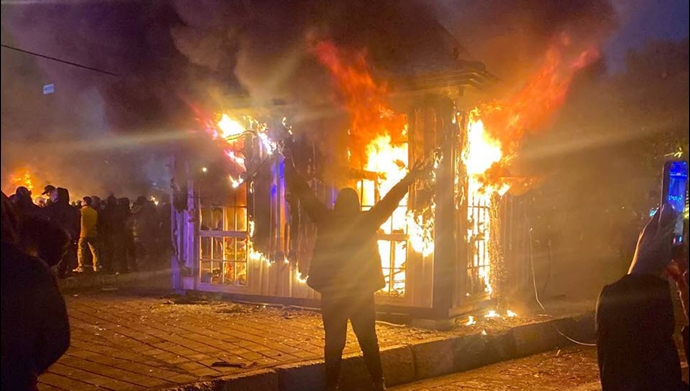
Ahead of September 16, the regime intensified security measures. State Security Forces chief Ahmadreza Radan publicly claimed that authorities were pursuing and arresting members of the People’s Mojahedin Organization of Iran (PMOI/MEK). Nevertheless, on September 15, Resistance Units carried out projections, graffiti, poster campaigns and other activities in Tehran, Mashhad, Isfahan, Shiraz, Kermanshah, Karaj, Kerman, Hamedan, Kashan and other cities.
The following day, September 16, Resistance Units carried out 40 operations in Tehran and 20 other cities. The targets included Basij bases and facilities associated with the IRGC and Ministry of Intelligence. The geographic spread extended from Mashhad and Karaj to Ahvaz, Kermanshah, Bandar Abbas, Zahedan and Bushehr.
These activities do not by themselves measure the level of opposition across Iranian society. But they establish something more concrete: despite a nationwide security alert and public threats of arrests, organized opposition activity continued across multiple provinces on one of the most politically sensitive dates of the year.
The pressures that fueled unrest have not disappeared
The regime’s security mobilization is taking place against an increasingly difficult economic background.
In early September the rial had fallen from around one million to the dollar a year earlier to more than 2.2 million, while official 12-month average inflation had reached 69.9%. Food prices are rising considerably faster. Economic pressure has therefore continued to erode household purchasing power while the authorities remain conscious of the possibility of renewed unrest.
On September 8, the government also doubled the price of gasoline purchased beyond the subsidized monthly quotas, raising the highest tier from 50,000 to 100,000 rials per liter. The measure came in an economy already suffering from rapidly rising food, transportation and living costs.
This economic environment matters because Iran’s recent protest waves have repeatedly developed amid combinations of economic grievances, political repression and broader demands for change.
Street deployments can raise the immediate cost of protest, but they do not resolve those underlying pressures, especially as there’s an organized Resistance that is waiting in the wings to organize and direct the next uprising.
Two competing images of Iran’s streets
The contrast around the uprising anniversary is therefore striking.
The regime fills Tehran’s streets with organized formations, weapons, military equipment to project an image of control and power.
At the same time, the Resistance Units are proving the hollowness of the regime’s displays of power with their continued defiance and activities, especially at a time where the regime is in a state of high alert and heightened security.
Controlling public space temporarily is not the same as eliminating the conditions that produce unrest. Persistent economic grievances, continuing security alerts and organized opposition activities show why the regime continues to devote such substantial resources to controlling Iran’s streets.