

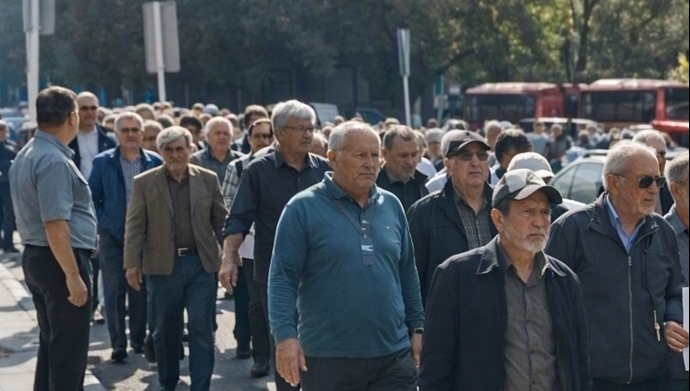

On Sunday, November 1, 2026, six major Iranian cities—Tehran, Isfahan, Ahvaz, Shush, Kermanshah, and Rasht—witnessed a coordinated wave of protest rallies and marches led by Social Security and steel industry retirees alongside public educators. Demonstrators took to the streets to denounce collapsing living standards, runaway inflation, and the rapid erosion of purchasing power. Moving beyond purely occupational grievances, the chants raised across the country targeted the core policies of the regime, exposing the state’s exploitation of religious rhetoric to mask systemic corruption while directly blaming foreign warmongering and the looting of oil revenues for the impoverishment of Iranian society.
Isfahan: Rejecting State Ideology and Confronting the Executive Branch
In Isfahan, retirees from the steel industry and the Isfahan foundry marched toward the provincial governorate to demand their delayed pensions and statutory benefits. The slogans echoing through Isfahan’s streets reflected a complete public break with the ruling establishment’s official narrative across three distinct fronts. Protesters directly challenged the state’s manipulation of religious sentiment to cover up financial graft, chanting: “Hussein, Hussein is their slogan; lies and theft are their trade.”
November 1—Kermanshah, western Iran
Retirees and pensioners of the Social Security Organization resume their weekly protests against poor economic and living conditions. In their protests they also called for the release of political prisoners and detained protesters. pic.twitter.com/Pa1UtwiHsz— People's Mojahedin Organization of Iran (PMOI/MEK) (@Mojahedineng) November 1, 2026
Simultaneously, demonstrators dismantled the state propaganda that routinely blames foreign powers for domestic crises, chanting in unison: “Our enemy is right here; they lie when they say it’s America.” Protesters also aimed their anger directly at the regime’s president, Masoud Pezeshkian, chanting: “Hey President, you lied to the nation,” underscoring the collapse of public trust in the government’s promises of economic reform.
Ahvaz and Shush: Linking Empty Dining Tables to Warmongering and Looted Oil Wealth
In oil-rich Khuzestan province, demonstrations by Social Security retirees in Ahvaz and Shush drew a direct line between household poverty and the ruling authority’s regional military adventures. Gathering outside the General Directorate of Social Security in Ahvaz to protest unprecedented price hikes, retirees summarized the root of Iran’s economic paralysis in their central chant: “Enough warmongering, our tables are empty!” The slogan reflects a deep-seated public awareness that national wealth is being drained to fund regional conflicts and proxy networks linked to the IRGC, rather than securing basic living standards at home.
November 1—Ahvaz, southwest Iran
Retirees of the education sector resume their protest rallies. In addition to protesting low pensions and poor economic and living conditions, they also took aim at the regime's warmongering policies that is making their lives worse. pic.twitter.com/zO8WuIycTs— People's Mojahedin Organization of Iran (PMOI/MEK) (@Mojahedineng) November 1, 2026
In nearby Shush, retirees rallied outside the Department of Labor against catastrophic inflation, confronting authorities over the plunder of national resources with the chant: “Where is the oil dollar? Only its inflation belongs to us!” By adding the slogans “Neither parliament nor government cares about the nation” and “Enough tyranny and oppression, our tables are empty,” demonstrators emphasized that both the legislative and executive branches are fully complicit in engineering the current livelihood crisis.
Kermanshah: Exposing the Currency Divide and Demanding Freedom for Political Prisoners
In Kermanshah, Social Security retirees gathered outside the agency’s provincial headquarters in a demonstration that merged economic grievances with political and human rights demands. Protesters exposed the mechanics of state corruption through the chant: “Embezzlements are in dollars, our wages are in rials!”—a sharp indictment of how state-connected insiders hoard hard currency while leaving working-class families to absorb the freefall of the national currency.
November 1—Kermanshah, western Iran
Retirees and pensioners of the Social Security Organization resume their weekly protests against poor economic and living conditions. In their protests they also called for the release of political prisoners and detained protesters. pic.twitter.com/Pa1UtwiHsz— People's Mojahedin Organization of Iran (PMOI/MEK) (@Mojahedineng) November 1, 2026
Demonstrators also linked the cost-of-living crisis directly to state repression and destructive military policies, chanting: “Death to high prices, poverty, war, and destruction,” “The imprisoned protester must be freed,” and “Solidarity, unity: the end of tyranny and injustice.” The prominence of these slogans highlights the growing convergence between the retirees’ livelihood movement and the broader struggle for the release of political prisoners and detained protesters.
Tehran and Rasht: Defiance Against the Commodification of Healthcare and Education
In the capital, Tehran, Social Security retirees staged a protest outside the organization’s central headquarters, signaling their resolve to maintain street pressure regardless of the conditions with the chant: “Neither cold nor heat can stop us.” Protesters denounced the predatory nature of the healthcare and insurance sectors, branding supplemental insurance companies as “highway robbers,” while demanding an annual bonus equivalent to two full months’ pension. They also defended broader public welfare rights, chanting: “Free education is our indisputable right.”
November 1—Tehran, Iran
Retirees of the education sector resume their rallies, protesting low pensions and poor economic and living conditions. pic.twitter.com/kRlwU8vcXe— People's Mojahedin Organization of Iran (PMOI/MEK) (@Mojahedineng) November 1, 2026
Concurrently, in the northern city of Rasht (Gilan province), retirees and teachers held a joint protest rally to condemn below-poverty-line wages and the government’s persistent refusal to implement statutory pay adjustments amid soaring living costs.
The coordinated demonstrations across these six cities demonstrate that Iran’s protesting public is no longer merely petitioning for incremental wage adjustments, but is actively confronting the ruling establishment over the structural causes of the crisis. Citizens are openly articulating that widespread poverty, hyperinflation, and the collapse of healthcare and education are the direct consequences of the regime’s policies and the IRGC monopolizing oil revenues and national assets to finance regional warmongering and multibillion-dollar embezzlement schemes—turning the streets into an ongoing arena of confrontation to reclaim their fundamental rights.