

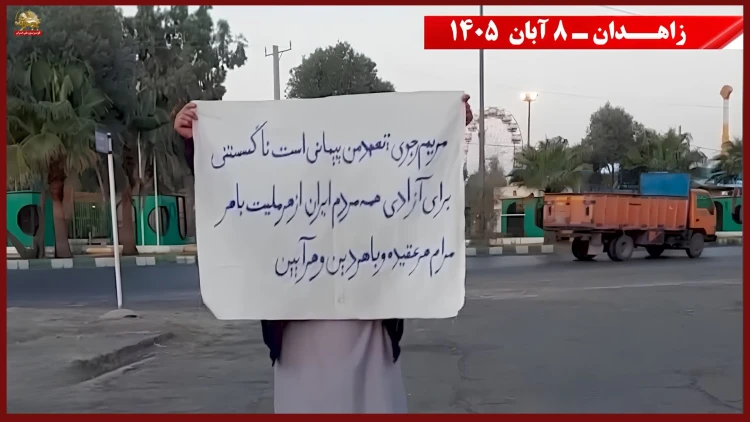

On October 30, 2026, Resistance Units affiliated with the People’s Mojahedin Organization of Iran (PMOI/MEK) continued their weekly anti-regime activities in Zahedan, southeastern Iran, spreading messages and slogans rejecting all forms of dictatorship and calling for freedom, equality, and a democratic republic.
October 30—Zahedan, southeast Iran
PMOI/MEK Resistance Units resume weekly anti-regime activities, rejecting all forms of dictatorship and spreading messages of resistance against tyranny. pic.twitter.com/tfT4d6sBGu— People's Mojahedin Organization of Iran (PMOI/MEK) (@Mojahedineng) October 31, 2026
The activities centered on the message of “Neither shah nor mullahs,” emphasizing opposition to both the restoration of the former monarchy and the continuation of clerical rule. Through their slogans, the Resistance Units stressed that Iran’s future must not be determined by hereditary rule, religious authoritarianism, or foreign dependence, but by the Iranian people themselves.
Rejecting dictatorship, whether under a crown or a turban
One of the central slogans of the October 30 activities declared: “Dictatorship is dictatorship, whether with a turban or a crown.”
The message summarized the Resistance Units’ rejection of both systems of authoritarian government. Other slogans condemned oppression under both the shah and the Supreme Leader, rejected monarchy and clerical rule, and denounced the history of abuses of the two tyrannical systems.
The slogans also denounced monarchy and the mullahs’ rule for a century of crimes against the Iranian people.
"To the people of Iran, the Shah’s son stands as a symbol of foreign dependency and an attempt to resurrect monarchical dictatorship—openly declaring that he takes pride in every act of his father’s regime" pic.twitter.com/PemqhYOW7s
— People's Mojahedin Organization of Iran (PMOI/MEK) (@Mojahedineng) October 31, 2026
These messages recalled a fundamental lesson of Iran’s modern history. The 1979 revolution ended the Pahlavi monarchy, but the establishment of religious dictatorship under Ruhollah Khomeini denied Iranians the democratic freedoms they had sought.
By condemning both systems, the Resistance Units emphasized that removing the clerical regime must not become a means of restoring hereditary dictatorship. A change in rulers that preserves authoritarian institutions would not fulfill the demand for freedom.
Their slogans drew a clear distinction between replacing one dictatorship with another and establishing a political system based on accountability and popular sovereignty.
Freedom, equality, and a democratic republic
Alongside their rejection of dictatorship, the Resistance Units presented a vision for Iran’s future through slogans demanding democracy, equality, freedom, and a democratic republic.
One message rejected both monarchy and supreme religious leadership in favor of democracy and equality. Another rejected the shah and the clerics while demanding freedom and republican government.
These slogans emphasized that the objective of political change is not simply to replace the current rulers but to establish a fundamentally different system in which government derives its legitimacy from the people’s will.
"The great lesson of two wars and an uprising over 40 years is that returning to puppet monarchical fascism is nothing more than a mirage." pic.twitter.com/ftyXynHEWO
— People's Mojahedin Organization of Iran (PMOI/MEK) (@Mojahedineng) October 31, 2026
The emphasis on equality also challenged the privileges associated with inherited power and religious authority. In a democratic system, political rights and participation must belong to citizens regardless of their background or beliefs.
Independence was another essential element of the campaign’s message. Iran’s future, the Resistance Units emphasized, must be determined by its own people rather than imposed through foreign intervention or dependence on outside powers.
The Resistance Units thus connected opposition to dictatorship with a positive demand for democratic government, presenting freedom, equality, and national independence as inseparable principles.
From Zahedan to Tehran: A nationwide rejection of tyranny
Another slogan connected Zahedan’s anti-regime activities to the broader struggle for freedom across Iran, expressing opposition to oppression from Zahedan to Tehran, whether under the shah or the Supreme Leader.
The geographical reference carried particular significance. Zahedan, the capital of Sistan and Baluchestan province, has witnessed some of the Iranian regime’s deadliest acts of repression.
"Regime change and the establishment of a free Iran is the responsibility of the Iranian people and their Resistance" pic.twitter.com/A0rFac67X6
— People's Mojahedin Organization of Iran (PMOI/MEK) (@Mojahedineng) October 31, 2026
On September 30, 2022, security forces opened fire on protesters and bystanders following Friday prayers, killing scores of people in a crackdown that became known as “Bloody Friday.”
By linking Zahedan with Tehran, the Resistance Units emphasized that the struggle against dictatorship extends beyond any single city, ethnic community, or region.
Their message presented opposition to both monarchy and clerical rule as a national demand, connecting the suffering and resistance of people in southeastern Iran to the broader struggle for democratic change throughout the country.
A continuing campaign for democratic change
The October 30 activities marked another week of anti-regime campaigning by Resistance Units in Zahedan. Similar activities on October 16 and 23 carried messages rejecting both monarchy and clerical dictatorship while advocating freedom and a democratic republic.
The consistency of these slogans underscores the Resistance Units’ central political message: opposition to the current regime does not mean support for returning to the political system overthrown in 1979.
Through their continuing activities, the Resistance Units in Zahedan reaffirmed their rejection of both forms of dictatorship and their demand for an Iran based on freedom, equality, independence, and the people’s right to determine their political future.