

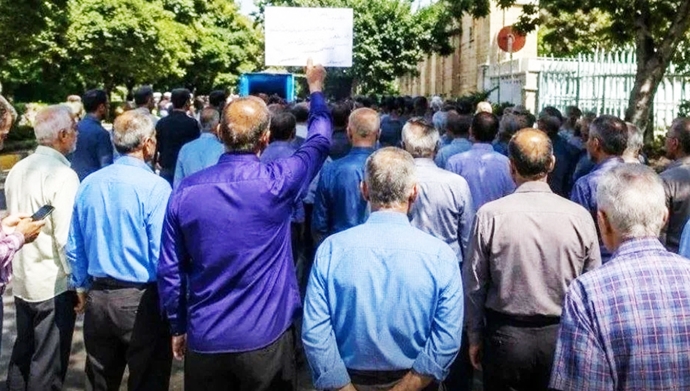

Why should retirees who spent their lives working have to march to demand the pensions and benefits they are owed? Why must workers protest to protect their jobs, students to demand safe food, and families to recover their savings? Across Iran, these questions are being raised in demonstrations by people whose livelihoods are under pressure.
On October 18 and 19, another wave of rallies brought retirees and investors into the streets of several cities, exposing an economic crisis that has become a confrontation with the policies and institutions of the clerical regime.
Retirees and investors return to the streets
On October 18, Social Security retirees protested in Tehran, Kermanshah, Shush, Rasht, and Ahvaz. Steel and iron industry retirees held a separate rally in Isfahan. Their gatherings challenged the erosion of pensions, declining purchasing power, and the handling of retirees’ assets.
The following day, telecommunications retirees protested in Kurdistan, Kermanshah, Isfahan, Hamedan, and Ilam provinces. In Isfahan, they gathered outside the governorate, demanding justice and condemning the loss of their rights.
Other demonstrations showed that the crisis reaches beyond pensioners. In Yazd, investors in the Pishgaman Institute blocked Fallahi Street over lost funds. Fajr Bahman shareholders demonstrated outside the judiciary in Mashhad, while applicants to the National Housing project in Dehdasht demanded answers and the return of their money.
Their grievances differed, but each reflected a loss of confidence in institutions responsible for safeguarding livelihoods.
A crisis affecting every part of society
These gatherings followed protests on October 10–12 that showed how widely hardship has spread. In Rasht, dismissed workers of the Khavar Spinning factory protested their lost jobs. In Tabriz, nurses demonstrated against poor living conditions and discrimination. Farmers in Biarjomand, near Shahrud, protested repeated electricity outages that had damaged their crops.
At Bu-Ali Sina University in Hamedan, students went on strike over the quality of university food after 53 female dormitory residents suffered food poisoning and were hospitalized.
Together, these protests show how economic insecurity and failures in basic services have spread into workplaces, healthcare, education, and agriculture. For many Iranians, even employment and retirement no longer guarantee stability.
Inflation and anger at powerful economic institutions
The economic backdrop helps explain why protests recur. Figures attributed to Iran’s Statistical Centre put annual inflation at 62.5 percent in July 2026. Rising prices are overtaking incomes, forcing families to cut back on food, healthcare, and other essentials.
Anger is also directed at institutions that protesters accuse of benefiting while retirees struggle. Telecommunications pensioners have singled out the Execution of Imam Khomeini’s Order (EIKO) and the Islamic Revolutionary Guard Corps (IRGC) Cooperative Foundation.
In Isfahan, demonstrators chanted, “We built telecommunications, the IRGC took it, and we lost.” In Kermanshah, protesters accused a major shareholder of taking their rights.
Their message was not simply that payments are inadequate, but that powerful institutions control economic assets while ordinary people pay the price.
From economic demands to political accusations
The slogans on October 18 and 19 reveal the protests’ political significance. In Tehran, retirees declared, “High prices, embezzlement; this is your economy.” In Kermanshah, protesters asked, “Where is the oil money? Inflation is for us,” and condemned “high prices, poverty, war, and destruction.”
In Isfahan, retirees delivered an even more explicit challenge: “Our enemy is right here; they lie that it’s America.” The slogan rejects explanations that place responsibility for hardships solely on foreign pressure and instead holds the authorities at home accountable.
Repeated protests have become more than appeals for pension or wage adjustments. Their language links daily hardship to corruption, the distribution of national wealth, and the regime’s priorities. Protesters are asking not only for what they are owed, but who is responsible for denying them their rights.
The demand for a dignified life
One slogan heard in Kermanshah captures the protesters’ determination: “Until we get our rights, we will not stop.” Their return to the streets underscores how little confidence they have that official channels will resolve their grievances.
Behind demands for adequate pensions, secure jobs, safe food, functioning services, and the return of savings lies a fundamental claim: the right to live with dignity.
In Iran, that claim has become a recurring act of public defiance—and a challenge to a regime confronted by the consequences of its own policies. And the solution is clear: the overthrow of the despotic regime and the establishment of a democratic republic based on the sovereignty of the people.