

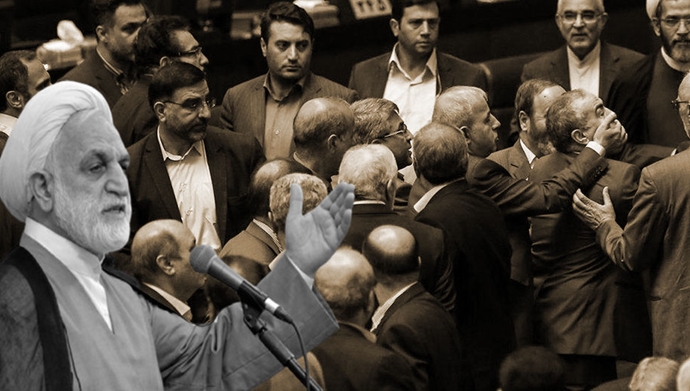

In his speech on January 27 at the 25th Conference of Public and Revolutionary Prosecutors, Iranian regime Judiciary Chief Gholamhossein Mohseni-Eje’i criticized former foreign minister Mohammad Javad Zarif’s statements at the Davos Summit. As quoted by Mizan, the judiciary’s news agency, Mohseni Eje’i said, “Today, the embodiment of tyranny is the American regime. We cannot rely on an unjust regime to solve our problems. We must not be intimidated by the power of tyrants; we must show the utmost perseverance and resistance against them.
“It is inappropriate for a representative of the state to speak in an international assembly in a way that weakens the cause of truth and pleases and delights the enemy. It is not appropriate to speak in a global forum as if there are internal conflicts in our country. It is unacceptable to make statements among foreigners that reinforce the enemy’s false narrative about the country’s weakness.”
He also responded to the vulgar language and outbursts of individuals dressed in burial shrouds (a symbolic act of protest in Iran): “It is permissible to critique any individual or institution, but in doing so, we must not resort to language and expressions that please and delight the enemy… Is it Islamic ethics to criticize others with words and language that make the enemy happy?”(Ibid).
These admonitions and warnings to the regime’s factions concerning the fate of the entire regime come amid ongoing disputes over negotiations with the United States, which have become a contentious topic between the two factions.
Regime President Masoud Pezeshkian, who stated on January 23 in a meeting in Ahvaz, “We must speak to the world in the language of peace and greeting,” faced harsh criticism and domestic threats afterward. These remarks, which hinted at an inclination toward negotiating with the West, triggered strong reactions from members of the rival faction.
He said, “China, with all its grandeur, is constantly threatened by the U.S., yet it still engages with it because it seeks to maximize its benefits in the world it lives in.”
In response to Pezeshkian’s remarks, clerics of various ranks attacked him during Friday prayers. Ahmad Alamolhoda, Friday Prayer leader in Mashhad, was among those who labeled him and his like-minded peers as individuals who are inclined toward the West.
In Tehran, Ahmad Khatami, a member of the Guardian Council, launched an even harsher attack on Pezeshkian. Referring to regime founder Ruhollah Khomeini’s earlier remarks about the U.S., he asked, “Has the U.S. become a lesser Satan? Or a greater one?”
However, in an even stronger reaction from domestic officials, Pezeshkian’s intelligence minister, Esmaeil Khatib, emphasized the dangers of negotiation, saying, “If the drumbeat of negotiations, infatuation, fear, and anxiety overcomes us, we will lose.” He warned about the risks of negotiating with the U.S., stressing that the country is never after a “win-win negotiation” but rather aims for Iran’s “submission and humiliation.”
The secretary of Tehran’s Promotion of Virtue Council wrote on social media, “Anti-coup forces must arrest Zarif upon his return to the country and interrogate him; otherwise, the nation will soon face more complex and very dangerous crises.”
The situation escalated to the point where MP Mohammad Manan Raeisi angrily shouted at Eje’I, “The official laws of the nation are being violated. This lawless person, at an international conference, shamelessly mocked the divine decree by saying, ‘In Tehran’s streets, women walk naked, and this is the right path.’ You are wrong about saying this is the right path. Who are you to say is the right path? You are out of line. Mr. Eje’i, two months ago, I came to you and said to address Zarif’s situation. You said it’s not my duty, let the Majlis (parliament) intervene. Nearly 40 days ago, the National Security Committee sent you a letter. When we speak with the speaker of parliament, he points to the judiciary; when we speak with the judiciary, it points to parliament!”
The opposing faction was not idle either. Responding to the rival’s theatrics and shroud-wearing protests, they wrote, “This coarse rhetoric is unworthy of a parliamentary representative and contradicts Islamic and Iranian cultural values. The question arises: How can a few motorcyclists or shroud-wearing individuals dictate the future of 85 million Iranians?” They also pointed out, “If there were free elections without barriers to candidacy and voting… people like Manan Raeisi and other members of the Stability Front would not have entered the parliament” (Source: the state-run Setareh Sobh newspaper, January 27).
What is evident in the remarks of Khamenei’s judiciary chief is the growing fear of the regime’s fragility both domestically and internationally.
The infighting among factions is a result of the current state of the regime, grappling with pervasive crises. Resorting to intimidation against any one faction will not bring it to a halt.