

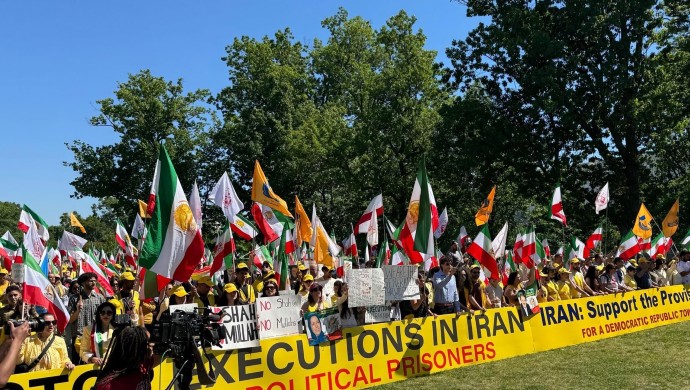

On May 16, 2026, thousands of Iranians and supporters of a free Iran gathered in Washington, D.C., to amplify the voices of a nation locked in a historic struggle for its liberation.
Against the backdrop of the massive December 2025–January 2026 nationwide uprising, where protests originating in the Tehran bazaar swiftly morphed into all-out demands for regime change, the ruling clerics have responded with a brutal campaign of repression. The regime’s recent execution spree, which claimed the lives of numerous political prisoners and protesters, stood at the forefront of the rally.
As the geopolitical landscape of the Middle East remains volatile following the international military strikes on regime targets between February and April 2026, the message from the streets of the U.S. capital was clear and resolute: The fate of Iran will not be decided by foreign interventions, backroom diplomacy, or aerial bombardments, but by the Iranian people and their organized Resistance.
May 16, 2026
Thousands in #DCFreeIranRally and March to condemn executions in Iran and support a democratic republic#StopExecutionsInIranhttps://t.co/RGz7GfXbpj— People's Mojahedin Organization of Iran (PMOI/MEK) (@Mojahedineng) May 16, 2026
With the legacy of the monarchy firmly rejected and the current theocracy facing an existential crisis, a diverse coalition of speakers—including former U.S. officials, human rights advocates, representatives of marginalized Iranian nationalities, and members of the Iranian diaspora youth—rallied around the National Council of Resistance of Iran (NCRI) and Maryam Rajavi’s Ten-Point Plan for a democratic, secular, and non-nuclear republic.
The Impasse of the Clerical Regime: Maryam Rajavi’s Keynote
In a powerful video address, Maryam Rajavi, President-elect of the NCRI, summarized the precarious state of the Iranian regime. Outlining the clerics’ inability to return to the pre-uprising status quo or chart a viable path forward, she noted that the establishment has “intensified their war against the Iranian people” by exploiting wartime conditions to initiate a bloody purge of political prisoners through a “strategy of the noose.”
Despite sending prominent members of the People’s Mojahedin Organization of Iran (PMOI/MEK) and rebellious protesters to the gallows, the regime has fundamentally failed to quell the unrest. Mrs. Rajavi highlighted the unyielding courage of the Resistance Units, pointing to their relentless daily operations and the recent assault by 250 MEK freedom fighters on the Supreme Leader’s headquarters. “They are acutely aware that this offensive has galvanized a new generation toward resistance and battle,” she stated.
Message to the demonstration by Iranians in Washington, D.C.
The people of Iran are marching toward a future defined by the ballot box—a future of pluralism, autonomy for our diverse ethnic nationalities, the equal participation of women in societal leadership, and the separation… pic.twitter.com/m9bIUCrQIO— Maryam Rajavi (@Maryam_Rajavi) May 16, 2026
Mrs. Rajavi also warned against the dual threats facing the Iranian democratic movement: the international policy of appeasement that seeks to preserve the regime, and the remnants of the Shah’s dictatorship, which she described as “wolves in sheep’s clothing” aiming to resurrect the dreaded SAVAK secret police.
Drawing a clear line toward the future, Mrs. Rajavi affirmed that the regime’s overthrow will be realized exclusively through the will of the Iranian people and their organized resistance. “We do not wait for this regime to collapse spontaneously, nor do we expect external actors to change it,” she declared. “The Army of Liberation is the only way to freedom.”
The “Strategy of the Noose”: Executions and Human Rights Abuses
In recent weeks, the Iranian regime has attempted to project power by rushing political dissidents to the gallows, a move speakers identified as a symptom of the state’s paralyzing fear. The rally honored the names of those who recently fell victim to this execution spree. Among them were dedicated PMOI members: Hamed Validi, Mohammad Massoum-Shahi, Vahid Bani Amerian, Abolhassan Montazer, Mohammad Taghavi, Ali Akbar Daneshvarkar, Pouya Ghobadi, and Babak Alipour.
Alongside them, the regime executed young protesters arrested during the December 2025–January 2026 uprising and other political dissidents.
.@PJK4brainhealth: Inside Iran, #ResistanceUnits and rebellious youth are acting across cities, striking IRGC and Basij symbols of repression. This is an organized struggle for freedom and democracy. #DCFreeIranRally #NCRIAlternativehttps://t.co/yq6BuPYzAf
— Iran Freedom (@4FreedominIran) May 16, 2026
Former U.S. Congressman Patrick J. Kennedy reflected on the backgrounds of the executed MEK members, noting the human capital the regime is destroying. “Vahid was only 34 years old. He was an electrical engineer and a fearless leader of a Resistance Unit,” Kennedy remarked. “Abolhassan was 67 years old, an architectural engineer, and a veteran member of the MEK, representing another generation of sacrifice, having been a political prisoner under both the Shah and the current mullahs.” Kennedy emphasized that a secure and confident regime “does not rush political prisoners to the gallows” or “execute engineers, students, or workers.”
The extraordinary defiance of these prisoners before their deaths was a recurring theme. Former U.S. Ambassador to Denmark, Carla H. Sands, recounted the profound moral clarity demonstrated by a six-member MEK unit in Ghezel Hesar prison. Knowing death awaited them, they stood shoulder-to-shoulder in the prison yard and sang an anthem of resistance: “I am the storm; tremble, you fragile willow! For your adversary is a seasoned warrior.”
.@CarlaHSands: I was deeply moved by the six @Mojahedineng heroes standing shoulder to shoulder in the Ghezel Hesar prison yard before execution. Knowing death awaited, they met their fate with defiance, singing "Resistance Battalions Arise." #DCFreeIranRally…
— NCRI-FAC (@iran_policy) May 16, 2026
“Think about the moral force required for human beings to knowingly move toward execution while singing an anthem of resistance and hope,” Ambassador Sands told the crowd. “The regime believed it was sending a message of fear, but instead, these heroes sang a message of immortality… In reality, their true offense was courage. Their true offense was refusing to bow.”
The Vanguard of Freedom: Support for the Resistance Units
Far from silencing the public, the executions and massacres have served as a catalyst for Iran’s youth, transforming the anger of the populace into organized action through the PMOI Resistance Units. Operating inside a highly suppressed environment, these units have consistently challenged the regime’s security apparatus.
Congressman Kennedy highlighted the tactical evolution and effectiveness of these groups, pointing out that in the lead-up to the rally, the units conducted a series of coordinated operations in 15 cities, targeting Islamic Revolutionary Guard Corps (IRGC) headquarters and Basij bases across the country. “These brave Iranians are not abstract symbols; they are real human beings risking everything to dismantle the instruments of repression,” he stated. “They tear down the portraits of dictators and spread hope where the regime spreads despair.”
Kimia Arya, Biology Student at the University of Houston: Across Iran, a new force has risen—a fearless generation of young men and women in the #MEKResistanceUnits who risk everything because they believe the only path to freedom is through courage, uprising, and the overthrow…
— NCRI-FAC (@iran_policy) May 16, 2026
Young Iranian speakers from the diaspora, such as Kimia Aria, a university student from Texas, underscored the demographics of this vanguard, specifically the prominent role of women. Tracing the history of female leadership within the Resistance back decades, Aria noted that under Maryam Rajavi’s leadership, thousands of young Iranian women have challenged both misogyny and dictatorship.
“The regime fears these women because they shatter the foundation upon which tyranny survives: silence, obedience, and fear,” Aria explained. “Every execution carried out by this regime reveals not strength, but weakness. A government that executes young activists for speaking out, organizing students, or resisting oppression is a government that is terrified of its own people.”
The Solution for Regime Change: The People, Not Foreign Intervention
As the international community grapples with Iran’s nuclear brinkmanship, regional terrorism, and internal instability, a distinct message emerged from the Washington rally regarding how regime change must be achieved. Speakers categorically rejected the notion that foreign military intervention, airstrikes, or proxy negotiations could bring democracy to Iran. Instead, they argued that genuine, lasting change must be organic, driven by the Iranian people and their organized Resistance movement.
General Wesley K. Clark, former NATO Supreme Allied Commander Europe, addressed the recent geopolitical military maneuvers, including the bombing of Iranian military and nuclear sites by foreign powers. While acknowledging these operations were aimed at degrading the regime’s military capacity, General Clark was unequivocal about their limitations in solving the Iranian crisis.
.@GeneralClark: The resistance is forming under the leadership of the MEK, NCRI, and Mrs. Rajavi. Organized in every province and representing every ethnic group, it stands for @Maryam_Rajavi's 10-point program—calling for secular democracy, elections, and human rights.…
— NCRI-FAC (@iran_policy) May 16, 2026
“I hope the people of Iran understand this was not directed against you,” General Clark said. “But here’s the truth. No airplanes flying at 35,000 feet, no battleships and aircraft carriers off the coast, no bunker-busting bombs—none of that is sufficient. It’s all on the periphery. The heart of the problem, the root of the problem, is in the regime itself, and that can only be changed by the people of Iran.”
Recognizing the brutal crackdown on the peaceful protests of early 2026, General Clark noted that the Iranian people have realized that peaceful demonstrations alone are insufficient against a regime willing to gun down tens of thousands in the streets. “You know you’re going to have to have armed resistance. People say, ‘Where’s it going to come from? Is it going to come from the CIA?’ Absolutely not. Is it going to come from the British? The French? The Germans? No, it’s going to come from Iran itself,” he affirmed, pointing directly to the organizational prowess of the MEK and NCRI in every province.
Ali Ziyaee, a young political science graduate and former athlete, echoed this sentiment. “It should be clear that real change cannot be imported or gifted by foreign powers,” he said. “It must come from an organized force inside Iran, led by those who have sacrificed, resisted, and built networks on the ground despite decades of repression.”
I was honored to address the thousands of anti-Iranian Regime demonstrators in Waahington, D.C. today.
They called for the end of politically-motivated executions, and for a free, Democratic Iran.
The group also endorsed Maryam Rajavi's Ten Point Plan for the Future of Iran. pic.twitter.com/LVkGN72933
— Rudy W. Giuliani (@RudyGiuliani) May 16, 2026
Former Mayor of New York City, Rudy Giuliani, delivered a message confirming the inevitability of the regime’s collapse, describing the ruling clerics as “insane maniacs” who cannot be trusted with nuclear capabilities. He emphasized that the regime is rotting from the inside out and that the NCRI’s Ten-Point Plan provides the crucial guidepost needed for the transitional period.
Rejecting the Turban and the Crown: A Vision for a Democratic Republic
A central tenet of the rally was the unanimous rejection of all forms of dictatorship. Following the January 2026 uprisings, monarchist factions—often backed by elements outside of Iran—attempted to co-opt the protests, marketing themselves as an alternative. However, the speakers exposed the true nature of the remnants of the Shah’s regime, pointing to their divisive rhetoric and their historical track record of torture and censorship.
Hejar Berenji, the U.S. representative of the Democratic Party of Iranian Kurdistan (PDKI), delivered a passionate defense of a pluralistic Iran, rebuking the notion that the country should return to autocracy. “Our message today must be clear… No dictatorship with a turban, no dictatorship with a crown, no dictatorship with a uniform, and no dictatorship with a new slogan and an old mentality,” Berenji declared.
PDKI Representative to the US @Hejar_Berenji: This regime cannot be reformed or trusted; the only solution is toppling the Islamic Republic. Real unity begins with justice and recognizing the national rights of Kurds and all marginalized nations. Our message to Washington is…
— NCRI-FAC (@iran_policy) May 16, 2026
Addressing the regime’s and monarchists’ attempts to label the legitimate rights of marginalized ethnicities as “separatism,” Berenji emphasized that Iran belongs to all its people: Kurds, Persians, Baluchis, Arabs, Azeri Turks, Turkmens, Lurs, Gilaks, and various religious minorities. “The Kurdish people are not a threat to Iran… Forced unity is not unity. Silence is not unity. Fear is not unity. Real unity begins with recognition. Real unity begins with justice,” he stated.
Ambassador Carla Sands provided a stark warning about the behavior of the supporters of Reza Pahlavi, noting their open glorification of the Shah’s secret police across European cities. “We now see individuals marching with large flags bearing the SAVAK emblems, wearing shirts and jackets displaying the insignia of an organization associated with torture chambers, executions, ripped fingernails, and the brutal repression of political dissidents,” Sands observed. She pointed out that instead of defending protesters as promised, these factions have emerged as “online mobs and street-level hooligans” harassing Iranians who reject both the theocracy and the monarchy.
Ambassador Sands reminded the audience of the historical continuum between the two dictatorships: “The crimes of the Shah’s regime helped to create the conditions that enabled Khomeini to hijack the 1979 revolution. By imprisoning, torturing, or executing democratic activists and crushing organizations like the MEK, the Shah decimated Iran’s democratic opposition.”
The youth delegation reinforced this historical awareness. “We will not allow the blood of our martyrs to be exploited to revive any tyranny, especially those of the past,” Ali Ziyaee stressed, confirming that the new generation is looking strictly forward toward a republic built on democratic principles, gender equality, and the separation of religion and state.
Looking Forward: The Path to a Free Iran
The Washington D.C. rally served as a definitive testament to the resilience of the Iranian people and their Resistance movement. Decades of executions, massacres, and smear campaigns have failed to extinguish the organized opposition. Today, the blood of martyrs like Vahid Bani Amerian and Abolhassan Montazer continues to fuel the Resistance Units that challenge the IRGC daily.
As the speakers concluded, they issued a unified call to the international community: abandon the remnants of appeasement, cease viewing the Iranian people as passive victims of geopolitics, and formally recognize their right to resist tyranny. The speakers urged global powers to embrace the NCRI as the legitimate democratic alternative and to support Maryam Rajavi’s Ten-Point Plan, which promises free and fair elections within six months of the regime’s collapse.
The attendees looked ahead to the upcoming global summit in Paris scheduled for June 20th, where 100,000 are expected to gather. The message from Washington remains an enduring warning to the ruling clerics and a beacon of hope for the Iranian populace: the tree of liberty in Iran is being watered by the courage of its patriots, and the dawn of a free, secular, and democratic republic is closer than ever.