

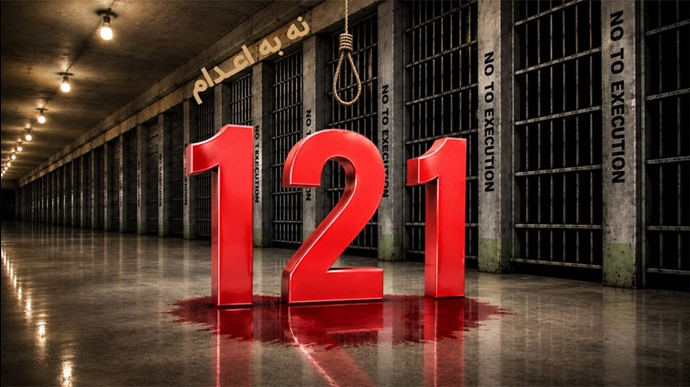

On Tuesday, May 19, 2026, inmates across 56 prisons in Iran participated in the 121st week of the “No to Executions Tuesdays” campaign. The prisoners held coordinated hunger strikes to protest the regime’s continuous issuance and implementation of death sentences.
The prisoners’ statement highlighted the regime’s recent actions following the nationwide uprisings of December 2025 and January 2026. According to the statement, for the past two months, regime forces have occupied city streets, conducted public weapons training, and used children in these gatherings in an attempt to institutionalize violence and suppress further protests. In tandem with this militarization, the judiciary has continued to hang dissidents.
The campaign highlighted two recent executions of protesters and minorities. On May 13, 2026, authorities in Ghezel Hesar Prison hanged 55-year-old Mohammad Abbasi, who was arrested during the January uprising in Malard. The prisoners noted that in an act of collective punishment, Abbasi’s daughter, Fatemeh, who was arrested alongside him, was sentenced to 25 years in prison and is currently held in Evin Prison. A day earlier, on May 12, Abduljalil Shahbakhsh, a Baluch political prisoner, was executed in Zahedan Prison.
Addressing the regime’s motives, the striking prisoners wrote: “We have repeatedly stated that executions, regardless of the type of charge, are not just the implementation of an unjust judicial sentence that deprives a human being of the right to life; rather, it is the most important tool of repression and state murder that has deep political, class, and ideological roots in the rule of the velayat-e faqih. This tool is used to create terror among the people to force the oppressed into submission.”
The statement emphasized that the state’s violence is ultimately failing to silence a restive society that is well aware of the regime’s systemic corruption. “If the government hangs the youth one after another today, it knows very well that these youth have felt class discrimination with all their being and are aware of the systematic corruption and looting of the government. It executes them to instill fear, oblivious to the fact that this violence is not only not silencing, but it plants the seeds of awareness, resistance, and uprising in hearts,” the prisoners declared.
Calling the campaign “a necessary step towards justice, freedom, and the elimination of all discrimination and oppression in the Iran of tomorrow,” the inmates urged political, human rights, labor, and civil activists to unite. They asked supporters, including workers, teachers, students, and retirees, to amplify their message to “awakened consciences in the international community.”
The prisoners participating in the 121st week of the hunger strike are located in the following 56 prisons: Evin (women’s and men’s wards), Ghezel Hesar (units 2, 3, and 4), Karaj Central, Fardis Karaj, Greater Tehran, Qarchak, Khorin Varamin, Chobindar Qazvin, Ahar, Arak, Langarud Qom, Khorramabad, Borujerd, Yasuj, Asadabad Isfahan, Dastgerd Isfahan, Sheiban Ahvaz, Sepidar Ahvaz (women’s and men’s wards), Nezam Shiraz, Adelabad Shiraz (women’s and men’s wards), Firuzabad Fars, Dehdasht, Zahedan (women’s and men’s wards), Borazjan, Ramhormoz, Behbahan, Bam, Yazd (women’s and men’s wards), Kahnuj, Tabas, Birjand Central, Mashhad, Gorgan, Sabzevar, Gonbad-e Kavus, Qaemshahr, Rasht (men’s and women’s wards), Rudsar, Haviq Talesh, Azbaram Lahijan, Dizel Abad Kermanshah, Ardabil, Tabriz, Urmia, Salmas, Khoy, Naqadeh, Miandoab, Mahabad, Bukan, Saqqez, Baneh, Marivan, Sanandaj, Kamyaran, and Ilam.