

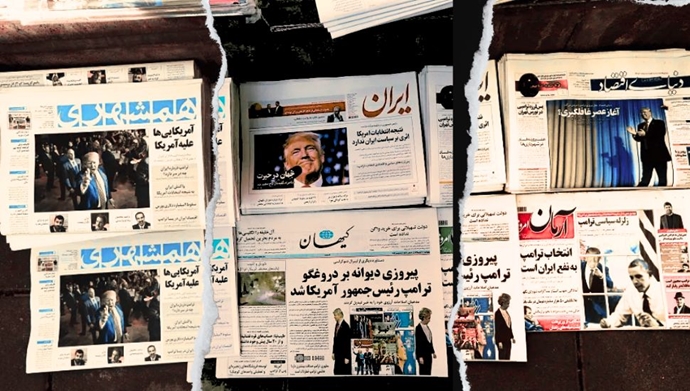

While an Iranian regime media outlet, with the headline “Tehran Stock Exchange Shocked by Trump’s Victory,” captured the shock from this event, Fatemeh Mohajerani, spokesperson for the government of Masoud Pezeshkian, responded to a question about the election’s impact on the regime’s economy. He stated, “The election of the U.S. president doesn’t hold much direct relevance for us. The overarching policies of the U.S. and those of the Iranian regime remain fixed. Necessary plans have been set in advance, so it doesn’t greatly matter who becomes the U.S. president.” He added, “Sanctions have considerably strengthened our domestic capacities, and today’s economy has enough resilience to withstand this pressure.”
However, the regime’s own media have a different opinion. For example, a piece in the state run Asr-e Iran website on November 6, which was titled “Why is Trump More Dangerous than Four Years Ago?” mocks those who downplay this event, stating, “They say nothing extraordinary has happened! This is like someone saying floods and rain are the same! Over the past four years, there have been numerous reports of Iran’s alleged intentions to assassinate Trump, which has worsened his view of Iran.” This regime outlet adds, “During his presidency, Trump displayed extremely hostile behavior toward Iran. First, he withdrew from the JCPOA; second, he killed Qasem Soleimani; and third, he cut Iran’s oil sales by two-thirds. Furthermore, he minimized direct involvement in the region, shifting influence to Israel and Saudi Arabia… This time, with his increased power and experience, Trump is likely to quickly intensify pressure on Iran, impacting the country through decreased oil revenues…”
Another government outlet also discussed sanctions, contradicting Mohajerani’s statement, and wrote, “Trump’s focus is on high-pressure sanctions that can quickly affect Iran’s oil sector. If he wins the election, the dollar rate will likely rise by around 10%. Iran’s oil exports have recently returned to pre-sanctions levels; yet during Trump’s presidency, they had dropped to below 500,000 barrels per day, placing intense pressure on Iran’s oil sector” (Etemad, November 6).
On November 6, the government newspaper Setareh Sobh also discussed the regional implications of this shift under the headline “The Unwritten Alliance,” noting that “there is a possibility of war between Iran, Israel, and the U.S.” The article states, “Some Arab countries that appeared to be Iran’s allies are stepping back from the Iran-U.S. conflict one by one and distancing themselves from Iran’s proxy forces. Iraq has declared neutrality, and Lebanon’s Minister of Economy has called for Hezbollah’s disarmament.”
In the same newspaper, a government-affiliated expert lamented the missed four-year opportunity during Biden’s presidency, writing, “Iran had valuable opportunities in recent years… We should have acted during the Democrats’ tenure. The problem lies not with the U.S. but with unresolved issues within our own country. Why did four years of a Democratic administration in the White House yield no benefits for Iran? No one can claim the U.S. election has no impact on Iran.”