

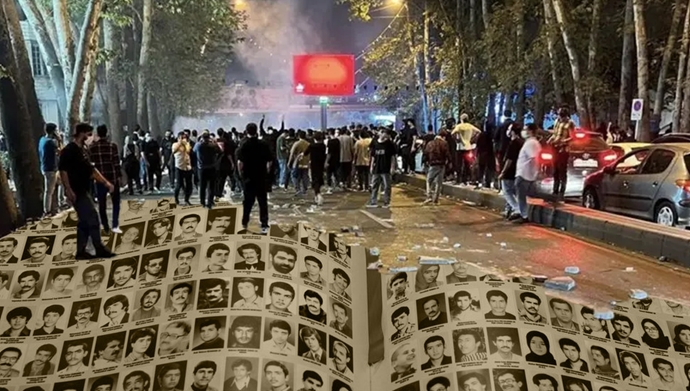

We are marking the 38th anniversary of the summer 1988 massacre, a dark chapter in Iran’s history where over 30,000 political prisoners were executed by the ruling regime. Yet, nearly four decades later, the fight for freedom in Iran is more alive than ever.
For 38 years, the battle between the 1988 martyrs and the regime’s executioners has not stopped for a single day. This historical confrontation has continuously echoed through the eight major uprisings that have rocked the nation since.
The latest was in December 2025 and January 2026, where Iran witnessed a massive round of nationwide uprisings that brought the regime to its knees. The regime only managed to maintain its hold on power by resorting to its usual playbook, the brutal massacre of thousands of protesters and a surge in executions of political prisoners. But again, it did not manage to stifle the spirit of resistance as rebellious youth across the country continue to fight against the regime.
The martyrs of 1988 are timeless sparks whose truth remains alive in the national collective memory, immune to the passage of time.
The 1988 massacre: An epic of defiance and a brutal cover-up
In the summer of 1988, then-regime supreme leader Ruhollah Khomeini issued a religious fatwa explicitly ordering the purge of all prisons of political prisoners who supported the People’s Mojahedin Organization of Iran (PMOI/MEK). As a result of his ruthless decree, more than 30,000 prisoners were hanged in the span of just a few months.
These mass executions were carried out following sham courts that lasted only minutes, completely denying the prisoners any legal right to a defense or a lawyer. During these minutes-long trials, prisoners were given a stark choice: either disown their pledge to the PMOI and their fight for freedom, or go to the gallows. In one of the greatest epics of Iranian history, 30,000 political prisoners defied the regime and heroically embraced death rather than surrender to tyranny.
The regime went to unprecedented lengths to hide and deny the 1988 massacre. Officials desperately tried to conceal the realities of the prisons and the immense scale of the crimes, marking the massacre as highly classified even to minor officials and representatives within the government. The victims were secretly buried in mass unmarked graves, and the locations were kept tightly guarded. The families of the prisoners were kept in the dark about the fate of their loved ones; when they were eventually informed of the executions, they were severely intimidated and explicitly instructed not to hold funerals.
Dictators throughout history have repeatedly failed to understand a fundamental truth: the blood of those seeking freedom and justice never dies. It does not simply vanish into the earth; rather, it multiplies, flows, and flourishes. The regime believed that by wiping out a generation of dissidents, they could secure their totalitarian rule indefinitely, fundamentally miscalculating the resilience of the Iranian resistance.
Staring down the noose: The defiance of recent PMOI martyrs
The unbreakable spirit of the 1988 martyrs is vividly reflected in the sacrifices of the 11 PMOI members executed by the regime over the past year. In a desperate bid for survival amid the massive uprisings, the regime sent these heroes to the gallows. Yet, they stared down the noose with the exact same defiance as their predecessors, proving that the regime cannot kill an ideal.
Their final letters and testaments stand as monumental declarations of victory over death:
Mohammad Taghavi, refusing to let his will to live be taken hostage, vowed: “I swear to fight valiantly until my last breath and to die standing, and to the last step.”
Pouya Ghobadi embraced his fate without regret, declaring: “I swear that in the final dawn of my life, with my head held high while gazing at the sky… I will endure the pressure of the noose until the last beat of my heart.”
Ali Akbar (Shahrokh) Daneshvarkar chose a life of sacrifice over submitting to tyranny, promising: “I swear by the blood of the fallen companions, we will stand until the end.”
Babak Alipour, in a triumphant analysis of the Iranian people’s power, penned: “Now that the lot has fallen to me, I will not withhold my humble life… I will continue my maximum resistance in prison and I will not bow down.”
Abolhassan Montazer rejected both the Shah and the mullahs’ dictatorships, challenging his executioners: “Every night, over and over, I fall asleep with this whisper, hoping to see the next morning: to remain a Mojahed, to fight as a Mojahed, and then to die a Mojahed.”
Vahid Bani Amerian addressed his captors directly, warning them of the unstoppable nature of the resistance: “Even if you execute me and people like me, we will multiply… I swear by the blood of my comrades: I will stand firm to the end.”
Mehdi Hassani, despite facing severe physical and psychological torture, made an unyielding pledge: “Until the last drop of my blood, I will not retreat a single iota from my ideal… No bowing down. Ready, ready, ready!”
Behrouz Ehsani found deep purpose in his ultimate sacrifice, stating: “I will not bargain with anyone over my life and am ready to sacrifice my life for the cause of the liberation of the Iranian people.”
Mehdi Khanaki, the latest PMOI martyr executed in July 2026, drew a direct line from the 1980s martyrs to today’s revolution, vowing: “I swear to always remain a Mojahed with steadfastness and a fighting spirit on this path, to die a Mojahed, and to fight with all my being.”
Sowing the seeds of the 2025-2026 uprisings: From death row to the streets
The sheer bravery of the youth in Iran’s streets who stood barehanded against the regime’s tyranny during the 2025-2026 revolution is a direct reflection of the courage shown by the PMOI martyrs on death row. Khomeini never imagined that his religious-political fatwa to massacre political prisoners would inadvertently pave the way for nationwide uprisings even more widespread than the events of June 1981, all seeking justice for the crimes of the 1980s.
The victims of 1988 became a guiding light for subsequent generations. Migrating from the execution halls and the mass graves of Khavaran to the awakened conscience of anti-dictatorship youth, they sent the powerful message that “my blood will not sleep.” It was ultimately the martyrs of 1988 who planted the seeds of rebellion in universities, schools, homes, streets, and squares, inspiring the creators of the uprisings from 1999 all the way to the monumental 2025-2026 revolution.
An enduring nightmare for the mullahs
Today, the regime is in a deeply vulnerable state. Following the death of supreme leader Ali Khamenei and the frantic installation of his son, Mojtaba, the ruling establishment is struggling to maintain its grip on power.
The 1988 massacre has remained a constantly awake nightmare for Khomeini’s rule and his current successors, who are now facing the inescapable consequences of those historical crimes. Neither Khomeini nor Khamenei ever anticipated the continuous, daily domestic and global expansion of the Justice-Seeking Movement, which currently pursues the regime’s ship like a powerful, inescapable wave.
Today, it is the martyrs of 1988, alongside the recently fallen heroes, who are calling out from the throats of the rebellious youth in the streets and the political prisoners in the dungeons, demanding that the executioners be held accountable. This historical clash, echoing from the gallows of 1988 to the barricades of the 2025-2026 uprisings, will persist until final justice is achieved by the awakened conscience of the Iranian nation.