

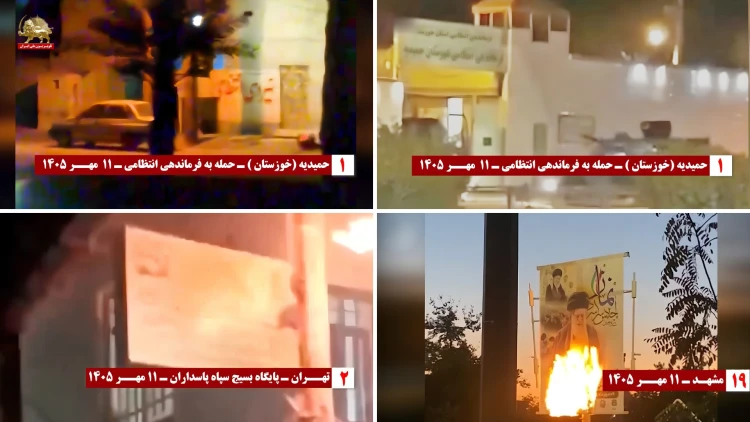

On October 3, PMOI/MEK Resistance Units carried out 20 operations against the Iranian regime’s centers and symbols of repression in response to the execution of Ali Hemmati and Majid Nik-Andish, two young protesters arrested during the January 2026 uprising.
The operations were reported in Tehran, Karaj, Mashhad, Shahriar, Yazd, Gorgan, Birjand, Aligudarz, and Hamidiyeh. They included actions against Basij and security force facilities, propaganda billboards and banners, and a Ministry of Intelligence billboard promoting surveillance of citizens and dissidents.
October 3—Iran
PMOI/MEK Resistance Units carry out 20 daring operations against the regime's centers and symbols of repression in response to the criminal execution of Alireza Raisi and Alireza Sepahi, two young protesters arrested during the January 2026 uprising. pic.twitter.com/dIqDLSzTR6— People's Mojahedin Organization of Iran (PMOI/MEK) (@Mojahedineng) October 7, 2026
The campaign came three days after Hemmati, 21, and Nik-Andish, 25, were executed following their arrest in connection with protests in Mashhad. The timing highlighted the contrast between the regime’s use of executions to intimidate society and the continued activities of Resistance Units across the country.
Targeting the regime’s apparatus of repression
Several operations were directed at institutions involved in repression and control. In Tehran, Resistance Units targeted an IRGC Basij base. In Karaj, they set fire to the entrance of another Basij base. In Hamidiyeh, they targeted the command headquarters of the regime’s security forces.
In Aligudarz, Resistance Units also set fire to a billboard promoting a Ministry of Intelligence department used for spying on citizens and dissidents.
Tehran
Resistance Units set fire to regime propaganda banner pic.twitter.com/ROST8Vkv1j— People's Mojahedin Organization of Iran (PMOI/MEK) (@Mojahedineng) October 7, 2026
The choice of targets reflected the stated purpose of the campaign. The Basij, security forces, and intelligence apparatus are central components of the regime’s system for monitoring and suppressing dissent. By targeting these institutions shortly after the executions, the Resistance Units demonstrated that repression and intimidation had not halted organized opposition.
Defying the regime’s propaganda symbols
A large part of the October 3 campaign targeted the regime’s propaganda infrastructure. Resistance Units set fire to or torched posters, banners, and billboards featuring Ali Khamenei in Tehran, Mashhad, Yazd, Gorgan, Birjand, and Aligudarz. In Mashhad, another operation targeted a propaganda banner featuring Qasem Soleimani, the eliminated head of the regime’s terrorist IRGC Quds force.
Mashhad was particularly prominent, with multiple reported operations against large posters, billboards, and banners associated with the regime. This carried added significance because Hemmati and Nik-Andish had been arrested in connection with the January uprising in Mashhad.
Mashhad
Resistance Units set fire to banner featuring Ali Khamenei pic.twitter.com/jHNDebkVsm— People's Mojahedin Organization of Iran (PMOI/MEK) (@Mojahedineng) October 7, 2026
Only days after their execution, Resistance Units were again operating in the same city and challenging symbols through which the regime seeks to project authority.
The executions that triggered the response
Iranian authorities executed Hemmati and Nik-Andish at dawn on September 30. The regime’s judiciary described them as “leaders” and “field elements” of protests in Mashhad’s Tabarsi district and accused them of involvement in unrest on January 8 and 9. Their death sentences were upheld by the Supreme Court before being carried out.
The case was part of a broader wave of death sentences and executions connected to the January uprising. Iran Human Rights had reported at least 100 people arrested in connection with the protests had been sentenced to death by September 14, while 29 had been executed since March 18. It also documented fair-trial concerns in protest cases, including restrictions on access to chosen lawyers and the use of torture and coerced confessions.
Yazd
Resistance Units set fire to regime propaganda banner featuring Ali Khamenei pic.twitter.com/coITJ3MawO— People's Mojahedin Organization of Iran (PMOI/MEK) (@Mojahedineng) October 7, 2026
The Iranian Resistance has warned that the regime is using executions to raise the cost of dissent and deter renewed protests.
Repression has failed to extinguish resistance
The October 3 campaign exposed the limits of the regime’s strategy of intimidation. The executions of Hemmati and Nik-Andish came amid warnings by the Iranian Resistance that the regime is resorting to capital punishment to raise the cost of dissent and discourage another round of protests.
Yet three days later, Resistance Units were carrying out operations across Iran, targeting both institutions of repression and symbols of authority.
Aligudarz
Resistance Units torch large propaganda billboard featuring Ali Khamenei pic.twitter.com/Nk2bVTWiMC— People's Mojahedin Organization of Iran (PMOI/MEK) (@Mojahedineng) October 7, 2026
The contrast is stark. The regime is trying to suppress dissent through arrests, death sentences, executions, and repression. But the Resistance Units’ response shows that these measures have not extinguished the willingness to resist.
For the Resistance, the message of the October 3 operations was that the blood of the uprising’s martyrs has not been shed in vain. Rather than silencing opposition, the executions were answered by renewed acts of defiance. The regime can take lives, but it has failed to extinguish the flame of resistance across Iran.