

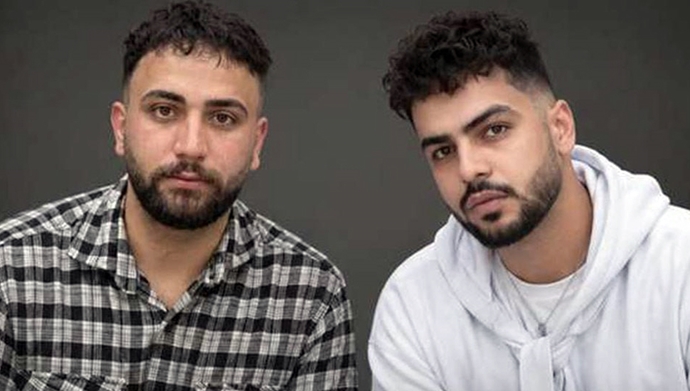

In the early hours of October 5, the Iranian regime executed Alireza Sepahi, 24, and Alireza Raisi, 21, two protesters arrested during the January 2026 uprising, at Dastgerd Prison in Isfahan.
The executions came just five days before October 10, World Day Against the Death Penalty, and marked the latest executions connected to the so-called “Alikhani Square” case, in which the regime has sentenced young protesters to death and lengthy prison terms over events during the January uprising.
The regime’s judiciary charged Sepahi and Raisi with “Moharebeh,” or “enmity against God,” through the use of weapons, “corruption on earth,” and acting against national security. They were sentenced to death in connection with the deaths of four members of the regime’s Special Units who had been involved in suppressing protesters during the uprising.
In a savage crime, Iran’s regime executed Alireza Sepahi, 24, and Alireza Raeisi, 21, two prisoners from the January 2026 uprising, in Dastgerd Prison in Isfahan this morning.
Alireza Sepahi and Alireza Raeisi, along with 10 other young people, were sentenced to death in the… pic.twitter.com/9k6cHu8HQe
— People's Mojahedin Organization of Iran (PMOI/MEK) (@Mojahedineng) October 5, 2026
Their executions bring to seven the number of defendants from the Alikhani Square case who have been sent to the gallows since July.
A case stripped of basic legal safeguards
The Alikhani Square case emerged from protests in Isfahan during the January uprising. The regime tied a group of arrested protesters to the deaths of four security officers at Alikhani Square and imposed death sentences on a number of the detainees.
From the outset, the proceedings were marked by serious violations of the defendants’ most basic legal rights. The young prisoners were denied the right to select independent lawyers. Even court-appointed defense attorneys were prevented from accessing the case files, depriving defendants facing capital punishment of meaningful access to their own cases.
The death sentences against Sepahi and Raisi were issued by criminal judges Morteza Barati Dorcheh and Mohammadreza Tavakoli. Twenty-three other defendants connected to the case have received prison terms ranging from five to ten years and that several others remain under active death sentences.
In all cases, the judicial process was deeply flawed, and the death penalties were imposed while defendants were denied fundamental safeguards required for a genuine defense.
Seven protesters executed from the same case
Sepahi and Raisi are the sixth and seventh defendants executed in the Alikhani Square case in less than three months.
On July 19, the regime hanged 18-year-old Erfan Esfandiari and 24-year-old Gol-Mohammad Mohammadi in Isfahan. Days later, on July 28, authorities publicly executed Abolfazl Sepahi, 24, a cousin of Alireza Sepahi, and Amirhossein Safari, 27, at Alikhani Square itself.
The public hangings were plainly intended to intimidate. Security forces deployed around the square and on nearby streets and rooftops. Yet residents gathered at the site, and as the executions were carried out, protesters confronted the Special Units and denounced the executioners. Security forces used tear gas to disperse the crowd.
On August 20, the regime executed another defendant, 21-year-old Ghaem Hosseini, bringing the number executed in the case at that point to five. The executions of Sepahi and Raisi on October 5 have now raised that toll to seven.
The Iranian Resistance had previously issued urgent warnings on July 19, July 28, and August 20 and calling to save the lives of the protesters arrested in the Alikhani case.
The gallows as a weapon against renewed protests
The repeated executions in the Alikhani Square case point to a broader strategy. Having faced a nationwide uprising in January, the regime is using the death penalty against young protesters not merely as punishment but as a means of intimidating a society where anger against the ruling establishment persists.
The regime intends to make participation in future protests synonymous with the threat of imprisonment and death.
Mrs. Maryam Rajavi, President-elect of the National Council of Resistance of Iran (NCRI), strongly condemned the executions of Sepahi and Raisi.
“I strongly condemn this inhuman crime and flagrant violation of international law,” Mrs. Rajavi said. “I urge the United Nations and member states to take immediate action to halt the execution of political prisoners and uprising protesters, particularly the five remaining defendants in the Alikhani Square case.”
The ruthless judiciary of the clerical regime announced that early this morning, two young protesters, Alireza Sepahi, 24 years old, and Alireza Raeisi, 21 years old, arrested during the January uprising in Iran, were executed in Isfahan’s Dastgerd Prison.
The Iranian Resistance…
— Maryam Rajavi (@Maryam_Rajavi) October 5, 2026
She called on the United Nations, its member states, and international human rights bodies to “take immediate and effective action to halt the execution of political and uprising prisoners,” particularly the remaining defendants facing death sentences in the Alikhani Square case.
Mrs. Rajavi also reiterated the need to bring the regime’s leaders and judges to justice for five decades of crimes against humanity and genocide.