

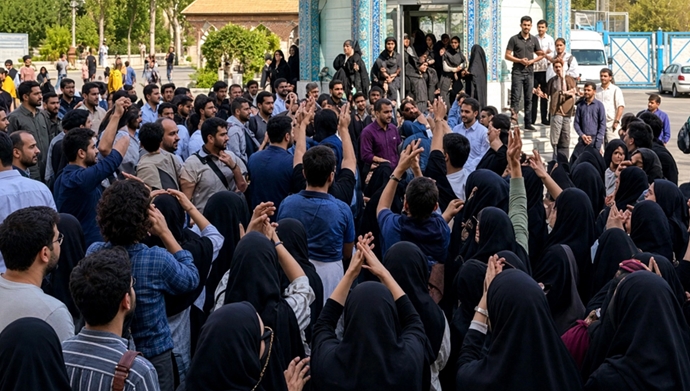

As Iran’s universities begin a new academic year, student protests are once again emerging as a source of concern for authorities.
On September 28, students at Allameh Tabataba’i University in Tehran protested rising educational costs, restrictions imposed by university security—particularly against female students—and the growing security presence on campus. Their demands also addressed compulsory hijab and imprisoned students. The slogan “Neither barracks nor business enterprise; long live the university” brought together opposition to both securitization and commercialization of the campus.
The protest came as senior university officials were publicly warning about renewed unrest. Mahmoud-Reza Aghamiri, president of Beheshti University, described university-age students as particularly susceptible to political influence. Masoud Tajrishi, president of Sharif University, warned that forces outside Iran would look for universities they could “stir up.” Their remarks reflected a concern rooted in the experience of the past year: universities have repeatedly become important centers of protest.
Universities in the January uprising
The role of universities became evident from the opening days of the uprising that began in late December 2025. What started with protests by merchants and shopkeepers in Tehran quickly spread to university campuses. Students at Tehran University and major universities including Sharif, Amirkabir, Beheshti, Allameh Tabataba’i, Iran University of Science and Technology, Isfahan University of Technology, and Yazd University held demonstrations and boycotted classes.
Campus protests continued as the uprising expanded across Iran. Authorities responded not only through arrests and security deployments but also by disrupting university life itself. In January, Tehran University dormitories were ordered evacuated for ten days, while Urmia University examinations were moved online.
Universities thus became one of the points where protests by different parts of society converged. Student demands were increasingly expressed alongside the broader anti-government slogans being heard in the streets.
Campuses carry the uprising forward
The importance of the universities became even clearer after the major January confrontations had subsided. When campuses reopened in February, student protests returned across Tehran University, Sharif, Amirkabir, Beheshti, Al-Zahra, Iran University of Science and Technology, Isfahan University of Technology, Ferdowsi University, and other institutions. Students boycotted classes, commemorated those killed during the January uprising, and in several universities confronted Basij forces.
The slogans were also explicitly political. At Amirkabir University, students chanted, “This is the last message; the target is the entire regime.” Other campuses heard chants including “Death to the dictator,” “Death to Khamenei,” and slogans rejecting both clerical rule and a return to monarchy.
The February protests showed how university networks could preserve and reactivate protest after the initial uprising had faced an extensive crackdown.
From student grievances to broader dissent
Student mobilization did not end with the aftermath of January. In June, protests over educational policies and perceived discrimination spread to more than 20 cities, including Tehran, Mashhad, Shiraz, Isfahan, Tabriz, Ahvaz, and Kermanshah. Students raised demands for educational justice while using slogans emphasizing solidarity and resistance to humiliation.
Later that month, Azad University students in Tehran, Karaj, and Ahvaz protested examination arrangements, compressed schedules, and educational conditions.
This pattern resurfaced at Allameh in September. Tuition and educational conditions, compulsory hijab, campus security, detained students, and broader economic pressures appeared together in the same protest. University grievances repeatedly provided an entry point for wider social and political dissatisfaction.
Repression reveals the authorities’ concern
The response has gone far beyond policing individual demonstrations. In June, the state-run Shargh newspaper reporting that five to seven Sharif University students had received expulsion orders and more than 20 had been suspended. Disciplinary files had reportedly been opened for more than 100 students at Iran University of Science and Technology, while 150–200 Tehran University students were preparing defense statements in disciplinary proceedings. Arrests and expulsions from dormitories were also reported.
These measures help explain the recent comments by university officials. The authorities’ concern is not simply that students might protest university policy; the record of January and February shows how quickly campuses can become part of a larger political confrontation.
Universities remain a persistent center of resistance
The pattern across the past year is consistent. Universities joined the January uprising, returned to protest after reopening in February, mobilized again over educational grievances in June, and entered the new academic year with another protest at Allameh.
The most visible campus protests documented during this period have repeatedly moved beyond demands for administrative reform. Their slogans have directly challenged clerical rule and called for the end of the existing political system.
That is why the reopening of universities matters. Students are once again concentrated in spaces where political memory, social networks, everyday grievances, and the ability to organize intersect. The regime fears the possibility that campus protests could again become part of a wider uprising.