

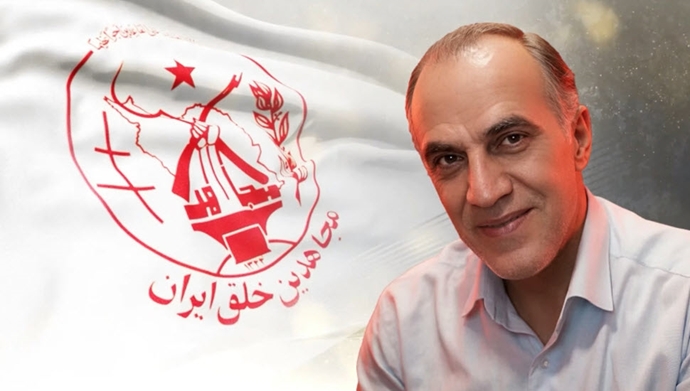

On the morning of March 30, 2026, the Iranian regime executed two dedicated political prisoners and members of the People’s Mojahedin Organization of Iran (PMOI/MEK), Ali Akbar (Shahrokh) Daneshvarkar and Mohammad Taghavi, following months of torture and sham trials. However, the regime’s gallows have never been able to extinguish the light of resistance.
Shortly after his death sentence was reconfirmed in November 2025, Shahrokh Daneshvarkar penned a profound letter from Ghezel Hesar Prison. This statement is not just a personal memoir; it is a historical testament. It showcases a conscious decision to sacrifice his life for freedom and highlights the very essence of the PMOI’s 60-year struggle against the dictatorships of both the Shah and the mullahs. It demonstrates exactly why the regime, despite its executions and torture chambers, cannot destroy a force built on such unwavering conviction.
A life dedicated to justice and defying corruption
Born on September 4, 1966, in Tehran, Daneshvarkar was raised by parents who taught him with “honest labor and pure milk” to be “sensitive to oppression” and to seek to help others. He studied civil engineering at the prestigious Khajeh Nasir University.
His commitment to justice was not just theoretical; he lived it out in Iran’s most deprived rural areas, including Veys village in Bashagard and Sargan village near Konarak in Sistan and Baluchestan. As a supervising engineer at a power plant project, where the livelihoods of many depended on the stroke of his pen, he refused to turn a blind eye to the regime’s systemic corruption. He boldly stood against “embezzlement, account manipulation… and those who had become engineers through nepotism.” As he wrote, he “tried to follow the path of justice and not let the rights of others and these workers be trampled.”
A journey through Iran’s political illusions
Daneshvarkar’s political awakening began as a 12-year-old during the 1979 anti-monarchic revolution. He went to the war fronts, but his truth-seeking nature made him reject Ruhollah Khomeini after witnessing the slaughter of prisoners of war. He realized the inherent tyranny of the regime’s core ideology: “Velayat-e Faqih [absolute clerical rule] means I am a sheep and the Supreme Leader must be my shepherd. So, I pushed Khomeini and his Velayat-e Faqih aside.”
Searching for a solution, he tried supporting the reformist faction during Mohammad Khatami’s presidency in 1997. But after four wasted years, Khatami shamelessly admitted he was nothing more than a “logistics provider” for the Supreme Leader. Daneshvarkar realized then that reforming the regime from within was an absolute “dead end.”
His final illusions regarding the rest of the Iranian opposition were shattered during the bloody November 2019 uprising, where the regime’s forces slaughtered at least 1,500 protesters. While the streets ran red with blood, Reza Pahlavi, the son of the ousted Shah, preached “non-violent struggle.” Daneshvarkar found this “truly nauseating,” realizing that passive resistance against naked brutality was meaningless.
Embracing the PMOI and the conscious choice of sacrifice
Faced with these political dead ends, Daneshvarkar overcame the regime’s massive propaganda and demonization campaigns against the PMOI. He realized that while Khamenei, Khatami, and Pahlavi were all fighting for personal “power,” the PMOI and its leadership solely sought “freedom for the people.”
He found the ultimate solution in Maryam Rajavi’s Ten-Point Plan, noting that it encompassed “everything a freedom-loving, patriotic person seeking right and truth” could want. Unafraid of the gallows, Daneshvarkar viewed his path as an “irreversible evolution,” and proudly stood by his choice to the very end. “If I were to walk this path again,” he declared, “I would go to war against oppression and the oppressor with a 100% offensive from the very beginning, with the slogan: Death to the oppressor, be it the Shah or the Leader!”
Full text of Ali Akbar (Shahrokh) Daneshvarkar’s message from Ghezel Hesar Prison (November/December 2025)
I am Shahrokh Daneshvar. Born on September 4, 1966, in Tehran. I studied civil engineering at Khajeh Nasir University, and right now, I am under a death sentence.
My life has been very strange and full of ups and downs. Perhaps telling it will be a guiding light for those who seek right, truth, and justice—but for those who do not look at the world and life through the lens of prejudice.
Before anything else, I must remember my late father and my dear mother, who, with honest labor and purity, taught me to be sensitive to oppression and to seek to help others.
Others should speak about my childhood and my time living in Veys village in Bashagard, or Sargan village near Konarak in Sistan and Baluchestan. But I must tell you about standing up to embezzlement and account manipulation at the power plant, confronting unprincipled work, and standing against those who had become engineers through nepotism. Even though I was the supervising civil engineer of the power plant project, and the livelihoods and salaries of many depended on the stroke of my pen, I tried to follow that same path of justice, refusing to let the rights of others and those workers be trampled.
During the anti-monarchic revolution, I was perhaps 12 years old and didn’t have much understanding of the situation. It might surprise you that I was an active mosque-goer; even as a student, I attended the Islamic seminary. I participated in some popular activities of the Construction Jihad. I was a literacy instructor for the Literacy Movement. I went to the war fronts and participated in several operations.
But that truth-seeking and anti-oppression drive inside me did not allow me to indifferently walk past the slaughter of prisoners that was happening at the front. That was what made me think once again about the path I was on, to see where my path was leading and what I was doing. I asked myself, what path is Khomeini taking? Well, it’s Velayat-e Faqih. What does Velayat-e Faqih mean? It means I am a sheep and the Supreme Leader must be my shepherd. So, I pushed Khomeini and his Velayat-e Faqih aside.
I was in this state of confusion over what to do when the 2nd of Khordad [May 1997] happened, and the story of [Mohammad] Khatami began. It seemed like a beautiful idea—that with step-by-step reforms, the regime could be reformed. I became a reformist. Four years of my life were wasted until he was a candidate again for his second term as the “smiling Seyyed.” He came and, with absolute shamelessness, said that during his previous term he was nothing more than a logistics provider. Again, I thought to myself: where am I going? I should have realized much sooner that reforming the Velayat-e Faqih regime within the framework of its own constitution is impossible. What should I have done? Another dead end.
Ah, overthrow! Yes, this regime must be overthrown. I reached this conclusion, but the reality was that there were very few opposition groups calling for regime change and overthrow. I was stuck at a very terrifying crossroads.
I had heard so many bad things about the Mojahedin that I was terrified to even get close to them. Dozens and dozens of questions were in my mind.
Time passed and we reached December 2017 and November 2019. Everyone knows what blood was spilled during the bloody November of 2019. Khamenei’s repressive regime mobilized all military, law enforcement, security, Basij, and IRGC organs and gave the order to fire. At least 1,500 people were killed. What happened after that? Reza Pahlavi came out and spoke of “non-violent struggle.” In the face of the naked violence this regime utilized, a peaceful, non-violent struggle had absolutely no place.
When I heard these words, I threw up Reza Pahlavi, because it was truly nauseating for someone not to see the blood of all those people.
Then I reached that difficult choice. There was nothing else left; there was only the People’s Mojahedin Organization of Iran. I had many questions. What were my questions?
– Why Iraq?
– Why the hijab?
– Why Islam at all?
– Was the fight between Khomeini and Rajavi just about a share of power?
I had many issues, but the most important thing that helped me be a bit more determined in my choice was this: every single faction I had passed through spoke ill of the Mojahedin. This made me think. Why? Why are they speaking badly about this organization? Let’s actually see what the Mojahedin say.
Mrs. Maryam Rajavi says: “The starting point of new paths is an all-out choice, and the starting point of massive leaps is commitment in an era where the world is captive to a lack of commitment.”
Wow! Mrs. Rajavi says her greatest commitment is the freedom of the Iranian people.
Let’s see what Mr. Massoud Rajavi says.
Now let’s review once more what has been happening.
– Khatami, with his “national dialogue,” is still seeking a share of power with Khamenei.
– Reza Pahlavi issued an “emergency booklet” in which he made all appointments and dismissals subject to his own royal opinion, meaning he placed himself at the very top of the pyramid of power.
– As for Khamenei and his reactionary dictatorship, his status is clear and we all know it.
They are all talking about power. How strange.
But these people [the PMOI] are talking about the freedom of the people. Their concern is the freedom of the people; they want nothing for themselves. What does this mean?
I don’t want to drag out the story of the path I took. In a word, the Mojahedin are seeking freedom—the freedom of the people. Why? Because they are the People’s Mojahedin.
For the hundredth time, I reviewed Mrs. Maryam Rajavi’s Ten-Point Plan. Exactly everything that a freedom-loving, patriotic person seeking right and truth wants is laid out there; it has all been accounted for, completely. Let’s look at how Mrs. Maryam Rajavi defines her ideological boundaries:
“The ideology and message of the Mojahedin against reaction and fundamentalism is that the main social, political, and economic boundary is not between Islam and non-Islam.”
Every day that passes, I become prouder, more steadfast, and more resolute in the path I have taken. There are many reasons I reached this point.
The path I have taken perfectly demonstrates the path of evolution. One of the laws of evolution is irreversibility and accelerating forward.
I have thanked God time and time again for His grace toward me. Wherever the path I took was wrong or led to a dead end, He gave me a nudge and saved me from that dead end. I must deeply thank all the brothers and sisters who helped me—someone who didn’t have a proper understanding of this path I was walking—to be on the right path, to be here.
I am proud to have leaders like Massoud Rajavi and Maryam Rajavi. Believe me, if I were to walk this path of my life again, I would go to war against oppression and the oppressor with a 100% offensive from the very beginning. I would do this again, but this time from the very start with the slogan: Death to the oppressor, be it the Shah or the Leader!
I will give my life once again for the freedom of my people.
I swear by the blood of the fallen companions, we will stand until the end.