

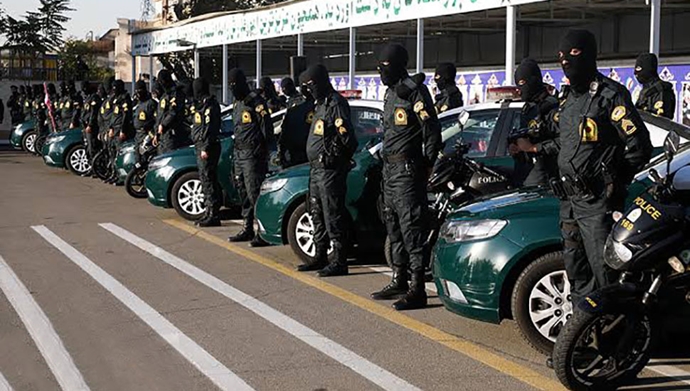

In late September, Iranian authorities placed the country’s principal military and security forces on maximum alert while deploying tens of thousands of personnel in Tehran and expanding measures ranging from street patrols and phone searches to detention capacity and anti-riot preparations.
Information obtained by the Iranian Resistance and published by the National Council of Resistance of Iran (NCRI) on September 25 indicated that the Army, Islamic Revolutionary Guard Corps (IRGC), Basij, and State Security Force (SSF) had been placed on a 100% alert status, with leaves canceled until midnight on September 27. The alert could be extended or reinstated depending on political developments and social conditions.
The individual measures reveal what the security apparatus is preparing for. The deployment includes 51,000 IRGC, Basij, and SSF personnel in Greater Tehran, concentrations of forces at major and secondary locations, motorized patrols, searches of pedestrians and mobile phones, new detention facilities, reinforcement of plainclothes units, recruitment efforts, new anti-riot equipment, and financial incentives for forces assigned to confront protests.
Taken together, these measures form an extensive architecture for preventing, detecting, containing, and responding to domestic unrest.
The disclosure also comes after several weeks in which the authorities had already intensified their public and organizational security presence. Days earlier, the regime hosted the large state-organized “Janfada-ye Iran” mobilization maneuver in Tehran, while security forces had been placed on heightened alert around the September 16 anniversary of the 2022 uprising.
These measures reflect the regime’s concern over the possibility of renewed uprisings. The authorities’ own allocation of manpower, money, equipment, surveillance capacity, and detention resources shows how prominently domestic unrest figures in their current security planning.
A security posture built around Iran’s cities
The scale of the deployment in Greater Tehran offers the clearest indication of the authorities’ priorities.
According to the NCRI Security and Counter-Terrorism Commission, 51,000 personnel were deployed to control Greater Tehran during the alert period: 21,000 from the SSF and another 30,000 from the IRGC and Basij. Forces were concentrated not only in major squares but also in secondary locations in Tehran and other major cities.
This distribution is significant. Concentrating forces exclusively at central squares would primarily prepare the authorities to confront large, announced gatherings. Dispersing them across main and secondary locations provides a broader capacity to respond when smaller gatherings emerge in separate neighborhoods or move between different parts of a city.
The authorities have also been conducting motorized parades in Tehran and other cities under the banner of “War Week.” These maneuvers are being used to maintain a high level of military and security presence.
The resulting security posture combines visibility with rapid deployment. The parades put uniformed and armed personnel in public view, while distributed concentrations of IRGC, Basij, and SSF forces give commanders personnel that can be dispatched if disturbances develop.
This transformation of major cities into heavily securitized spaces is evidence of the authorities’ concern not only about large demonstrations but also about smaller local flashpoints. The security system is preparing simultaneously for large gatherings and decentralized incidents.
From controlling crowds to monitoring individuals
The security measures extend beyond positioning forces where demonstrations might occur.
Motorized patrols are reportedly stopping pedestrians on sidewalks and around traffic lights, carrying out body searches, and inspecting mobile phones in an attempt to identify potential protest organizers. Some of those stopped are being detained.
This shifts the security operation from conventional crowd control toward preventive surveillance.
Rather than waiting for a gathering to form and then dispersing it, phone searches and individual screening provide security forces with tools to identify political activity, communications, or connections before a protest develops.
The preparations extend to what happens after arrests. The NCRI disclosed that new detention facilities have been established in remote and uninhabited areas for use in potential arrests, with the measure based on authorities’ experience during previous uprisings.
This also fits a broader pattern visible earlier in September. Ahead of the fourth anniversary of the 2022 uprising, SSF chief Ahmadreza Radan publicly said authorities were pursuing and arresting members of the People’s Mojahedin Organization of Iran (PMOI/MEK).
The September 25 disclosure therefore describes more than a temporary show of force. It points to efforts to strengthen the state’s ability to detect political activity at street level and process arrests if unrest expands.
Expanding the Basij and plainclothes apparatus
Another component of the security buildup concerns personnel.
Basij chief Hossein Taeb is seeking to increase Basij recruitment, particularly among unemployed people, by offering higher salaries and benefits, with particular emphasis on Tehran.
Taeb and Hassan Hassanzadeh, commander of the IRGC in Greater Tehran, have also launched a joint plan to strengthen the regime’s plainclothes forces.
Plainclothes personnel serve a different function from highly visible riot police or IRGC units. Their deployment can provide a security presence without the same visibility as uniformed formations, making them useful for monitoring gatherings, identifying participants, and intervening alongside other security units.
Financial incentives extend beyond new Basij recruits. The information obtained by the Iranian Resistance indicates that the authorities have increased salaries, bonuses, and mission payments for SSF, IRGC, and intelligence personnel to encourage their presence during protests.
This financial component is evidence of the regime’s difficulties maintaining motivation within the security apparatus.
Anti-riot preparations began before the latest alert
The September 25 alert did not begin from zero.
The IRGC and SSF had already introduced new anti-riot equipment to security and law-enforcement units and that training on the equipment had begun approximately one month earlier.
This means at least part of the preparation predates the immediate alert and reflects a longer process of strengthening protest-control capabilities.
The distinction matters because a short-term security alert can be ordered in response to a particular event or anniversary. Procurement of new riot-control equipment, training personnel in its use, recruiting additional forces, strengthening plainclothes units, and preparing detention facilities require more sustained planning.
In this context, the September 27 expiration of the current maximum alert does not necessarily mark the end of the broader security posture. The alert can be extended or reintroduced depending on political developments and social conditions.
September’s street maneuvers were part of the same security picture
The newest measures become more significant when placed alongside the security mobilizations already visible earlier in September.
On September 18, the authorities staged the “Janfada-ye Iran” campaign in Tehran, bringing uniformed participants, armed volunteers, drones, and other military equipment into the streets. State media claimed 313,000 participants, while President Masoud Pezeshkian and senior military officials attended.
The government presented the event as a demonstration of readiness and unity in the face of external threats. But it took place only two days after the fourth anniversary of the September 2022 uprising, when authorities had already heightened security because of concerns about renewed unrest.
What the security posture reveals
This accumulation of measures as evidence of the ruling establishment’s fear of another nationwide uprising. That assessment goes beyond the operational facts themselves, but the factual record supports a narrower and important conclusion: the prospect of domestic unrest occupies a significant place in the authorities’ security planning.
On the one hand, the state organizes parades, military displays, and mass mobilizations intended to demonstrate strength and control. On the other, it continues devoting tens of thousands of personnel and substantial intelligence, financial, detention, and riot-control resources to monitoring and controlling its own cities.
That continuing readiness may be the clearest indication of how seriously the regime continues to regard the possibility of renewed unrest.