

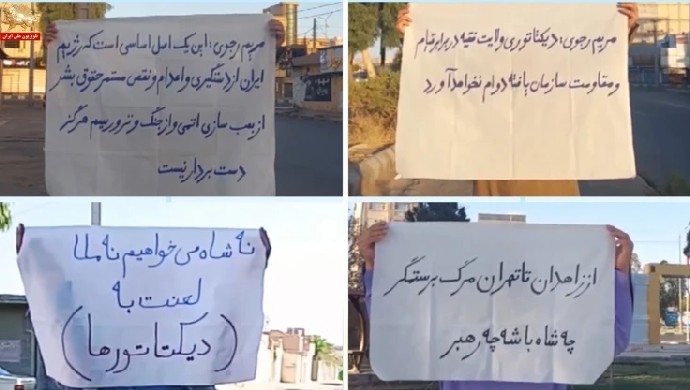

On August 7 in Zahedan, southeast Iran, PMOI/MEK Resistance Units took to the streets to mark two monumental milestones in Iran’s historical struggle for freedom: the 38th anniversary of the 1988 massacre of political prisoners and the 120th anniversary of the Constitutional Revolution.
Through a daring display of placards in public places, these rebellious youth demonstrated that the legacy of those who refused to surrender to tyranny remains a driving force in the current nationwide resistance. Their messages made it unequivocally clear that the “dictatorship of Velayat-e Faqih cannot survive in the face of widespread uprising and organized resistance.”
July 7—Zahedan, southeast Iran
PMOI/MEK Resistance Units mark the anniversary of the 1988 massacre of political prisoners by continuing the legacy of 30,000 martyrs who refused to surrender to the regime. pic.twitter.com/sEGUXt1Awt— People's Mojahedin Organization of Iran (PMOI/MEK) (@Mojahedineng) August 8, 2026
A central theme of the Resistance Units’ campaign in Zahedan was drawing a “fiery red demarcation” between the Iranian people and the forces of dictatorship. Their slogans rejected any return to the past, warning that “one of the regime’s primary levers to counter the uprising and resistance is promoting a manufactured alternative centered around the remnants of the Shah’s dictatorship.”
Echoing a six-decade struggle against both the theocracy and the monarchy, the youth held up signs declaring, “Down with the oppressor, be it the Shah or the Supreme Leader,” and “A dictator is a dictator, whether with a turban or a crown.” They emphasized that both monarchical and mullahs’ rule are responsible for a century of crimes, demanding: “No to mullahs, no to shah, yes to freedom and a democratic republic.”
"The dictatorship of Velayat-e Faqih cannot survive in the face of widespread uprising and organized resistance." pic.twitter.com/FjgrFw7sjt
— People's Mojahedin Organization of Iran (PMOI/MEK) (@Mojahedineng) August 8, 2026
To contextualize their current fight, the Resistance Units drew deep inspiration from the pioneers of the Constitutional Era. They noted that learning lessons from the bitter experiences of early constitutionalists has elevated their political awareness against the current regime. They vowed that the ruling mullahs’ atrocities will never undermine the “legendary, Amirkhiz-like perseverance of the Iranian nation,” referencing the impenetrable stronghold of constitutionalist hero Sattar Khan in Tabriz.
The living legacy of the 1988 martyrs
Today’s defiance is deeply intertwined with the epic resistance of the summer of 1988. Following a religious fatwa by then-Supreme Leader Ruhollah Khomeini to purge prisons of PMOI/MEK supporters, over 30,000 prisoners were hanged in mere months.
These victims faced minutes-long sham trials with no lawyers and were given a stark choice: disown the PMOI and their fight for freedom, or go to the gallows. They heroically chose death over surrender. The regime desperately sought to hide this crime, secretly burying victims in mass unmarked graves and severely intimidating families against holding funerals.
"It is a fundamental truth that the Iranian regime will never abandon arbitrary arrests, executions, systemic human rights violations, nuclear weaponization, war, and terrorism." pic.twitter.com/kArKhmSV6T
— People's Mojahedin Organization of Iran (PMOI/MEK) (@Mojahedineng) August 8, 2026
Yet, as the activists in Zahedan pointed out, the regime’s continuous reliance on arbitrary arrests, executions, terrorism, and systemic human rights violations has failed to crush the public’s explosive rage. “Through these executions, the regime only steels the resolve of the rebellious youth to overthrow this bloodthirsty dictatorship,” they proclaimed.
For 38 years, the battle between the 1988 martyrs and the regime’s executioners has not stopped for a single day, continuously echoing through eight major national uprisings. Dictators historically fail to realize that the blood of freedom seekers does not vanish into the earth; it multiplies and flows. By attempting to wipe out a generation of dissidents in 1988, the regime fundamentally miscalculated the resilience of the Iranian resistance—a resilience now vividly alive in the brave actions of today’s Resistance Units.