

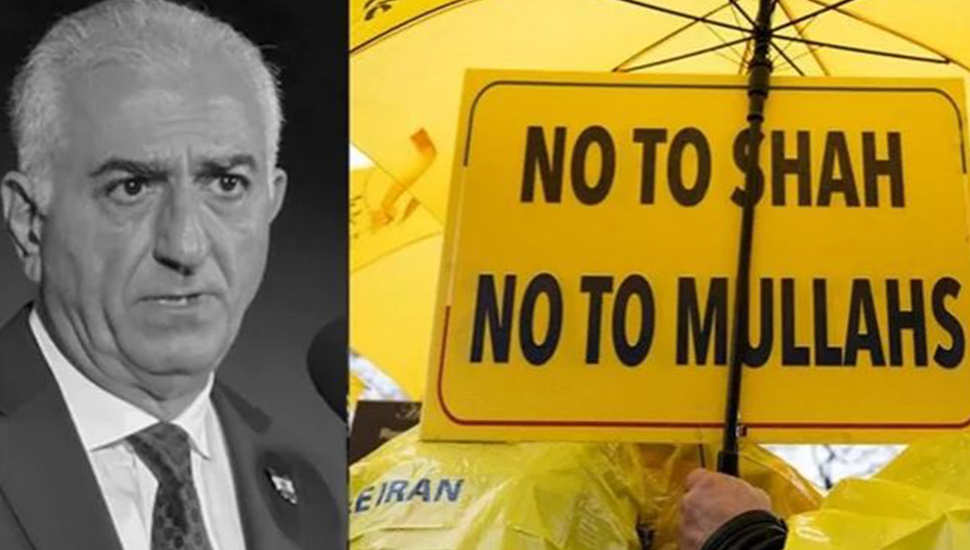

On November 7, 2026, the Friedrich Naumann Foundation presented its Freedom Prize to the Iranian people at Frankfurt’s Paulskirche, and designated Reza Pahlavi, son of Iran’s deposed Shah, as the trustee to receive the award.
But his selection raises a fundamental question: Who gave the heir to Iran’s former dictator the authority to represent a nation whose political activists and prisoners have repeatedly rejected a return to the dictatorship of his father and grandfather?
The authoritarian legacy Pahlavi refuses to confront
In Frankfurt, Pahlavi presented himself as a champion of freedom and democratic elections, invoking Iran’s long parliamentary tradition. Yet this history exposes a contradiction in his political narrative.
Iran’s Constitutional Revolution of 1905–1906 established parliamentary institutions nearly two decades before his grandfather, Reza Shah, founded the Pahlavi dynasty in 1925.
Rather than advancing constitutional government, Reza Shah progressively dismantled parliamentary independence. Elections were manipulated, opposition politicians were excluded and murdered, and the legislature became subordinate to royal authority.
His son, Mohammad Reza Shah, continued the authoritarian tradition. His regime enabled the 1953 coup against democratically elected Prime Minister Mohammad Mossadegh. The notorious SAVAK secret police imprisoned and tortured political opponents, while political participation remained tightly controlled.
In March 1975, the Shah established the Rastakhiz Party, turning Iran into a single-party state and eliminating even the pretense of multiparty politics.
Yet Reza Pahlavi has never distanced himself from these abuses and even expressed pride in his father and grandfather’s legacy.
In an April 12, 2026 interview with Swedish public broadcaster SVT, Pahlavi was confronted with his family’s history of authoritarian rule. Rather than condemn it, he declared: “I’m not here to defend or condemn,” adding that he was “extremely proud” of his heritage and what had been accomplished during that era.
The following day, during a visit to the Swedish parliament, Pahlavi again avoided directly addressing questions about his father’s dictatorship.
This raises a fundamental contradiction: how can Pahlavi present himself as a champion of democracy while declining to condemn the repression and destruction of political freedoms under the dynasty whose legacy he celebrates?
From Iran’s streets to its prisons: Rejecting both the Shah and the mullahs
The rejection of monarchy is not confined to political debates among Iranians abroad. It has emerged repeatedly in protests and organized resistance activities inside Iran.
One of the slogans heard during the nationwide uprisings in the past decade was: “Down with the oppressor, be it the Shah or the Supreme Leader.”
Chanted by university students and other protesters, the slogan expressed rejection of both the former monarchy and the ruling theocracy. It also appeared in demonstrations in subsequent years, challenging the notion that opposition to the mullahs’ regime automatically translates into support for restoring the Pahlavi dynasty.
The most direct challenge to the Frankfurt decision came from Iran’s prisons.
On October 28, 2026, 142 political prisoners from 21 prisons, including 11 prisoners under death sentences, issued a statement condemning the selection of Reza Pahlavi to receive the Freedom Prize.
On November 1, another 48 prisoners from 17 prisons joined the protest, bringing the reported total to 190 prisoners across 38 prisons.
The prisoners recalled the monarchy’s history of imprisonment, torture, and executions. They rejected attempts to rehabilitate that dictatorship and demanded a democratic republic based on separation of religion and state, gender equality, and autonomy for Iran’s nationalities.
Their statements are particularly significant because they come from people imprisoned under the current dictatorship who nevertheless refuse to embrace the previous one.
This position is reflected in activities by PMOI Resistance Units across Iran, who are rejecting all forms of dictatorship with placards bearing messages such as “No to mullahs, no to Shah, yes to freedom and democratic republic” and “Monarchy and mullahs’ rule are responsible for 100 years of crime.” In every corner of Iran, people from all walks of life are making it clear the choice should not be between two forms of dictatorship. The clear choice is a democratic republic.
Democratic promises and the intimidation of political opponents
Pahlavi’s democratic rhetoric also faces questions over the conduct of some of his supporters and political allies.
In a July 2026 Reuters interview, journalist Steve Stecklow confronted Pahlavi about statements by people close to him. His adviser Saeed Ghasseminejad had declared: “You’re either with Prince Reza Pahlavi or with the Islamic Republic.”
Pahlavi’s wife, Yasmine, had also reposted an image bearing the slogan: “Death to the three corrupts, mullahs, leftists, and PMOI.”
Concerns about intimidation intensified following the murder of Iranian-Canadian activist Masood Masjoody, a former Pahlavi supporter who became his critic. Two individuals associated with monarchist activism were charged with first-degree murder.
Associated Press also documented threats against other Iranian diaspora activists, including messages invoking SAVAK.
The Frankfurt controversy extends beyond Iranian opposition groups
The decision to designate Pahlavi as trustee also drew objections from prominent German figures.
An open letter signed by 71 individuals, including former Bundestag President Wolfgang Thierse, former Justice Minister Brigitte Zypries, and former UN Human Rights Council President Joachim Rücker, challenged the foundation’s choice.
The signatories questioned whether Pahlavi could legitimately represent Iran’s diverse opposition and warned against conferring political authority without democratic authorization.
In Belgium, Foreign Minister Maxime Prévot rejected calls to recognize Pahlavi as the legitimate representative of the Iranian people, insisting that only Iranians could decide who should lead their country.
The controversy intensified when Pahlavi was invited to address the Royal Military School in Brussels on November 6.
Around 30 prominent Belgian figures, including former Deputy Prime Minister Louis Michel, former Defense Minister André Flahaut, and former minister of state Gérard Deprez, called for the invitation to be withdrawn. They warned that receiving Pahlavi in an official military institution could imply government endorsement of a political figure associated with the former Shah’s dictatorship.
The Belgian parliament also abandoned plans for an official reception following objections and the Foreign Ministry’s reservations.
The opposition to Reza Pahlavi inside Iran and across the globe demonstrates that rejection of both monarchy and clerical dictatorship reflects the will of the Iranian people.
The right to determine Iran’s future belongs to its people, not to inherited royal titles or international award ceremonies.