

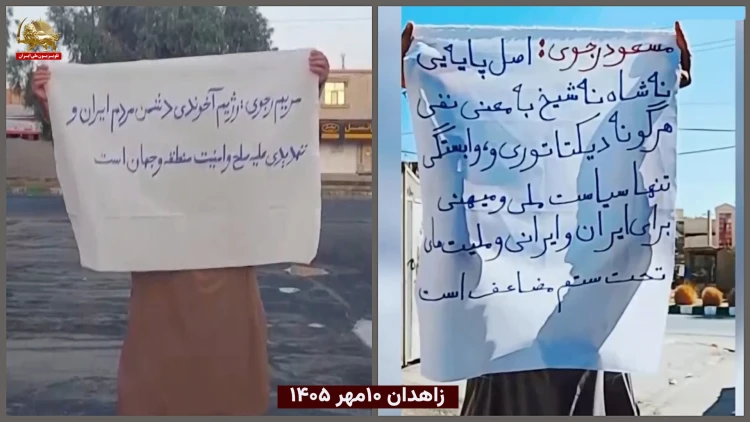

On October 2, 2026, PMOI/MEK Resistance Units resumed their weekly anti-regime activities in Zahedan, southeast Iran, displaying placards in public places with messages of resistance and political change.
Their messages centered on several recurring themes: overthrowing the clerical regime, rejecting both religious and monarchical dictatorship, relying on organized resistance inside Iran, and encouraging the younger generation to join the struggle for freedom.
The activities also connected the current struggle with those who have paid the ultimate price for resisting the regime. They honored the tradition of resistance in prisons, standing firm before the gallows, and the role of rebellious youth and Resistance Units in carrying the struggle forward.
October 2—Zahedan, southeast Iran
Resuming their weekly activities, PMOI/MEK Resistance Units reiterate their commitment to the fight to overthrow the tyrannical regime of the mullahs and spread messages of the Iranian Resistance. pic.twitter.com/YPpHcN9ONr— People's Mojahedin Organization of Iran (PMOI/MEK) (@Mojahedineng) October 3, 2026
Rejecting dictatorship in all its forms
One of the most prominent themes of the October 2 campaign was the rejection of both the ruling theocracy and restoration of the former monarchy.
The placards declared, “From Zahedan to Tehran, down with the oppressor, be it the shah or the supreme leader,” and, “A dictator is a dictator, whether with a turban or a crown.” Other messages included, “We want neither shah nor mullahs, dictators be damned,” and, “No to mullahs, no to shah, yes to a democratic republic.”
Other placards placed this position within the reality of Iran’s modern political history. They reminded that the 1979 revolution was hijacked by Khomeini and warned against attempts by the remnants of the shah regime to replace the current dictatorship with another form of authoritarian rule.
"The mullahs' regime is the enemy of the Iranian people and a threat against the peace and security of the region and the world." pic.twitter.com/XWvIlKOJOC
— People's Mojahedin Organization of Iran (PMOI/MEK) (@Mojahedineng) October 3, 2026
Through these messages, the Resistance Units rejected the choice between Iran’s former monarchy and the current clerical system, while advocating a democratic republic as the alternative.
Organized resistance as the path to change
In their activities, the Resistance Units also emphasized the role of organized forces inside Iran. Messages declared, “We can and we must overthrow the mullahs’ regime,” and stressed that democratic change will be achieved “at the hands of the people of Iran and their organized resistance.”
This theme reflects the broader reality of the situation in Iran: neither foreign military intervention nor accommodation with Tehran provides a solution to Iran’s political crisis, and change must instead come from Iranian society and an organized movement operating inside the country. The expansion of Resistance Units and organized resistance inside Iran is one of the central pieces of this strategy.
"Overthrowing this regime is the mandate of the Iranian people, the rebellious youth, uprising cities, and the National Liberation Army" pic.twitter.com/D1XDzXSVAs
— People's Mojahedin Organization of Iran (PMOI/MEK) (@Mojahedineng) October 3, 2026
In their activities in Zahedan, Resistance Units reiterated their message by stressing that Iran will be liberated by Resistance Units, rebellious youth, uprising cities, and the National Liberation Army.
A new generation carries the struggle forward
The October 2 messages gave particular attention to younger Iranians. One placard declared that “Generation Z challenges both dictatorship and foreign dependence—whether Shah or mullahs,” while another described Resistance Units and “vanguard youth” as a model for Iran’s younger generation.
That theme has also appeared among imprisoned PMOI supporters. In a September 2026 message from Evin Prison, Arghavan Fallahi and Forough Taghipour identified themselves with Generation Z and opposition to both the Shah and the mullahs. They explicitly named four PMOI members executed earlier in 2026—Babak Alipour, Pouya Ghobadi, Vahid Bani Amerian, and Mehdi Khanaki—as figures whose path they intended to continue.
"The answer to the Iran question is the total overthrow of the religious dictatorship" pic.twitter.com/CyyGa7gha3
— People's Mojahedin Organization of Iran (PMOI/MEK) (@Mojahedineng) October 3, 2026
Bani Amerian, Alipour, and Ghobadi were members of the same Resistance Unit. Babak Alipour, 34, and Pouya Ghobadi, 33, were executed on March 31, while 33-year-old Vahid Bani Amerian was executed on April 4. Mehdi Khanaki, a 26-year-old law graduate and PMOI member who had participated in the January 2026 uprising, was executed on July 22. Resistance Units subsequently held activities across Iran commemorating him and pledging to continue his path.
Their names give concrete meaning to the Zahedan placards linking youth, prison, resistance, and the gallows: executions have become part of the memory through which younger Resistance supporters describe their own political commitment.
Keeping the flame of resistance alive
The October 2 activities therefore went beyond a collection of anti-regime slogans. They connected opposition to the current government with rejection of the former monarchy, presented organized resistance as the Resistance Units’ proposed path for political change, and linked today’s younger activists to those who have been imprisoned or executed.
That continuity is captured in one of the messages displayed in Zahedan: “The Resistance Units have chosen rebellion in the cities of Iran, resistance in prisons, and standing tall even in the face of the gallows.”
Through their recurring public activities and their commemoration of those executed in the struggle, the Resistance Units are keeping their memory present on Iran’s streets. The October 2 campaign in Zahedan presented the struggle not only as a political objective for the future, but as a continuation of sacrifices already made—a flame that its participants seek to pass from one generation to the next.