

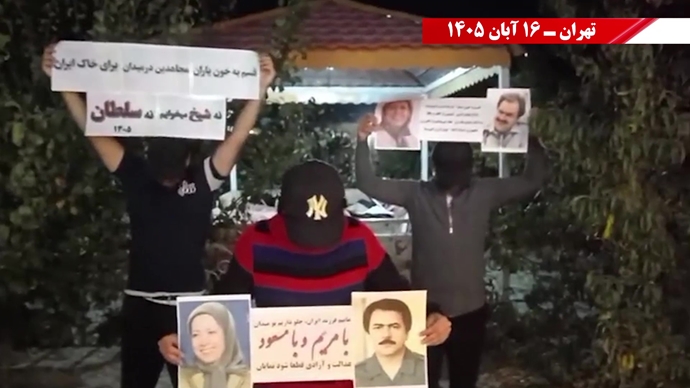

In November 2026, Resistance Units affiliated with the People’s Mojahedin Organization of Iran (PMOI/MEK) marked the seventh anniversary of the November 2019 uprising with anti-regime activities across Iran, reaffirming their determination to keep the spirit of the uprising alive and prepare for the next wave of nationwide protests.
Despite the regime’s security measures, Resistance Units displayed placards in public locations across Tehran, Karaj, Mashhad, Isfahan, and Shiraz, carrying messages of resistance, regime change, and rejection of all forms of dictatorship.
November 2026—Iran
PMOI/MEK Resistance Units mark the 7th anniversary of the November 2019 uprising with anti-regime activities, showing that the spirit of freedom will not be silenced by the regime's brutality. pic.twitter.com/nRwo8r5otA— People's Mojahedin Organization of Iran (PMOI/MEK) (@Mojahedineng) November 9, 2026
In Tehran, one placard declared, “We the Resistance Units are ready for uprisings. People of Iran, let’s get ready for the next uprising.”
The activities combined remembrance of those killed in the November 2019 crackdown with a message that the struggle for freedom continues and that Iran’s future must be a democratic republic, free from both clerical and monarchical dictatorship.
Keeping the memory of the November 2019 uprising alive
The November 2019 uprising began on November 15 following the regime’s sudden increase in gasoline prices. What started as protests over economic hardship rapidly spread to more than 190 cities and evolved into nationwide demonstrations demanding an end to clerical rule.
The regime responded with a brutal crackdown. Security forces, including the Islamic Revolutionary Guard Corps (IRGC) and Basij, opened fire on protesters while authorities imposed a near-total internet blackout. According to PMOI figures, at least 1,500 protesters were killed, and thousands more were arrested.
Tehran
A group of Resistance Units with placards and slogans:
"We are the children of Iran, taking the lead in the field. With Maryam and with Massoud [Rajavi], justice and freedom will definitely manifest. Swearing by the blood of comrades, the PMOI stands on the battleground… pic.twitter.com/680lho9X0M— People's Mojahedin Organization of Iran (PMOI/MEK) (@Mojahedineng) November 9, 2026
Seven years later, Resistance Units are commemorating the uprising as a turning point in the struggle against the regime.
In Tehran, a placard declared, “The November uprising dealt crushing, foundation-shattering blows to the rotting edifice of the regime.”
The anniversary campaign follows 30 operations carried out by Resistance Units on November 2, 2026, targeting regime institutions and symbols of repression. Those operations formed part of a broader campaign of 90 activities across Tehran and 24 other cities.
Resistance Units call for renewed uprisings and regime change
Across the country, the anniversary activities emphasized that the November 2019 uprising remains a source of inspiration for continued resistance and preparations for future protests.
In Karaj, Resistance Units displayed a placard warning, “The tremors of overthrow are looming for the mullahs’ regime.”
Another message in the city called for intensified resistance against the regime on the anniversary of the uprising.
In Tehran, a placard proclaimed, “Iran’s democratic revolution will be victorious and the mullahs’ regime will be swept away from our homeland.”
Karaj
"On the anniversary of the November uprising, the response of Iran's children is maximum offense against the regime" pic.twitter.com/1YYOXhh9M8— People's Mojahedin Organization of Iran (PMOI/MEK) (@Mojahedineng) November 9, 2026
In Shiraz, Resistance Units displayed messages emphasizing resistance as the path to freedom. One declared, “The only way to freedom is resistance and regime change,” while others stressed the need to confront the regime’s repression.
In Mashhad and Tehran, Resistance Units also displayed slogans expressing support for Maryam Rajavi and Massoud Rajavi and the broader struggle of the organized Iranian Resistance.
Together, these messages presented the November anniversary not merely as a remembrance of the past, but as an occasion to reaffirm the Resistance Units’ commitment to continuing their activities and preparing the ground for another uprising.
Neither shah nor mullahs: Rejecting all forms of dictatorship
One of the most prominent messages of the anniversary campaign was the rejection of both the ruling theocracy and any return to the monarchy overthrown in 1979.
In Isfahan and Shiraz, Resistance Units displayed placards declaring, “Down with the oppressor, be it the shah or the supreme leader.”
Another placard in Shiraz stated, “Iranians are aware and despise the shah and mullahs.”
Shiraz
"Iranians are aware and despise the shah and mullahs" pic.twitter.com/nxQFvkHIVW— People's Mojahedin Organization of Iran (PMOI/MEK) (@Mojahedineng) November 9, 2026
These slogans directly challenge efforts by Reza Pahlavi, the son of Iran’s former shah, and his supporters to present restoration of the Pahlavi dynasty as the alternative to the current regime.
The Resistance Units’ message is that the struggle against clerical rule must not lead to the replacement of one dictatorship with another. Their rejection of both hereditary monarchy and religious authoritarianism places popular sovereignty and democratic government at the center of their political demands.
Their activities reflect a growing national movement that rejects all forms of dictatorship, including letters by 190 political prisoners who protested Pahlavi being designated by a German foundation as the recipient of a freedom prize meant for the people of Iran.
A democratic republic as the alternative
The anniversary activities also highlighted the political alternative advocated by the Iranian Resistance.
In Isfahan, a placard declared, “Maryam Rajavi’s Ten-Point Plan guarantees a free Iran.”
The plan calls for a democratic republic based on universal suffrage, political pluralism, separation of religion and state, gender equality, abolition of the death penalty, and fundamental freedoms.
By combining calls for regime change with explicit rejection of both the shah and the mullahs, the Resistance Units emphasized that Iran’s future must be determined by its people rather than by religious or hereditary authority.
Seven years after the November 2019 uprising, their anniversary activities reaffirm that the memory of those killed continues to inspire resistance. The message conveyed by the placards is that the struggle remains unfinished and that the Resistance Units are determined to keep its spirit alive, preparing for the next uprising and pursuing a democratic republic in Iran.