

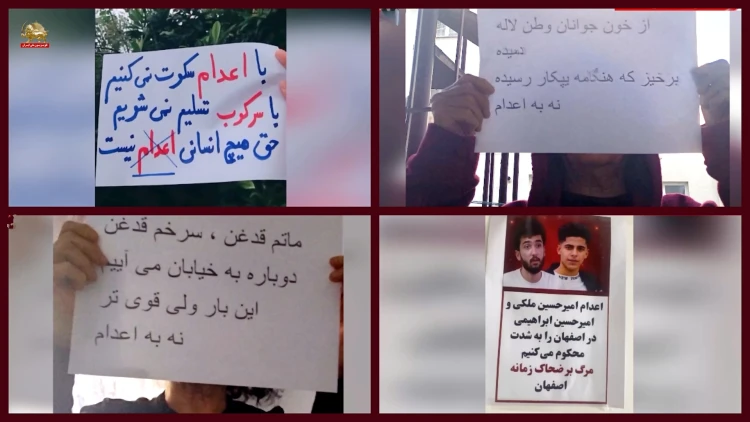

On November 10, 2026, Resistance Units affiliated with the People’s Mojahedin Organization of Iran (PMOI/MEK) carried out anti-regime activities across Iran in solidarity with the “No to Executions Tuesdays” campaign, displaying placards condemning executions and demanding freedom for political prisoners. The activities took place in Tehran, Isfahan, Zanjan, Hamedan, Lahijan, Rasht, and Kerman.
The activities coincided with the 146th consecutive week of the “No to Executions Tuesdays” campaign, during which prisoners in 66 prisons staged coordinated hunger strikes against the regime’s use of capital punishment. Through their messages, the Resistance Units condemned the recent execution of two young protesters, demanded the revocation of death sentences against PMOI supporters, and declared that executions would not silence the people’s resistance.
Resistance Units demand freedom for political prisoners facing execution
In Tehran, Resistance Units highlighted the cases of political prisoners facing death sentences for their alleged support of the PMOI. One placard declared, “The death sentence of Zahra Tabari must be revoked,” while demanding the release of Arghavan Fallahi and an end to the planned execution of Manouchehr Fallah.
Zahra Tabari, a 68-year-old electrical engineer arrested in April 2025, was sentenced to death on charges related to PMOI membership. Following a retrial, the Revolutionary Court in Rasht issued another death sentence against her on April 14, 2026.
November 10—Iran
PMOI/MEK Resistance Units carry out anti-regime activities express their support with the "No to Executions Tuesdays" on its 146th week. pic.twitter.com/aNFyIE7Wih— People's Mojahedin Organization of Iran (PMOI/MEK) (@Mojahedineng) November 11, 2026
Arghavan Fallahi, a 25-year-old PMOI supporter imprisoned in Evin Prison, received a death sentence in July 2026 on charges of baghi, or armed rebellion. Manouchehr Fallah, detained since June 2023, faces imminent execution after the regime’s Supreme Court upheld his death sentence on October 22, 2026, and referred his case for implementation.
Another placard in Tehran declared, “Every death sentence is a wound on the body of freedom,” and called for the release of protesters detained during the 2022 and 2026 uprisings.
Resistance Units honor two young protesters executed in Isfahan
In Isfahan and Zanjan, Resistance Units condemned the November 3 execution of Amirhossein Maleki and Amirhossein Ebrahimi, two 20-year-old protesters arrested during the January 2026 uprising.
In Isfahan, one placard declared, “From the blood of our comrades, a thousand storms will rise,” paying tribute to the two young men. Another condemned their executions and called for the overthrow of the regime. Similar messages appeared in Zanjan, where Resistance Units denounced the killings.
Isfahan
"We condemn the execution of Amirhossein Maleki and Amirhossein Ebrahimi in Isfahan. Down with this regime." pic.twitter.com/JzU4ou5NGG— People's Mojahedin Organization of Iran (PMOI/MEK) (@Mojahedineng) November 11, 2026
Maleki and Ebrahimi were executed at Dastgerd Prison in Isfahan in connection with the case known as the Ali-Khani Square case. Seven other defendants in the same case had previously been executed, bringing the number of executions to nine. Other young prisoners convicted in the case remain at risk of execution.
The Resistance Units’ messages reflected their determination to keep the memory of the executed protesters alive and oppose further death sentences against participants in the uprising.
Resistance Units reject the regime’s campaign of intimidation
Across several cities, Resistance Units challenged the regime’s reliance on executions to suppress dissent and intimidate society.
In Tehran, one placard declared, “We swear on the blood of our comrades that we will stand till the end,” warning that further executions would provoke uprisings. Another described executions as a means by which the regime attempts to preserve its rule.
In Zanjan, Resistance Units declared, “Executions will not silence us. We will not surrender in face of repression.” Other messages demanded an Iran without executions and the release of political prisoners.
Zanjan
"Executions will not silence us. We will not surrender in face of repression. No human deserves to be executed." pic.twitter.com/SCVx0QgNn1— People's Mojahedin Organization of Iran (PMOI/MEK) (@Mojahedineng) November 11, 2026
In Hamedan, placards proclaimed, “You can’t kill freedom with the noose,” and warned that repression would not bring security to the regime.
In Lahijan, Resistance Units declared, “We will return to the streets, stronger than before,” while in Rasht, a placard stated that executions would not stop the determination of PMOI supporters.
Together, these messages conveyed the Resistance Units’ rejection of executions as an instrument of political control and their determination to continue opposing the regime’s repression.
The 146th week of a growing nationwide anti-execution campaign
The “No to Executions Tuesdays” campaign began in January 2024 as an initiative by political prisoners protesting the regime’s increasing use of capital punishment. Nearly three years later, the weekly hunger strikes have expanded to 66 prisons across Iran.
The November 10 campaign statement reported that at least 15 prisoners, including six political prisoners, had been executed during the preceding week. It also warned that 15 political prisoners had received death sentences over the same period.
Hamedan
"You can't kill freedom with the noose. Down with the regime of executions. No to executions." pic.twitter.com/a5UCCxcMqV— People's Mojahedin Organization of Iran (PMOI/MEK) (@Mojahedineng) November 11, 2026
Despite threats, communication restrictions, and punitive measures by prison authorities, participating prisoners have continued their coordinated protests.
The Resistance Units’ activities extended this campaign beyond prison walls, connecting the prisoners’ demands with public expressions of opposition to the death penalty.
In Kerman, a placard summarized this solidarity: “The ‘No to Executions Tuesdays’ campaign is the voice of resistance against executions. No to executions.”
Through their November 10 activities, PMOI Resistance Units reaffirmed their solidarity with political prisoners and their commitment to an Iran without executions, conveying the message that repression and death sentences will not extinguish the demand for freedom.