

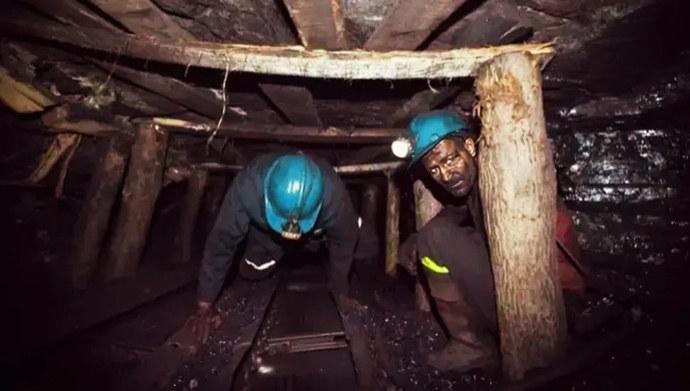

Iran’s regime sends oppressed miners, deprived of any safety facilities, into the depths of the earth to earn an honorable living, without even providing the minimum requirements for working in grueling conditions. The national resources and public assets of these very miners are used to fill the pockets of criminal clerics and oppressive Revolutionary Guards, while the rest is spent on exporting fundamentalism and terrorism; yet, no responsibility is taken for ensuring the livelihood and lives of these laborers.
The explosion at the Madanjoo mine in Tabas, South Khorasan Province, occurred due to methane gas accumulation, claiming the lives of 50 miners. This is yet another incident where mines under the ownership and management of the agents of religious fascism collapse or where methane explosions and other workplace safety hazards claim the lives of helpless miners, plunging their families into eternal sorrow.
On September 21, a deadly explosion occurred in one of the tunnels of the Madanjoo coal mine due to methane gas accumulation, and the bodies of the deceased were handed over to their grieving colleagues. This incident ranks as one of the significant mining disasters in the world.
In 2010, the collapse of the San José mine in Chile, which resulted in relatively few casualties, was considered the largest mining disaster in the world. In Iran, the Yurt mine explosion in Golestan Province in 2017 claimed the lives of 44 people. Today, the plundering clerical regime, due to its neglect of infrastructure and workplace safety, ranks at the top of the world’s most exploitative and irresponsible regimes towards the lives of miners, with 52 Iranian miners whose lives have been destroyed.
On September 22, Hamshahri news website quoted Mohammad-Ali Akhoundi, director general of the provincial crisis management in South Khorasan Province, as saying, “Methane gas accumulation in the tunnels caused workers to suffocate in the coal mine. The gas concentration caused an explosion at a depth of 250 meters vertically and 700 meters diagonally.”
The many small and large accidents in Iran’s mines, like many significant events in the country, are not properly documented. However, over the past two decades, the deadly and tragic accidents in mines controlled by the agents of the regime have been so painful that some have made it into the news. In just the past six months, 20 accidents have occurred in the country’s mines, claiming the lives of at least 60 people.
Since the early days of the clerical regime’s usurpation of the people’s right to sovereignty, mines also came under government control and were handed over to state and semi-state enterprises, as well as the “Execution of Imam Khomeini’s Order” foundation, to exploit the miners mercilessly.
In 2020, the deputy director of the Geological Survey of Iran stated, “The country’s mining areas are owned by organizations and entities that do not allow individuals to explore or extract.” The head of Iran’s Mining House also remarked, “25% of the country’s total production in the mining sector is controlled by semi-state entities” (Source: Fardaye Eghtesad news website, July 30, 2023).
In contrast, many miners working in the depths of the mines earn about 85 million rials, which is below the minimum wage. The harsh working conditions and low pay for miners in Iran have worsened since the clerics took power.
On May 21, 2021, the official ILNA news agency reported, since the 2000s, fatal accidents have increased, with “over 3,000 incidents occurring in mines during the 2010s, leading to injuries for around 13,000 workers and the deaths of more than 430 miners.”
Ahmad Mokhtari, a 48-year-old accountant, worked as a safety officer at the Tabas mine. He was on his break when the “engineer” asked him to check the safety of Block “C.” His family and coworkers say his “self-rescue” device did not work due to its old age. Ahmad entered Block “C” at 10:00 AM, and by 11:15 AM, his body was brought out. He had two children, aged 14 and 7, and his youngest daughter’s first day of school was on September 29.
As one of the family members of a victim of the mining incident said: “Write down what they did to us. We even had to pay for transporting our loved ones’ bodies. We paid between 150 to 200 million rials just to bring their bodies home, and that too without refrigeration; they only gave us a few pieces of ice to place over the corpses” (Source: The state-run Shargh newspaper, September 25).