

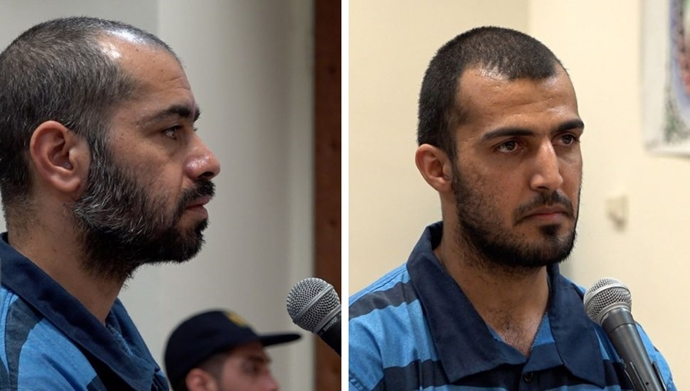

On Monday morning, June 1, 2026, the mullahs’ regime executed two brave protesters, Mehrdad Mohammadinia and Ashkan Maleki. The regime labeled these rebellious youths as leaders of the recent January uprising. They were sentenced to death by Branch 15 of the Tehran Revolutionary Court, presided over by the notorious “hanging judge” Abolqasem Salavati. The judiciary cited heavily fabricated charges against them, including acting against national security, confronting the system, destroying public property, and clashing with State Security Force (SSF) agents.
In a brutal crime on Monday, June 1, 2026, Iran's regime hanged two protesters, Mehrdad Mohammadinia and Ashkan Maleki, in Tehran under the label of "leaders of the riots."
Mizan, the news agency of the regime’s judiciary, stated that the reason for executing the two rebels was… pic.twitter.com/Oxs493UFka
— People's Mojahedin Organization of Iran (PMOI/MEK) (@Mojahedineng) June 1, 2026
Furthermore, they were accused of setting fire to a so-called seminary named ‘Imam Hadi’ and the Basij center at the Jafari Mosque in Kuy-e Nasr (Gisha), western Tehran. This mosque has long been a key center for suppression; according to state media, Ebrahim Raisi, the henchman of the 1988 massacre, controlled it for 20 years starting in 1996.
The responsibility of the international community
In response to these heinous acts, Mrs. Maryam Rajavi, President-elect of the National Council of Resistance of Iran (NCRI), emphasized that the Iranian people will not be intimidated. She stated that executing honorable youth will not save the crisis-ridden regime but will “double the resolve of rebellious youths in fighting this illegitimate regime.”
The clerical regime has committed another horrific crime in Iran, executing two brave young protesters, Mehrdad Mohammadi-Nia and Ashkan Maleki, on charges of leading protests in January.
The regime’s judiciary sentenced them for "acting against national security" and "clashing… pic.twitter.com/rPeVD5sRdo
— Maryam Rajavi (@Maryam_Rajavi) June 1, 2026
Mrs. Rajavi urgently called upon the United Nations Security Council, the European Union, and its member states to strongly condemn these criminal executions and take effective measures to halt the slaughter of political prisoners and protesters. She warned that the international community’s silence is viewed by the ruling mullahs as a green light to continue their daily crimes and slaughter, noting that the perpetrators of 47 years of massacres will eventually face justice in a free Iran.
A campaign of state terror
These latest hangings are part of a massive, daily surge in executions orchestrated by the regime to instill fear within a deeply restless society and impose collective punishment. Authorities are relentlessly targeting participants of recent uprisings. On May 25, the regime executed Abbas Akbari Faizabadi, a courageous protester from Nain, on fabricated charges of “Moharebeh” (waging war against God) and armed rebellion.
Earlier, on May 13, 55-year-old Mohammad Abbasi was hanged in Ghezel Hesar Prison for his involvement in the Malard protests following brutal torture in Evin Prison’s Ward 209 and a sham trial lacking an independent lawyer, also presided over by Abolqasem Salavati. In a staggering display of vindictiveness, Abbasi’s daughter, Fatemeh, was sentenced to 25 years in Evin Prison.
Between May 3 and May 21 alone, at least 22 executions were recorded across several cities. Oppressed ethnic minorities are increasingly falling victim to this state terror. On May 21, Kurdish political prisoners Ramin Zeleh and Karim Maroufpour were executed in Naqadeh Central Prison following severe abuses and legal limbo. Similarly, on May 12, Baluch political prisoner Abduljalil Shahbakhsh was executed in Zahedan on charges linked to the 2022 Bloody Friday massacre.
A sign of weakness, not power
The Iranian Resistance reiterates the urgent necessity of referring the regime’s horrific human rights dossier to the UN Security Council to ensure accountability for 47 years of crimes against humanity and genocide. Executing Iran’s proud youth fails to save this moribund religious fascism; it only redoubles the anger of the Iranian people against their bloodthirsty rulers.
Ultimately, these daily executions are not a demonstration of power. They are the desperate and futile attempts of a severely weakened regime seeking to silence an increasingly restive nation—a society that no longer fears standing up and confronting the apparatus of repression.