

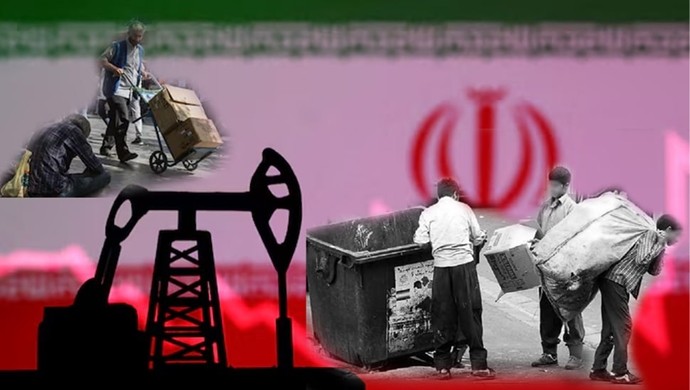

Coinciding with World Hunger Day, a staggering admission within Iran’s state-affiliated media has laid bare the catastrophic reality of the country’s economic and social collapse. A report published by the Donya-e-Eqtesad daily has highlighted urgent warnings from leading economists and academics regarding an impending “poverty explosion.” Experts state that the devastating fallout of recent conflicts, combined with the total collapse of oil revenues, has pushed the Iranian population to the brink of absolute destitution. With projections indicating that those living under the absolute poverty line will soon surpass 40 million, the regime’s Ministry of Intelligence has reportedly issued internal security alerts, fearing imminent popular uprisings fueled by hyperinflation and systematic economic mismanagement.
Economic Paralysis: Negative Growth and Chronic Unemployment
During an economic policy symposium in Tehran, academic experts presented grim metrics reflecting a state of total structural paralysis. Hojat Mirzaei, a faculty member at Allameh Tabataba’i University, revealed that due to an effective maritime blockade and oil exports plummeting to near zero, Iran’s economic growth for the current year is projected to contract sharply between -8.8% and -10%. Mirzaei warned that this contraction will plunge an additional 3.5 to 4.5 million citizens into absolute poverty within months, pushing the total number of impoverished Iranians past the 40-million threshold.
Furthermore, Hossein Pezhmanpour, head of the Saba Research Institute, highlighted the clinical death of the labor market, noting that the regime managed to generate a meager 57,000 jobs over the past year. He added that labor market indicators entered a freefall following the recent 12-day conflict. Speaking at the same panel, Kosar Yousefi pointed out the alarming expansion of the “working poor” phenomenon, where a vast segment of the workforce remains below the poverty line despite being employed, with the average duration of unemployment stretching to an unprecedented 3 to 4 years. Meanwhile, Gholamreza Keshavarz Haddad emphasized that the clerical regime’s financial infrastructure was already entirely fractured even prior to the latest military escalations.
Systemic Famine: The Devastating Reality of Marginalized Provinces
This year’s World Hunger Day highlights a grim reality within Iranian households, where severe food insecurity has become pervasive due to the collapse of the national currency and the erosion of purchasing power. Hunger is no longer a abstract term but a daily struggle for millions, particularly in urban slums and historically oppressed provinces such as Sistan and Baluchestan, Ilam, Khuzestan, and Kerman. Local and international human rights monitors report severe malnutrition among children and acute shortages of basic staples like milk, meat, rice, and eggs. Terms like “plain bread” or “filling the stomach with tea” have transitioned from expressions of hardship into literal survival strategies for millions of families.
This humanitarian crisis is not the result of a scarcity of natural resources. Iran possesses vast agricultural potential and sits on some of the world’s largest oil and gas reserves. Instead, the root cause lies in systemic corruption and the regime’s deliberate policy of plundering national wealth to fund its military apparatus, ballistic missile programs, and domestic security forces. By prioritizing ideological and regional ambitions over human and social needs, the state has left the population with broken, discriminatory, and wholly inadequate subsidization schemes.
Fearing the Backlash: Intelligence Apparatus Braces for Unrest
Faced with this suffocating economic reality, the Donya-e-Eqtesad report revealed that the Ministry of Intelligence issued urgent warnings on May 26, cautioning against the formation of widespread social unrest driven by hyperinflation and shortages of vital commodities. This security alert reflects deep-seated anxieties within the ruling apparatus that the silent “voice of the hungry” could transform into a nationwide uprising.
The regime is acutely aware that the elimination of its oil revenues and the intensifying internal factional infighting over remaining resources can no longer contain public fury. Chronic food poverty has evolved into a direct threat to domestic stability. Sociological indicators suggest that depriving a child in southern Tehran or the outskirts of Zahedan of a basic meal is the primary catalyst driving millions back onto the streets. This looming explosion, organized and sustained by grassroots resistance networks, poses an existential challenge to the clerical dictatorship.