

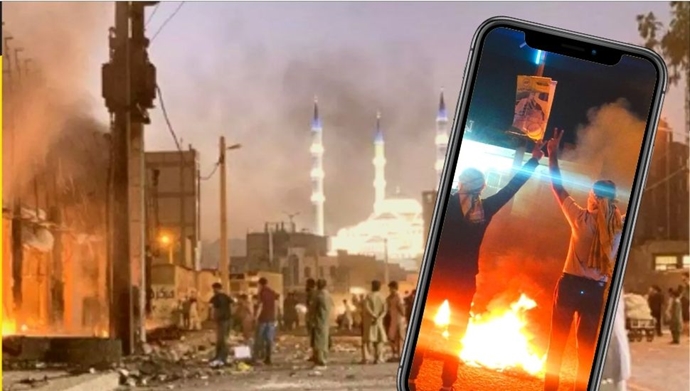

On the second anniversary of the “Bloody Friday” of Zahedan, on Friday, September 27, 2024, Baluch people once again turned the city’s Friday prayers into anti-regime protests. With slogans such as “We swear on the blood of the martyrs that we will stand till the end ” and “Political prisoners must be freed,” they held a passionate march. With their raised fists and loud chants, they once again honored the memory of the martyrs of that day and reaffirmed their commitment to them.
On the second anniversary of the Bloody Friday of Zahedan, Resistance Units held placards with slogans with motivating phrases such as “From Zahedan to Tehran, my life for Iran,” “The message of Bloody Friday’s martyrs: No surrender,” and others highlighted more aspects of the Iranian people’s roadmap toward establishing a democratic republic.
On the second anniversary of the "Bloody Friday" of Zahedan, the people of Zahedan protested with slogans such as "We swear by the blood of the martyrs, we stand until the end" and "Political prisoners must be freed," demanding justice for the martyrs.
Protesters also carried… pic.twitter.com/xKCViLCfUe
— People's Mojahedin Organization of Iran (PMOI/MEK) (@Mojahedineng) September 27, 2024
At the same time, Iran’s rebellious youth marked the event by setting fire to regime symbols and centers in Zahedan, Iranshahr, and various cities, spreading the enduring message of the struggle of the Baluch people until victory. They reminded the entire Iranian population once again of the determination of the youth of this deprived region in seeking justice for the martyrs and the overthrow of the regime.
The youth of the region also lit fires in the streets of Zahedan, bringing the central slogan “Death to Khamenei” to the masses, reminding them of the ongoing uprising.
The eternal martyrs of Zahedan
The Bloody Friday of Zahedan is one of the most tragic yet unforgettable events in Iran’s contemporary history, which occurred on September 30, 2022. On this day, the people of Zahedan, inspired by the nationwide protests of 2022, gathered after Friday prayers in protest against the rape of a 15-year-old Baloch girl by a local police commander. They held a demonstration in front of Zahedan’s 16th precinct, demanding the arrest and trial of the perpetrators. However, instead of listening to the people’s protests, the regime’s security forces attacked them with unprecedented brutality. The direct shooting at defenseless civilians and worshippers led to over a hundred casualties, both dead and wounded.
This crime is only part of the systematic oppression and discriminatory policies of the regime’s supreme leader against ethnic and religious minorities. Not only did the regime refuse to take responsibility for the incident, but it also distorted the facts and further suppressed any attempts to broadcast the tragedy in the media. Just as the regime never released the actual death toll from the entire uprising, it never provided an accurate count of those killed on that day. However, through the efforts of the people, the Iranian resistance, and the brave Baloch citizens, the names of the martyrs were gradually identified and made public. Some of them have since become symbols of resistance and perseverance in the great uprising of 2022, including:
Hasti Narouyi, one of the child martyrs of the uprising and a symbol of the oppression faced by Baluch children, was killed on Bloody Friday. She was only seven years old and had gone to Friday prayers with her grandmother. She was supposed to start first grade the following week, but she was killed by gunfire from security forces. Hasti was one of many children killed by security forced during the 2022 protests.
Khodanur Lojei, an unregistered resident of Shirabad, Zahedan, was a beloved young man known for his joyful spirit. The day after Bloody Friday, he was pursued and shot by government forces. A photo of him, bound hand and foot to a pole at a regime outpost months before his death, due to a clash with Basij forces, became an international symbol of resistance.
The flag bearers of the uprising
Zahedan’s Bloody Friday stands as a symbol of the regime’s systematic repression and violence against the rightful demands of the Iranian people. The memory of the martyrs of that day will forever remain a cry against the regime’s oppression and injustice.
Following the incident, regime supreme leader Ali Khamenei, acutely aware of his extreme unpopularity among the Baluch people, repeatedly attempted to send reconciliation and mediation delegations to the region. However, each time, they were met with a firm “No” from the proud Baluch people. To understand the depth of resentment in brave Baluchestan, one need only look at the continued protest demonstrations held during Friday prayers, where for two consecutive years, the banner of uprising has remained raised, sending a message of freedom and liberation, and rejecting both the mullahs and monarchy to the rest of Iran.
This incident once again demonstrated that the regime will use any means necessary, even at the cost of citizens’ lives, to maintain its grip on power. It also reinforced the only viable path forward in confronting the Iranian regime—echoing the roadmap emphasized by Resistance Units in last Friday’s prayers: “The response to the Bloody Friday massacre is uprising until the regime is overthrown.”