

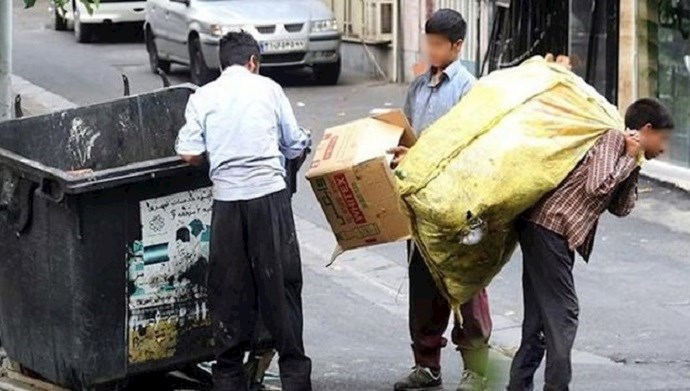

On March 24, Khabar Online, a state-run media outlet quoted Mohammad Sadr, a member of the Iranian regime’s Expediency Discernment Council, as saying “All experts, without exception, believe that economic problems are destroying the country. 30 million people live below the poverty line, and we must know that the solution to economic problems is not purely economic; it must also be solved from a foreign policy perspective, and foreign policy must come to the aid of economic problems.”
One of the primary reasons why 30 million Iranians have fallen below the poverty line is the rampant inflation that has crippled the country’s economy for decades. Since the late 1970s, the value of Iran’s national currency has been in continuous decline, with annual inflation rates often fluctuating between double and even triple digits. This situation, which has worsened in recent years due to currency depreciation and rising production costs, has significantly reduced household purchasing power. For example, the poverty line in 2025 for a family of four is estimated to exceed 250 million rials per month, while the official minimum wage for workers in the same year barely reaches one-third of this amount. This growing gap between income and living expenses—particularly in securing necessities such as food, housing, and healthcare—has pushed millions into absolute poverty.
A significant portion of oil revenues and other national resources, instead of being used to military activities, or organized corruption networks. This misallocation of resources, often carried out through opaque and extralegal institutions, has led to reduced investment in productive sectors, increased unemployment, and the widespread entrenchment of poverty.
The Economic and Social Dimensions of the Poverty Crisis
The poverty of 30 million Iranians is not just a statistical figure; it is a sign of the gradual collapse of the country’s economic and social foundations. The poverty line, which unofficial estimates place at over 250 million rials per month for a family of four in 2025, illustrates the inability of households to afford necessities like food, housing, and healthcare. This situation has been exacerbated by relentless inflation that has persistently eroded the national currency’s value and drastically reduced people’s purchasing power. Socially, this level of poverty has led to increased class inequality, the expansion of slums, and the rise of social issues such as addiction, crime, and family disintegration. However, this crisis did not arise spontaneously or due to external factors. Instead, it is rooted in the political and economic structure of the mullahs’ regime, which has systematically directed the nation’s resources toward a small circle of power elites.
The mullahs’ regime, which under Article 110 of its Constitution grants absolute power to the Supreme Leader in all political, economic, and military matters, has concentrated wealth and power in the hands of a privileged few instead of ensuring social justice. This structure has effectively created a class-based system where major decisions are not made for public benefit but rather to ensure the regime’s survival and the financial interests of its inner circle. The regime’s economic policies—such as opaque resource allocation, inefficient subsidies, and neglect of infrastructure development—have been designed in a way that has trapped most of the population in financial hardship while channeling enormous wealth to institutions under Supreme Leader Ali Khamenei’s control.
Khamenei’s office, as the central hub of power in the regime, has played a key role in this crisis. Operating beyond any legal oversight or public accountability, this institution controls massive economic conglomerates such as the Execution of Imam Khomeini’s Order (EIKO), Astan Quds Razavi, and the Foundation of the Oppressed (Mostazafan), securing a significant portion of the nation’s wealth.
This accumulation of wealth, in stark contrast to the impoverished lives of millions of Iranians, reflects the extent of corruption at the highest levels of the regime. Not only does Khamenei’s office use this wealth to maintain its grip on power, but it has also expanded this systemic plunder through a network of loyalists and privileged offspring of officials, known as Aghazadeh (Elite children of government figures).
The Economic Empire of the IRGC
The Islamic Revolutionary Guard Corps (IRGC), acting as both the military and economic arm of the regime, is another major factor contributing to the deepening poverty in Iran. Over time, the IRGC has transformed into an economic empire, controlling key sectors of Iran’s economy, including oil, gas, telecommunications, and construction. According to unofficial estimates, the IRGC directly or indirectly controls over 60% of Iran’s economy. This dominance, often achieved through non-bid contracts and large-scale projects, has allowed the IRGC and its commanders to appropriate public resources for their own benefit. Meanwhile, millions of Iranians struggle to afford their daily bread.
The Luxury Lifestyle of Iran’s Elite Offspring
The children and relatives of high-ranking regime officials, known as Aghazadehs, serve as blatant symbols of corruption and inequality, playing a significant role in this crisis. Benefiting from political and economic privileges due to their family connections, they engage in massive embezzlement and lead extravagant lifestyles, further widening the social divide to unprecedented levels. From illegal currency trading and smuggling of imported goods to seizing public properties and investing abroad, their activities have not only weakened Iran’s economy but also fueled widespread resentment and anger among the impoverished population. While 30 million Iranians struggle below the poverty line, Aghazadehs flaunt their wealth on social media or enjoy lives of luxury in Western countries, serving as a stark reminder of the extreme class divide.
The poverty of 30 million Iranians signals the moral and social collapse of a regime that once claimed to champion justice and defend the oppressed. This reality—where over one-third of the population is deprived of necessities—is a direct consequence of policies that have siphoned national resources toward Khamenei’s office, the IRGC, and the ruling elite’s children, plunging most of society into poverty and despair. This has created a deeply polarized society, where a privileged and wealthy minority stands in stark contrast to an impoverished and disenfranchised majority.