

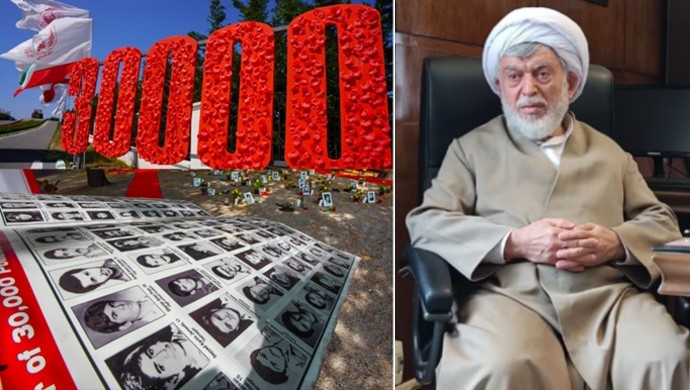

On the afternoon of Thursday, April 3, 2025, Gholamhossein Mohseni Eje’i, the head of the Iranian regime’s judiciary, announced in a statement the death of Hossein Ali Nayeri, a cleric and judge who headed Ruhollah Khomeini’s “Death Committee” responsible for the 1988 massacre of political prisoners.
In 1981, Nayeri was one of three Sharia judges appointed by Khomeini to persecute members of the People’s Mojahedin Organization of Iran (PMOI/MEK). Many young PMOI supporters, including high school and university students, were executed by firing squad under Nayeri’s orders. Nayeri was the first person named in Khomeini’s fatwa (religious decree) ordering the massacre of all steadfast PMOI members in 1988. Addressing Nayeri and other members of the Death Committee, Khomeini wrote: “Those who are in prisons across the country and remain steadfast in their support for the Monafeqin [hypocrites, the regime’s derogatory term for the PMOI], are Mohareb [waging war against God] and are condemned to execution… I hope that you will obtain the satisfaction of God Almighty with your revolutionary rage and hatred towards the enemies of Islam. The gentlemen who are charged with making judgements should not hesitate or show doubt or concern… try to be fierce against the unbelievers…”
Thirty-four years after the massacre, on July 10, 2022, Nayeri explained the main reason for the killings, stating: “That period had special conditions. The country’s situation was critical. Meaning, if it weren’t for the Imam’s [Khomeini’s] decisiveness, perhaps we wouldn’t have this security at all. Perhaps the situation would have been entirely different. Perhaps the system wouldn’t have survived at all. There were 50-60 assassinations happening daily in Tehran and other cities.” In his first public comment about the 1988 massacre, he said: “What should be done in such a critical situation? A decisive ruling must be issued. The one who runs the court and has matters in hand must resolve the issue. In these conditions, you can’t run the country with pleasantries!” (Islamic Revolution Document Center website, July 10, 2022).
During a meeting on August 15, 1988, between Ayatollah Hossein Ali Montazeri (Khomeini’s designated successor at the time) and the members of the Death Committee, Nayeri was the main person arguing with Montazeri. In response to Montazeri, who pleaded, “It is the month of Muharram, at least show shame before Imam Hussein in the month of Muharram,” Nayeri ruthlessly demanded the execution of 200 more PMOI prisoners as soon as possible within that same holy month.
Cleric Mohammad Moghiseh, an executioner involved in the massacre at Gohardasht Prison, described Khomeini’s insistence on the genocide of PMOI members after the Death Committee’s meeting with Montazeri, in a video clip released after his death. Moghiseh said: “After one day, we went to Jamaran [Khomeini’s residence], seven of us, sat on our knees. The Imam was sitting on the sofa wearing a skullcap and cloak. Mr. Nayeri explained what had happened, that we went to Qom and this happened and that happened, [Khomeini] said this issue concerns me directly. Don’t involve Qom or other places. Be careful that not a single one of these Monafeqin [PMOI members] escapes the divine decree.”
In the winter of 1988, satisfied with the cruelty shown by Nayeri and Ebrahim Raisi (who later became president and died in 2024) in the genocide of PMOI members, Khomeini issued three separate decrees appointing Nayeri and Raisi to handle pending cases and execute prisoners in various cities. In one of these decrees dated January 21, 1989, Khomeini effectively placed Nayeri and Raisi above the regime’s Supreme Judicial Council, addressing them: “All cases that, surprisingly, have remained dormant in that council until now, shall be placed at the disposal of Nayeri and Raisi, so that they may execute God’s command as soon as possible, for delay is not permissible.”
In the August 15, 1988, meeting between the Death Committee and Montazeri, Khomeini’s then-deputy, Montazeri called the members of the Death Committee, including Nayeri and Raisi, “the greatest criminals” whom “history will condemn.” Reading from his letters concerning the massacre of steadfast PMOI members, Montazeri stated: “The Mojahedin-e Khalq are not individuals… It is a thought… We should have countered this thought with thought; now, we didn’t have anyone who could speak with logic… This kind of massacre without trial, especially against prisoners and captives, will definitely benefit them in the long run, and the world will condemn us… The Mojahedin-e Khalq are not persons; they are a type of thinking and understanding, a form of logic… Killing does not solve it; rather, it promotes it.”