

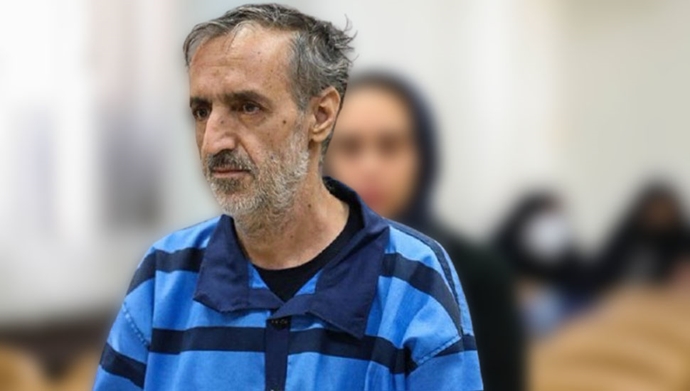

Besieged by relentless domestic and foreign crises, Iran’s regime is carrying out executions on a daily basis. Terrified of another nationwide uprising, the ruling mullahs are desperately utilizing the gallows to instill fear within a deeply restless society that is no longer afraid to confront the state’s apparatus of repression.
The focal point of this brutal campaign of state terror is the recent execution of courageous protesters who boldly stood up to the regime’s suppressive forces. Early on Wednesday, May 13, 2026, the regime hanged 55-year-old rebel Mohammad Abbasi in Ghezel Hesar Prison. Abbasi was arrested during the January uprising in Malard.
The judiciary accused Abbasi of participating in “riotous gatherings” and of involvement in the killing of State Security Force (SSF) Colonel Shahin Dehghan, a criminal figure who played an active role in suppressing the uprising.
The judiciary of the mullahs’ regime has announced the execution of the courageous protester Mohammad Abbasi, who was arrested during the January 2026 uprising in Malard, west of Tehran Province, Iran.
Once again, I underscore that these brutal daily executions reveal, above all… pic.twitter.com/gtlXtEDDK6
— Maryam Rajavi (@Maryam_Rajavi) May 13, 2026
The legal proceedings that led to Abbasi’s death were a sham. Following his arrest, he was subjected to brutal interrogations and torture in the solitary confinement cells of Evin Prison’s notorious Ward 209. Denied access to an independent lawyer, he was sentenced to death by Branch 15 of the Revolutionary Court in Tehran, presided over by the infamous “hanging judge” Abolqasem Salavati. The regime’s Supreme Court (Branch 39) swiftly upheld the sentence, completely ignoring his family’s appeal for a retrial.
In a staggering display of collective punishment, Abbasi’s daughter, Fatemeh, who was arrested alongside her father, has been sentenced to 25 years in prison and remains incarcerated in the women’s ward of Evin Prison.
Systematic repression of oppressed minorities
Abbasi’s execution is part of a systemic, nationwide crackdown that heavily targets ethnic minorities. On May 12, 2026, the regime executed Abduljalil Shahbakhsh, a Baluch political prisoner, in Zahedan Prison. He was accused of “rebellion through armed attack” on SSF centers and membership in the Ansar al-Furqan group.
At dawn today in Iran, the clerical regime committed yet another heinous crime by hanging Abdoljalil Shahbakhsh, a Baluch political prisoner, in Zahedan Prison.
I strongly condemn these inhumane crimes against our Baluch compatriots. The ruling religious fascism vainly believes… pic.twitter.com/X6f2g8OnsL
— Maryam Rajavi (@Maryam_Rajavi) May 12, 2026
The regime claimed Shahbakhsh was conducting reconnaissance to seek revenge during the 2022 uprising. This is inextricably linked to the Bloody Friday massacre of September 30, 2022, in Zahedan, where the Revolutionary Guards and suppressive forces murdered more than 115 Baluch compatriots. The extrajudicial killing of minorities also continues on the streets; on May 11, Ministry of Intelligence agents opened fire on a vehicle on the Pahreh-Sarbaz road, killing four Baluch compatriots.
A broader wave of state terror and fabricated charges
These political killings are embedded in a massive surge of executions across the country. Between May 3 and May 13, at least 20 executions were recorded, though the actual number is undoubtedly higher due to the regime’s secrecy.
To justify this killing spree, the judiciary routinely fabricates charges. On May 13, 33-year-old Ehsan Afreshteh was executed under bogus allegations of “espionage” for Israel. On May 11, 29-year-old Erfan Shakourzadeh was executed for allegedly cooperating with US and Israeli intelligence. The gallows are operating relentlessly nationwide, claiming lives in Birjand, Tabriz, Ardabil, Qazvin, Kermanshah, and Isfahan over the course of just a few days.
The responsibility of the international community
The silence of UN member states in the face of these atrocities is a blatant disregard for universal human rights. Mrs. Maryam Rajavi, President-elect of the National Council of Resistance of Iran (NCRI), strongly condemned these anti-human crimes, calling on the UN Secretary-General, Security Council, and High Commissioner for Human Rights to take immediate action to halt the executions.
She stressed that the leaders of this regime must face justice for 47 years of crimes against humanity and genocide. The Iranian Resistance also reiterates the urgent imperative for an international fact-finding mission to visit Iran’s prisons and meet with political prisoners.
Ultimately, these executions are a profound sign of the regime’s weakness, not its power. As Mrs. Rajavi noted, “Daily executions signify the regime’s fear of mounting public anger. But the storm of the uprising lies ahead, and the regime cannot escape its overthrow.” The ruling religious fascism is futilely trying to escape the flames of the people’s anger, but a restive Iranian society has proven it will not back down.