

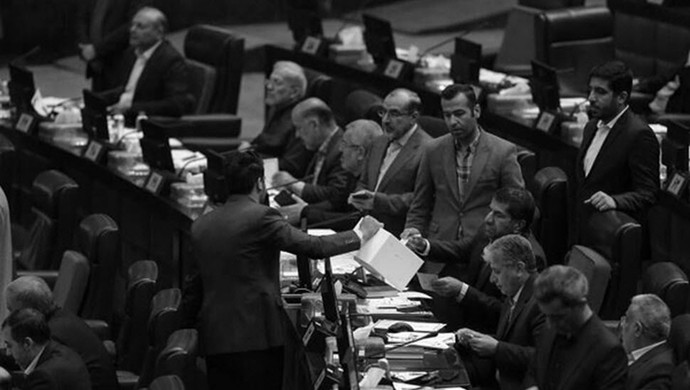

On Wednesday, October 2, the Iranian regime’s parliament once again witnessed protests by its members, who with chants and raised fists expressed gratitude to the Islamic Revolutionary Guard Corps (IRGC) for its recent missile attack. This scene was reminiscent of the parliament’s session on September 29, following the killing of Hezbollah leader Hassan Nasrallah, but with a different tone. The session on September 29 was marked by frustration and protest over the lack of action after the killing of Hamas leader Ismail Haniyeh and the escalation to Nasrallah. However, the protests in the October 2 session were marked by joy over the missile strike and a sense of unity.
However, when some members of parliament gave speeches during the same session, it became evident that beneath this thin veneer of unity, there was intense internal conflict. MP Ali Ashgar Nakhaei Rad launched severe attacks on regime president Massoud Pezeshkian for his remarks in New York, saying, “The president talks at the UN about our readiness to abandon weapons, and while he admits himself that he does not understand politics, he engages in impromptu interviews and speeches. His reckless and unorthodox remarks, which stem from weakness, hurt the hearts of the Iranian people. He clings to the same pleading diplomacy that has failed for eight bitter years, and as stated by the Supreme Leader, the government who carried out those policies should serve a lesson for future administrations. He seeks meetings with Western officials and tolerates insults from some second-tier Western politicians. Moreover, in response to a journalist’s question about readiness to negotiate with Iran, instead of a clear and unequivocal ‘No!’, he deferred to proving America’s brotherhood.”
Meanwhile, on October 3, in an article from the regime’s reformist faction, the government-run Shargh newspaper referenced a video of a “friendly” phone conversation between IRGC Commander Hossein Salami and Pezeshkian after the missile strike. The article described it as “an antidote to the toxic content spread over the past week,” which aimed to create a major rift between the government and the IRGC, and “even beyond that.” However, the same article reveals deep contradictions and divisions between parliament members and the IRGC, stating, “Those who claimed to be defenders of field commanders did not hold back from mocking and criticizing those very commanders. It got to the point where they claimed, ‘The military commanders don’t listen.'” The article goes on to mention that one member of parliament close to Saeed Jalili posted on X, “Who, by defying the Leader’s order and halting the operation to avenge the martyr Haniyeh, caused the assassination of Sayyid Hassan Nasrallah?”
On September 29, The government-run Entekhab news agency responded to this question, writing: “The president’s son replied to Amir Hossein Sabeti, a close advisor to Saeed Jalili, who had claimed that the president prevented Iran’s response to the assassination of Martyr Haniyeh. Sabeti had tweeted, ‘While I appreciate Mr. [Ali] Motahari’s good stance, I ask Mr. Motahari to specifically state who was deceived by America and, by defying the Leader’s order and halting the operation to avenge Martyr Haniyeh, caused the assassination of Sayyid Hassan Nasrallah? Why should 80 million Iranians and the resistance front pay for the naivety of a few?’”
Motahari posted on X, “Iran’s hesitation in responding to the assassination of Haniyeh in Tehran, while the world was waiting for Iran’s response, emboldened the Zionist regime to assassinate Hassan Nasrallah as well. We were deceived by America, which kept sending messages saying, ‘Don’t strike, we will establish a ceasefire next week.'”
Thus, in the deadly quagmire of war that now engulfs the warmongers, the feuds within the regime continues to rage after the missile strike.
Notably, during the October 2 parliamentary session, Nakhaei Rad reopened the issue of the appointment of former foreign minister Javad Zarif as Vice President for Strategic Affairs, declaring it “forbidden and null and void” based on the regime’s laws. He also reminded Pezeshkian of a regime statute stating, “The offender or offenders will be punished under Islamic penal law.”