

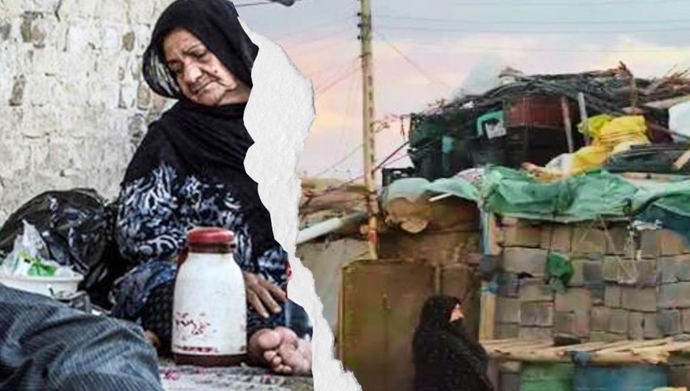

Where are the billions in Iran’s annual budgets being spent, providing no return or benefit in securing housing for most of the country’s people? Why don’t these vast and astronomical resources, derived from Iran’s mineral wealth and treasures, go to these people so they may have safe and stable shelter?
– On May 13, 2023, the state-run Entekhab news website quoted housing expert Ahmad Reza Sarhadi as saying, “Some people cannot even rent a house in lower-class areas of Tehran. Renting a 50-square-meter home in Naziabad now requires 1 billion rials down payment and a monthly rent of 100 million rials.”
– On July 29, 2023, Faraz website wrote, “It is rare to find anyone in Iranian cities who does not worry about housing. Thousands of families have put their household items in storage and are now homeless. According to the latest statistics, about 70 percent of each Iranian household’s income, on average, is spent on rent. Two years ago, the average price per square meter was 33 million rials, and now it has reached 78 million rials.”
– On November 8, Arman news website quoted deputy minister for rural development Abdulkarim Hosseinzadeh as saying, “20 million of our population live in slums. There are seven types of poverty and nine types of inequality that we face with all these issues.”
The reason for this situation is that there is no relationship between the reality of the lives of most Iranians and the policies of the regime. People’s lives are caught in the grinding wheels of high prices, homelessness, and marginalization, while the regime prioritizes speeding up executions to spreading fear.
A regime researcher, Hojat Mirzaei, published the “Shocking Report on the Poverty Rate in Iran.” This report clearly states the priorities of the clerical regime:
“Despite multi-trillion-rial budgets for dozens of religious institutions and seminaries, their output has been zero, if not negative! If we had used these massive religious budgets to eradicate poverty, we would have achieved better results. People see the cause of their poverty, misery, and hardship in our ideology, and they express their happiness at the death of each cleric, especially officials.”
Now, regime President Massoud Pezeshkian, whose promises are consistently met with negative social and media reactions, faces these harsh realities resulting from the regime’s systemic creation of poverty, inflation, homelessness, and marginalization.
On November 8, in a headline titled “Pezeshkian’s difficult mission for 20 million marginalized,” Arman news website quoting the deputy minister for rural development and the head of the Social Workers Association, reminded Pezeshkian of his unsupported promises as a pre-failed experiment:
“Inflation and the decrease in people’s economic power have led to widespread social consequences. One result is the rise in the number of people living in slums and the expansion of informal settlements. In the past three years, rent prices have increased so much that many people have been forced to move to the outskirts of big cities to continue living and working… Poverty is rampant almost everywhere in Iran.”
In addition to budget priorities and intensifying executions, the mullahs’ regime builds housing in other countries, while millions of Iranians are pushed to the margins due to a lack of housing.
Thus, the housing issue and the rise in marginalization in Iran are not economic at all but are entirely political issues between the people and the regime.
These examples, numbers, and figures have persisted from one administration to another, reaching no conclusion. When an economic network rooted in profiteering is under the regime Supreme Leader Ali Khamenei’s command—prioritizing proxies, warmongering, and regime preservation—Pezeshkian can only act as the regime’s whitewasher, merely retracing the steps of his predecessors.
This is the endless cycle of crisis within which the regime operates in search of a way out. These reports, with their figures and statistics, clearly indicate that a battle is underway between the victims of class disparity—such as the 20 million marginalized—and the mullahs’ regime.