

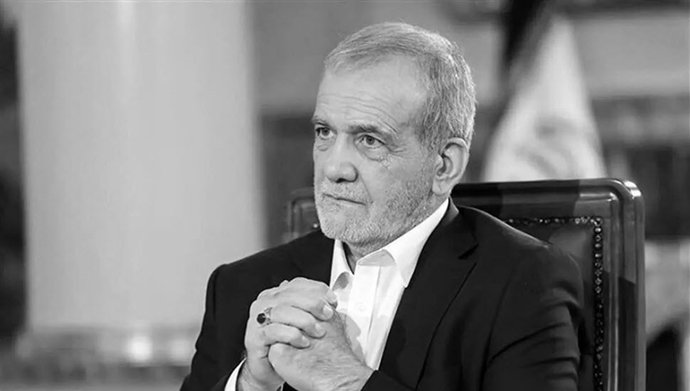

One hundred days have passed since Masoud Pezeshkian assumed office as the Iranian regime’s president. Globally, it is customary to assess the first 100 days of a new government, during which administrations generally present their 100-day report for public review. However, Pezeshkian’s government has not done so. It is clear that even if they had achieved a passing grade, it would have been closely scrutinized and amplified many times over.
The government-affiliated newspaper Jahan-e Sanat wrote on November 12, “The government and Masoud Pezeshkian have chosen, so far, to refrain from issuing an analytical statement on their record, as well as on what their successes and failures have been. Some political analysts say that this lack of an analytical report by Pezeshkian itself should be considered one of his failures.”
Another measure of the new government’s performance is the extent to which it has fulfilled its promises and adhered to its campaign plans and slogans.
Regarding his agenda, Pezeshkian made it clear from the outset, explicitly stating that he had no specific program and intended to continue along the path of his predecessor, Ebrahim Raisi. Although he portrayed himself in campaign speeches as opposed to internet censorship, corruption, and violence in society, even media outlets aligned with him now write, “Not the slightest move, or even word, indicating a softening or reduction of the heavy security atmosphere prevailing over the country, especially in major provinces, has been seen yet… Should the lack of any concrete steps or clear plans toward lifting the internet censorship, beyond vague promises and calls for patience, be taken as a sign of the President’s commitment to consensus?” (Shargh November 12).
In these 100 days, the exchange rate for the dollar, a clear indicator of economic conditions, rose from 580,000 rials to 700,000 rials, indicating a further 20% devaluation of the national currency. Bread, the staple or, in some cases, the only food for the poor, has become at least 40% more expensive. Prices of other food items, from dairy products to legumes, have also climbed, with the most severe increase seen in housing costs, which have risen between 25% and 75%, along with transportation, water, electricity, and gas costs. Pezeshkian’s superficial concern for people’s livelihoods, showcased during the regime’s elections, appears to have resulted in even more severe economic strain on the people.
A state-affiliated media outlet summarized Pezeshkian’s 100-day record in two words: “almost nothing.” However, this summary is not entirely accurate. The reality is that in every area—economic, political, social, and security—Pezeshkian has worsened the dire legacy he inherited from Raisi’s government. For example, in this 100-day period alone, the number of executions has exceeded 440, which is more than double the number of executions during the same period under Raisi, who had made a career out of executing dissidents and innocent people.
During this time, Pezeshkian has repeatedly supported the regime’s execution policies, openly disparaging those who have condemned them. Of course, no different behavior can be expected from someone fully loyal to the regime.
Two months ago, on September 17, Pezeshkian held a news conference in which he presented a picture of his administration, stating, “In this situation, whether in energy, gas, electricity, environment, or money, we are moving toward collapse. We are creating many imbalances, and we are drowning in them every day… If we don’t account for our resources and increase consumption, we will certainly face destruction one day.”
After these hundred days, this picture has undoubtedly darkened further.