

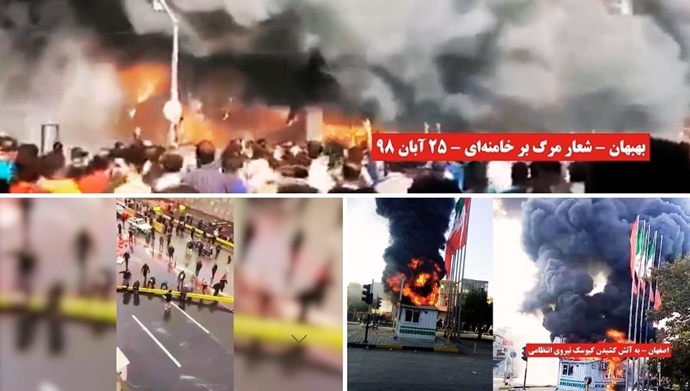

Iran’s November 2019 uprising, which is marking its fifth anniversary, has characteristics that set it apart from other nationwide uprisings. Beginning on November 15 and lasting for a week, this uprising sent shockwaves throughout the regime. The uprising began with the sudden state-imposed price hike on fuel and gasoline. The people of Iran, living under extreme poverty and fed up with decades of corruption and tyranny, poured into the streets to protest the regime’s destructive policies. The movement soon turned into a nationwide uprising.
As acknowledged by cleric Alireza Adyani, representative of regime supreme leader Ali Khamenei and head of the regime’s ideological and political security forces, the intensity and scope of the uprising extended to 165 cities across 25 provinces, generating “instability”—or rather, uprisings—at 900 points nationwide in just one day. The main centers of the uprising were Shahriar, Shahr-e Qods, Shiraz, Behbahan, Isfahan, and Tehran.
The explosive anger of the people
A defining aspect of this major uprising was the explosive anger of the people, fueling widespread fires aimed at destroying regime-affiliated institutions. Furious citizens and rebellious youths attacked and set fire to banks, gas stations, police stations, governorate offices, district offices, police kiosks, security vehicles and motorcycles, Basij and IRGC bases, large stores owned by the Revolutionary Guards, seminaries, Friday prayer leaders, ATMs, aid committee funds, and other regime facilities. Contrary to the regime’s demonizing propaganda, it is noteworthy that the protestors did not harm any places or belongings of ordinary citizens and their targets were regime buildings and assets.
Another characteristic of this uprising was its organized nature and the cooperation of the people and rebellious youth to overcome the regime’s brutal security forces.
Mojtaba Zonnour, the head of the Security Commission in the Majlis (parliament), said in a government television interview on November 24 that year:
“They threw 50 tear gas grenades at a Basij base to capture it. They had received training, with teams assigned specific tasks. Using special materials, they could crack walls or columns on impact, disabling or destroying structures. Teams were assigned to break locks; one team would complete its task, and the next team would proceed with the following steps.”
To quash an uprising that threatened the regime’s foundation, Khamenei ordered brutal force, resulting in his agents killing at least 1,500 people with bullets. They even shot at young people who sought refuge in the marshlands with heavy machine guns. Additionally, as reported by Michelle Bachelet, UN High Commissioner for Human Rights, at least 7,000 people were arrested in 28 provinces following the start of the protests.
Youth, the driving force of the November uprising
Young people and women played a significant role in the uprising. The book “Silent Fire,” published by an expert research institution named “Rahman,” concludes based on various reports and data that the majority of participants, as well as those arrested or killed in the November 2019 uprising, were underprivileged young people.
“The youth movement is where awareness and deprivation converge—youth are aware of the deprivation in society, they suffer from it, and seize every opportunity to express their dissent. In the November protests, these young people played a prominent role. It could be said that they were the driving force behind these protests” (Overview of the November 2019 Protests, Rahman Institute, June 2020).
Another key feature was the emergence of women as a powerful force for change, tapping into their historical potential. In many cities, the uprising progressed with the pioneering role, courage, and audacity of women. This role was so conspicuous in breaking through obstacles that the oppressive regime had no choice but to acknowledge the “leadership role of women.” This did not go unnoticed by even the IRGC’s own news agency:
“The prominent role of women in leading the recent unrest is noticeable. In several areas, especially around Tehran, women aged 30 to 35 seem to play a specific role in leading the protests. According to observations by Sobhe-No’s reporter, these women, dressed uniformly, each take on a distinct task—one films the protests, another blocks vehicles, and another encourages people to join the protests. Why women have become key players in the recent protests is itself a question worth asking” (Fars News Agency, November 20, 2019).
Yes, such a presence does raise questions. What is the answer?
A Resistance movement with a strategy
Iran’s democratic movement, fortified by an organized Resistance and a clear alternative to the mullahs’ regime, has kept the people’s struggle for freedom on the right path. Any event in Iran directed towards the regime’s overthrow will inevitably proceed along a path paved by this Resistance, with guiding lights marking the way. The November 2019 uprising stands as the clearest testament to this strategy.
On June 20, 1981, hundreds of thousands of PMOI supporters and members held protests across Iran, marking the beginning of the all-out resistance against the mullahs’ regime. In the decades since it was become clear that the only solution to bringing freedom in Iran is the path of the Resistance. The November 2019 uprising was the fruit of a 40-year-old tree, whose seeds were planted by the PMOI in 1981 and nourished with blood and suffering of more than 120,000 members and supporters of the organization who laid down their lives for freedom.
The legacy of the November uprising will persist until a democratic republic rises from the ruins of theocratic despotism.