


The Iranian regime is facing a “tsunami of internal crisis,” driven by a collapsing economy, widespread public discontent, and deepening social challenges that have turned the Iranian people’s daily lives into a struggle for survival, Maryam Rajavi, President-elect of the National Council of Resistance of Iran (NCRI), declared in her speech at the second day of the Free Iran 2025 Conference.
This is not a temporary downturn but a systemic failure engineered by a corrupt clerical dictatorship that prioritizes its nuclear ambitions and regional warmongering over the welfare of its people. This growing chasm between the rulers and the ruled was starkly illustrated by the popular boycott of the regime’s sham elections following the death of former regime president Ebrahim Raisi, where more than 90% of the population refused to participate, signaling a nationwide rejection of the ruling establishment.
The anatomy of a deliberate collapse
The severity of Iran’s economic crisis is rooted in the regime’s deliberate squandering of the nation’s wealth. While ordinary citizens suffer, the regime has wasted over $2 trillion on its nuclear weapons program, yet less than 2% of Iran’s electricity is generated by nuclear power. This gross mismanagement has catastrophic consequences. Iran, a country with the world’s second-largest natural gas reserves, now experiences daily blackouts and imports a significant portion of its gasoline.
As Mrs. Rajavi noted, this is a crisis of choice, not of scarcity. “Had the regime invested even just 10% of that amount [spent on the nuclear program] into building solar or gas power plants, the daily lives of millions of Iranians would not be plunged into such widespread hardship and chaos,” she stated.
The regime’s economic policies are a tool of plunder. “Runaway inflation has become a tool for looting the pockets of ordinary citizens,” Mrs. Rajavi explained. “Purchasing power has plummeted, the Iranian rial has become one of the world’s most worthless currencies, and investment across many sectors has all but dried up.” This has pushed major state-owned institutions, including banks and pension funds, to the brink of collapse, while the revenue from oil and petrochemical sales is devoured by the machinery of repression and war, leaving nothing for the impoverished people of Iran.
From economic hardship to widespread hostility
The regime’s policies have brought Iranian society to the brink of social upheaval. Job security has been destroyed, with over 95% of Iran’s 20-million-strong labor force now working in unstable, temporary jobs with no future. A quarter of the population has been forced into impoverished outskirts by homelessness and grinding poverty. Basic necessities like healthcare, education, and housing are now out of reach for vast segments of the population.
This economic devastation has been compounded by an environmental crisis, with severe water shortages placing a significant portion of the population under extreme duress. This is not a natural disaster but a political one, caused by the “systematic exploitation of water resources by the Revolutionary Guard Corps (IRGC), coupled with Khamenei’s anti-patriotic policies,” as Mrs. Rajavi said in her speech.
This combination of economic ruin and social deprivation has forged an unbridgeable divide between the people and the state. As Mrs. Rajavi observed, “The defining characteristic of Iranian society today can be summed up as a widespread hostility toward the regime. The majority of people, in their everyday conversations, position themselves in direct opposition to the ruling establishment, often referring to the dichotomy as ‘them’ versus ‘us.’”
The people’s verdict: daily protests and strikes
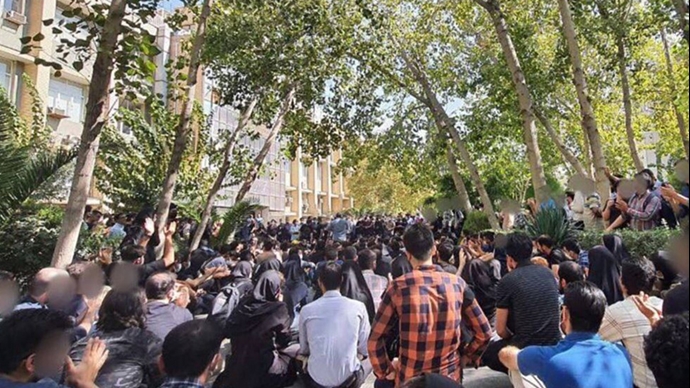
Despite a brutal wave of repression—including over 1,275 executions during Masoud Pezeshkian’s brief ten-month tenure—Iran’s cities continue to erupt daily with protests and strikes. From oil workers to farmers, teachers to retirees, the Iranian people are making their voices heard.
Recently, courageous truck drivers launched a nationwide strike across 152 cities, crying out against a system built on injustice. Hardworking bakers, crushed by rising costs and constant power outages, have also made it clear they will not remain silent. These protesters are not merely demanding economic relief; they are challenging the legitimacy of a regime that has plundered their nation. As Mrs. Rajavi declared, “Today, they are the voice of millions upon millions of hardworking people who have been plundered by this regime.”
These acts of defiance, coupled with the ongoing “No to Executions Tuesdays” campaign inside 46 prisons, show a nation that has lost its fear. The simmering rage of the people is a clear sign that the regime’s foundation is cracking. The day is fast approaching when this popular anger, led by an organized resistance, will bring an end to decades of tyranny. As Massoud Rajavi, the Leader of the Iranian Resistance, has said, the final goal is a “new democratic revolution.”