

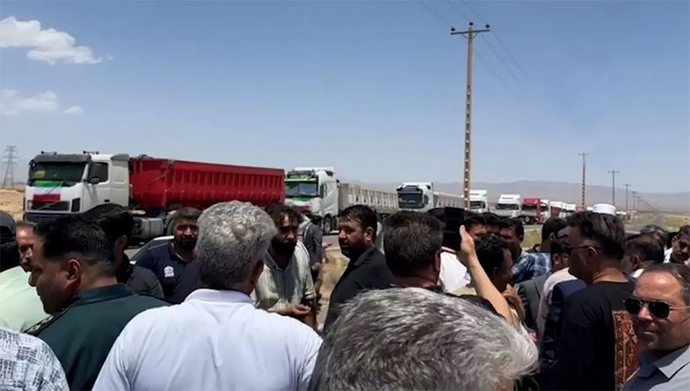

A powerful wave of nationwide protests, spearheaded by an unrelenting truck drivers’ strike, is sweeping across Iran, exposing the profound failures of the clerical regime and uniting disparate segments of society in a common struggle for their rights. As economic hardship bites deeper, fueled by decades of corruption and mismanagement, the Iranian people are demonstrating an unshakeable resolve, transforming individual grievances into a collective roar for fundamental change. This exploitation, which is the deepest wound of various strata of people in the most class-based period of Iran’s history, is driving the resistance.
The truck drivers’ strike: a defiant national movement
The nationwide strike by Iran’s truck drivers, a critical component of the nation’s economy, has become a potent symbol of this burgeoning resistance. Entering its eleventh day around May 31, 2025, the strike has demonstrated remarkable resilience, expanding its reach to at least 155 cities across all 31 provinces, with some reports indicating participation in as many as 163 cities.
From Isfahan and Kermanshah to Ahvaz and Sanandaj, drivers refused to operate their vehicles, transforming transport hubs into scenes of civil disobedience. This persistent action underscores the drivers’ determination in the face of a regime that has consistently ignored their severe economic pressures, including exorbitant insurance costs, the relentlessly rising prices of essential spare parts and fuel, and freight rate adjustments that fail to keep pace with rampant inflation.
The strike’s momentum has been further bolstered by expressions of solidarity from other transport workers. Taxi drivers in the cities of Sabzevar and Arak have joined the striking truck drivers. The Syndicate of Workers of the Vahed Company of Tehran and Suburbs Bus Company also issued a statement supporting the truck drivers’ strike and condemning the arrest and threats against them.
One striking driver in Sabzevar highlighted this growing unity, stating, “Now not only truck drivers but also tanker drivers and Nissan drivers have joined us. I ask other drivers, if they want professional and financial success for themselves and their friends, to join us, and I also ask other citizens to support the drivers in this path. To solve these crises, we must all help each other.”
In Tabriz, northwest Iran, civil activists organized a rally in support of truck drivers across the country.
A growing chorus: diverse sectors join the struggle
The truck drivers’ courageous stand is not an isolated phenomenon. It resonates deeply across a nation pushed to its limits, with various other sectors of Iranian society simultaneously voicing their grievances against the regime’s systemic failures. On May 31, 2025, workers from the Puya Nakh factory in Ilam, western Iran, held a protest rally outside the provincial governor’s office. Their demands were clear: the resumption of factory operations, payment of long overdue wages—with reports indicating some have not received wages for several months and have been unemployed for three months—and an end to threatened layoffs.
In Yazd, central Iran, parents of students gathered outside the Yazd governor’s office to protest a sudden and exorbitant 370-million-rial tuition hike at the Seyed Al-Shohada School. Meanwhile, in Lordegan, western Iran, residents protested the abrupt halt of a crucial water supply project, decrying the mismanagement of natural resources in a region ironically rich with water sources yet plagued by scarcity due to poor governance and neglect.
These diverse protests underscore a shared experience of hardship and a collective rejection of a regime that has overseen an economy made “sick and weak” by what even the state-affiliated Ham-Mihan newspaper on June 1, 2025, quoting Ahmad Zeidabadi, described as “incompetent governments and ruinous economic policies.”
Regime’s fear laid bare as unity strengthens resistance
The expanding protests and the remarkable unity displayed by different social strata have clearly alarmed the ruling establishment. The regime’s response has been a predictable mix of intimidation, arrests, and hollow promises—tactics that are increasingly failing to deter the defiant populace.
Authorities have arrested drivers in cities like Hamedan and Bijar, labeling them “security disruptors.” However, such acts of repression have only solidified the protesters’ resolve. The striking truck drivers declared in a recent enlightening and revealing statement, “The arrest of our colleagues has made our union stronger, and we demand the immediate and unconditional release of all arrested colleagues.”
This determination was echoed by the Union of Truck Drivers and Transporters of Iran, which powerfully stated, “These threats only prove that our voice has reached a point where it has shaken the foundations of injustice… We stand firm until our rightful demands are met.”
The regime’s profound anxiety is palpable. Khamenei’s representative and Friday prayer leader in Bojnourd, Reza Nouri, publicly lamented on May 30, 2025, “There is the issue of truck drivers, there is the issue of bakeries… Our enemies are lurking; they are looking to create chaos… a big chaos out of a small dispute.” This attempt to blame “external enemies” rather than address legitimate grievances reveals the regime’s deep-seated fear of popular uprising. The regime is terrified of the continuation and expansion of the strike and the unity of the drivers, understanding the far-reaching economic crisis and its immediate political consequences against the regime’s existence.
The regime knows it has stolen and plundered the assets of various strata and, caught in an economic crisis, has no real solutions to offer after eleven days of the truckers’ strike. Its history of extreme brutality, with striking protesters proving to the regime that more than 1,200 executions during the presidency of Masoud Pezeshkian and 170 executions in the month of Ordibehesht (April-May 2025) alone have failed to break the people’s resolve for their demands.
A unified cry for freedom and justice
The events unfolding across Iran, particularly the sustained and expanding truck drivers’ strike, are a powerful testament to the Iranian people’s escalating frustration and their courageous defiance in the face of a corrupt and repressive regime. The convergence of protests from diverse sectors—drivers, factory workers, parents, and ordinary citizens—underscores a unified rejection of the economic devastation and systemic exploitation that have become hallmarks of the clerical establishment. Protesters are increasingly clear that their struggle transcends mere professional demands, with chants such as “Death to the oppressor, be it Shah or Leader,” a clear denunciation of the entire ruling structure.
This collective outcry is not simply about economic hardship; it is a profound demand for fundamental change, justice, and the restoration of the people’s sovereignty. The regime’s inability to quell this growing dissent, despite its vast repressive apparatus, highlights its increasing isolation and the Iranian people’s unyielding determination to reclaim their rights and their nation’s future.
The unity of these striking groups and professional guilds is the most important factor in defeating the regime’s attempts to break the strikes, signaling a potent grassroots movement paving the path, as consistently articulated by the Iranian Resistance, towards a democratic and accountable government.