

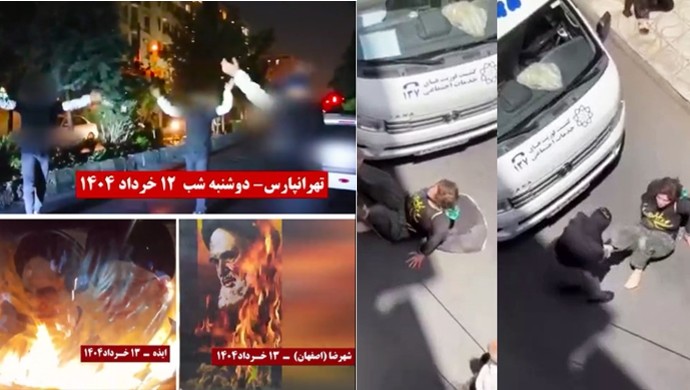

On the evening of June 2, 2025, as the clerical regime sought to enforce a climate of fear through suppression and executions, the streets of Tehran’s Tehransar district echoed with a different sound: defiance. In full view of an encouraging public, courageous PMOI Resistance Units chanted slogans demanding freedom for striking truck drivers and calling for the overthrow of the theocracy.
This bold act of protest, one of many recent operations by the organized Resistance, laid bare the regime’s failure to control the population through brute force alone. This happens as the regime is unveiling of a sweeping new architecture of repression. In a desperate and panicked move, officials announced two major initiatives designed to create a total surveillance state—a panopticon where every citizen is watched from the sky and monitored on their own street. These measures are not a sign of strength, but of a regime terrified by the growing connection between a volatile society and the vanguard of the Iranian Resistance.
The first pillar of this new repressive strategy is an Orwellian aerial surveillance program aimed at placing the entire capital under the watchful eye of the Islamic Revolutionary Guard Corps (IRGC). Tehran’s mayor, Alireza Zakani, a notoriously corrupt figure loyal to Khamenei, announced a formal agreement with the IRGC University to implement the plan.
According to regime officials, this project will use advanced technology, including satellites and drones launched from IRGC airfields, to conduct “permanent” surveillance over Tehran’s vast 5,980-kilometer perimeter, stretching from the Alborz mountains to the Qom highway. While Zakani attempted to justify this unprecedented level of monitoring by citing “security challenges and economic and social corruption,” its true purpose is clear. It is a high-tech tool designed to preemptively crush protests and monitor the movements of citizens, a direct admission that the regime has lost its ability to control dissent on the ground through conventional means.
To complement the high-tech surveillance from above, the regime is fortifying its control at the grassroots level through a sinister plan masked in deceptive language. Regime president Masoud Pezeshkian has championed a so-called “neighborhood-based management” model, cynically framing it as a way to provide “support” and “increase society’s resilience against threats.”
However, the core of this initiative reveals its true, repressive nature. Pezeshkian stated that all support measures would be consolidated “around the axis of the Basij,” the regime’s notorious plainclothes paramilitary force. The commanders of the IRGC and the Basij have eagerly announced their readiness to cooperate with the government on this plan, which includes the formation of 30,000 “neighborhood transformation councils.” This is a thinly veiled scheme to expand the state’s security apparatus into every community, creating a vast network of spies and enforcers. The objective is not “community support” but to create an atmosphere of paranoia and control, aimed squarely at containing the explosive anger of the populace.
These two initiatives—drones in the sky and Basij on the streets—are not isolated policies. They represent a coordinated, two-pronged strategy to construct a total surveillance state. This fortress, however, is not built on a foundation of strength, but on the shifting sands of fear and fragility. The regime is reacting to the unceasing operations of rebellious youth, which have relentlessly targeted centers of plunder and oppression, even during periods of high security.
These panicked measures reveal a regime cornered by internal and external crises, staring into the face of a volatile society. It is terrified of the sparks of courage shown by the Resistance, knowing they can ignite the flames of a devastating and crushing uprising. By building a panopticon, the Iranian regime is sending a clear message to the world: it is profoundly afraid of its own people and the organized Resistance that gives them voice and direction.