


The shocking news released by the Iranian regime’s Deputy Health Minister about the annual death of 10,000 workers due to work-related accidents, despite all the cover-ups and distorted statistics provided by regime officials, points to the silent tragedies afflicting Iranian workers under the mullahs’ rule. Statistics indicate that 96 percent of workers are employed under temporary contracts, without job security or insurance, and in high-risk conditions.
In the catastrophic explosion in Bandar Abbas, a major port city in southern Iran, regime sources, including Bahar News, reported that over 90 percent of the maritime company workers present at the docks during the explosion were either missing or turned to ash. The names of most of them were not registered anywhere, and many reportedly lacked birth certificates or identification cards.
In the Tabas mine explosion, caused by a methane gas leak in the mine located in the city of Tabas, eastern Iran, at least 52 workers were killed, and at least 20 others were injured. A report prepared for the regime’s parliament (Majlis) cited lack of adequate ventilation, unsuitable working conditions, absence of safety standards, and shortage of protective safety equipment as reasons for this disaster.
In the Yurt mine explosion in Golestan province, at least 44 miners were killed due to the absence of necessary and minimum safety requirements.
However, this is not the entirety of the painful story of the silent and organized killing of workers. Iranian workers are already condemned to a gradual death in the invisible oppressive court of the ruling mullahs. The declared wages for workers cover only one week of their living expenses, while vast profits go into the pockets of the ruling employers and plundering foundations affiliated with the Islamic Revolutionary Guard Corps (IRGC) and the office of regime supreme leader Ali Khamenei.
For example, last year, the net profit of 20 large enterprises affiliated with regime organizations reached 2,500 trillion rials. Meanwhile, workers with their minimum wage cannot even afford a single proper meal. According to the regime’s Bahar News, meat consumption among the working class does not even reach one kilogram per year (equivalent to about two and a half grams per day).
The regime’s Supreme Labor Council has set the base wage for workers for the Persian calendar year 1404 (March 2025 – March 2026) at 103.99 million rials, while the cost of a household living basket is estimated at over 350 million rials. This demonstrates the vast gap between workers’ income and living expenses. The financial and psychological pressure resulting from work accidents pushes workers’ families to the brink of collapse. The increasing instances of suicide among workers reflect the unbridled oppression by the ruling clerics.
The clerical regime has institutionalized and systematized the exploitation of workers and the funneling of their labor’s proceeds into the pockets of the IRGC and regime officials. The encroachment of the IRGC and security institutions on productive and industrial enterprises, especially in the oil, gas, steel, petrochemical, and mining industries, has subjected workers in these sectors to the most brutal exploitation and job insecurity. In the Supreme Labor Council, no one represents the workers. Representatives should be elected by the workers, but the government, through repression and creating an atmosphere of fear, has not allowed the formation of independent labor unions.
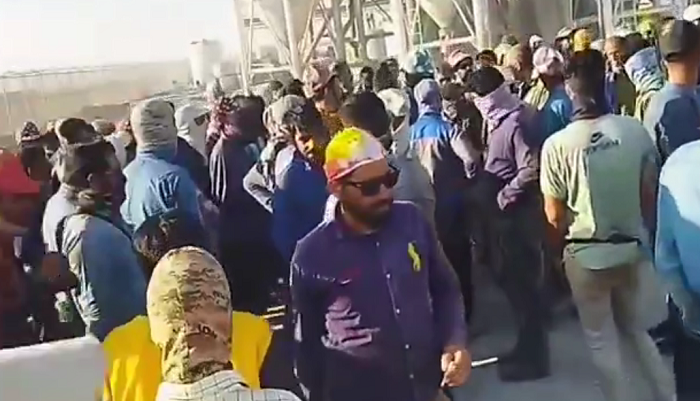
Workers have risen in opposition to these inequalities and injustices through their demonstrations and gatherings. In the Persian calendar year 1403 (March 2024 – March 2025), at least 918 labor gatherings and demonstrations took place.
After the scandal involving the IRGC and foundations affiliated with Khamenei, whose hoarding of dangerous explosive materials for missile purposes caused the horrific Bandar Abbas explosion, retirees and workers chanted on International Workers’ Day: “From mine to port, it’s a place for killing workers,” “The worker is awake, despises discrimination,” “We will not live under oppression, we sacrifice our lives for freedom”…
The 45-year experience of Iranian workers and laborers under the clerical dictatorship clearly shows that corruption, discrimination, plunder, and inequality in the anti-worker regime can only be extinguished by an uprising and fire engulfing the entirety of the oppressive rule of the mullahs.