

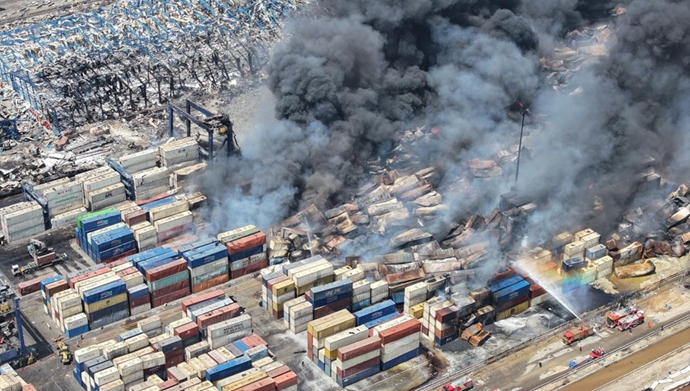

Thirty hours after the major explosion in Bandar Abbas, a major port city in southern Iran, and amid the regime’s cover-up of the situation, the true extent of casualties, damages, and the cause and circumstances of the disaster remain unclear. Reports indicate subsequent explosions, the spread of fire, and the shattering of building windows within a several-kilometer radius. By midday Sunday, regime sources reported over 1,200 injured and 36 dead. Subsequently, the governor of Hormozgan province announced that 40 people were killed in the catastrophe.
Hours after the explosion in Bandar Abbas, the Associated Press reported, “Private security firm Ambrey says the port received missile fuel chemical in March. It is part of a shipment of ammonium perchlorate from China by two vessels to Iran… The chemical used to make solid propellant for rockets was going to be used to replenish Iran’s missile stocks.” AP quoted Ambrey as saying, “The fire was reportedly the result of improper handling of a shipment of solid fuel intended for use in Iranian ballistic missiles.”
The Associated Press added: “It’s unclear why Iran wouldn’t have moved the chemicals from the port, particularly after the Beirut port blast in 2020. That explosion, caused by the ignition of hundreds of tons of highly explosive ammonium nitrate, killed more than 200 people and injured more than 6,000 others… Social media footage of the explosion on Saturday at Shahid Rajaei saw reddish-hued smoke rising from the fire just before the detonation. That suggests a chemical compound being involved in the blast, like in the Beirut explosion.”
Some reports from the Iranian regime’s media also point to the explosion involving oil and petrochemical products, which are controlled by the mafia of the Islamic Revolutionary Guard Corps (IRGC), clearly indicating the footprint of this terrorist organization in this avoidable disaster.
On April 27, the state-run Khabar Online quoted Hamid Hosseini, a member of the regime’s Chamber of Commerce, as saying, “This port is an export port for oil and petrochemical products and also an import port for oil products needed by Iran. Undoubtedly, the incident that occurred can affect the export of petrochemical products, oil products, and even steel.”
The lack of transparency and the sudden confirmations and denials by regime leaders further highlight the criminal role of the IRGC in this disaster. Reza Talaei-Nik, an IRGC brigadier general and spokesperson for the regime’s Ministry of Defense, fearing the consequences of exposing the role of the IRGC and police forces in handling and storing hazardous chemical materials and solid fuel needed for ballistic missiles at the port, said: “People should be assured that there were no imported or exported shipments for fuel or military use within the incident area or in the entire Shaheed Rajaee port” (Asr-e Iran, April 27). Ahmad Moradi, MP for Bandar Abbas, also rushed to the scene and denied that the explosion in Bandar Abbas was due to missile fuel, according to Khabar Online on April 27.
The Farhikhtegan newspaper, affiliated with Ali Akbar Velayati, an advisor to regime supreme leader Ali Khamenei, while acknowledging the lack of transparency and a “frank and comprehensive report” on the disaster, wrote: “Two main scenarios are conceivable for this incident. Either this explosion was the result of a sabotage act concurrent with negotiations, or it stemmed from flaws in internal processes and negligence in managing stockpiled goods. In either case, responsible authorities are expected to provide a professional, frank, and comprehensive report to the people.”
Eskandar Momeni, the regime’s Minister of Interior, also stated: “The cause of the explosion is under investigation, and violators will be dealt with decisively” (Mizan News Agency, April 27).
More than 24 hours later, explosions continue to rock Bandar Abbas as more containers detonate.The true death toll is several times higher than officially reported and certainly exceeds 100.
The IRGC, intelligence forces, and other organs of repression have mobilized—not to…— Maryam Rajavi (@Maryam_Rajavi) April 27, 2025
It is clear that the IRGC and the regime are mainly responsible for this disaster and its mishandling. While offering her condolences to the victims, Mrs. Maryam Rajavi, the president-elect of the National Council of Resistance of Iran (NCRI), said, “The IRGC, intelligence forces, and other organs of repression have mobilized—not to contain the fires or rescue the wounded—but to control the situation and cover up the shipment of solid fuel for ballistic missiles and the full scale of the disaster.”