

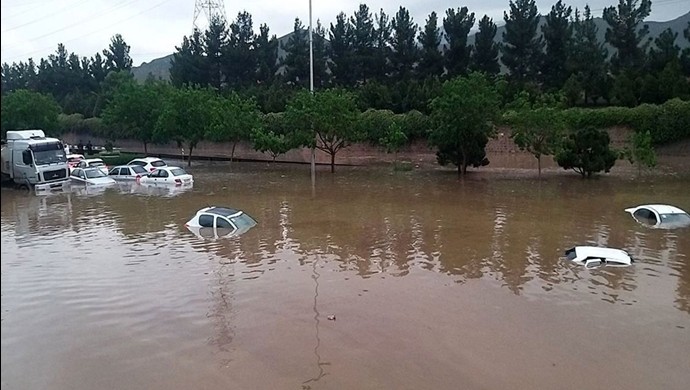

In the last week, a devastating flood swept through parts of Mashhad, claiming numerous lives, injuring many more, and leaving thousands of families destitute. The harrowing images of the flood dragging defenseless people and sweeping away dozens of cars, with passengers still inside, flooded social media from May 15 to 17. These scenes starkly highlighted the regime’s failure to implement any substantial infrastructural measures or provide adequate emergency assistance during natural disasters.
Amidst the catastrophe, what angered the public even more was the response from regime officials, who at times shamelessly denied the flood’s existence. For instance, the regime-affiliated website Entekhab quoted a statement from Mashhad’s municipal authorities, saying, “No, no, no! There is no flood; it’s just a minor waterlogging. It’s not as bad as it seems; only cardboard cars were washed away, not people’s iron cars! If you have any footage of these events, send it to us!” Did the municipal authorities believe people wouldn’t notice the severity of the floods? This outrageous denial further exacerbated public outrage.
In a similarly callous response, former IRGC commander and current Interior Minister Ahmad Vahidi commented on the victims of the Mashhad flood, saying, “Bury the three who have died for free; their burial and shrouding will be done for free!” This insensitive remark was met with widespread condemnation.
The regime’s denial and incompetence triggered factional infighting. A member of Mashhad’s city council seized the opportunity to blame the flood-related fatalities on unauthorized constructions and the construction of the southern beltway in Koohshad, conveniently ignoring the regime’s long-standing neglect of these issues. Similarly, Majid Dabirian, another city council member, stated that some of the missing were children whose schools had been closed.
As the regime’s official website Entekhab reported, many of the missing persons from the flood remain unaccounted for, and more floods are anticipated. On May 17, a meteorologist from the regime’s organization predicted the likelihood of further floods and agricultural destruction due to intensifying rainstorms. The meteorologist also warned of a relative drop in temperature and potential hail in the highland areas of the capital on May 17 and 18.
The ongoing disaster unfolds against the backdrop of systemic corruption and mismanagement by the regime. Recent revelations by Mohammad Hossein Azimi, Secretary-General of the Islamic Iran Front, have exposed deep-rooted corruption within the regime. Azimi highlighted the pervasive embezzlement and monopolistic practices by regime agents, particularly in relation to major companies and the manipulation of resources. His detailed exposé revealed deliberate price manipulation, circumvention of sanctions, and the embezzlement of billions of dollars.
The catastrophic floods in Mashhad and the regime’s handling of the crisis underscore the broader context of Iran’s pervasive corruption and mismanagement. The clerical regime’s inability to address natural disasters effectively, coupled with its systemic corruption, only fuels the determination of the Iranian people to seek change and establish a democratic republic. The devastating impact of the regime’s policies is evident in the suffering of unpaid workers, impoverished retirees, teachers, nurses, and the broader society, who continue to protest and express their readiness to overthrow the oppressive regime.