

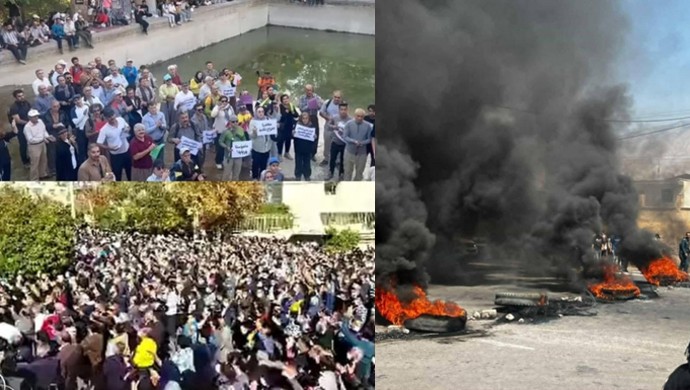

While Iran’s clerical regime attempts to project an image of unshakeable strength, its own statements and actions betray a deep and growing panic. A recent declaration by the Islamic Revolutionary Guard Corps (IRGC), intended as a show of force, inadvertently serves as a confession of its fear of a new, powerful “emerging threat”: the nation’s own enraged and defiant populace.
This fear is not unfounded. As protests flare across the country, fueled by a collapsing economy and a state that cannot provide even the most basic services, the regime is turning its security apparatus inward to face the people it claims to serve.
The streets erupt as society reaches its boiling point
State-affiliated media and experts are now openly warning that Iranian society is on the verge of a “social explosion.” This explosive potential is rooted in a devastating economic crisis. According to a regime expert, Masoud Nili, quoted by Khabaronline on August 28, over 10 million people were pushed below the poverty line in just two years. But recent protests show that the public’s demands have escalated far beyond economic grievances.
August 26—Shiraz, southern Iran
Students at the girls' dormitory of Shiraz University held nightly protests against constant water and electricity outages. "Water, electricity, life is our undeniable right," The students chant.#IranProtestspic.twitter.com/UuD2r9rvDJ— People's Mojahedin Organization of Iran (PMOI/MEK) (@Mojahedineng) August 26, 2025
In late August, the streets of Shiraz and Kazerun became flashpoints of resistance. Protesters in Shiraz chanted “Freedom, Freedom, Freedom” and “Iranians will die but will not accept humiliation,” demonstrating that their core demand is fundamental political change, not just a solution to power outages. In Kazerun, the cry of “Death to the dictator” echoed, leaving no doubt about the target of their anger. A state-run media outlet, Rouydad24, acknowledged this dangerous reality on August 20, writing, “The tolerance of the people has a limit… small and scattered dissatisfactions will sooner or later turn into a big social wave.”
The IRGC’s coded confession of internal threats
Faced with this growing wave of dissent, the IRGC has revealed its true priority. In a statement released on August 24, the IRGC declared that due to its “deep understanding of the complexities of the security environment and emerging threats,” it has prioritized enhancing its “defense and security capabilities.” This is the regime’s coded language for preparing to suppress a domestic uprising. The “complex security environment” is not a foreign border; it is the restive cities of Iran. The “emerging threats” are not an external army; they are the hungry and disenfranchised Iranian people.
This rhetoric is backed by concrete action. In response to the protests, the IRGC has been conducting extensive military maneuvers across Tehran since mid-August, bringing in reinforcements from other provinces out of sheer “fear of the eruption of public anger.” While the IRGC’s official statement speaks of a “deep bond between the government, the nation, and the armed forces,” its actions prove that its primary function is to terrorize and control that same nation.
A hollow narrative of propaganda versus reality
The regime’s propaganda machine works tirelessly to mask this grim reality. The IRGC’s statement audaciously claims that “underprivileged Iranians… have tasted the sweet taste” of its role in national development and dismisses all criticism as “psychological operations.” This narrative collapses when confronted with the reality described in the regime’s own media.
The outlet Rouydad24 writes of “small dinner tables” and families who, already crushed by inflation, must now endure scorching summer heat with no water, no electricity, and no internet. While the regime habitually blames international sanctions for these failures, its own experts are beginning to admit the truth. A communications expert, quoted by the ISNA news agency, confirmed that the infrastructural crisis is largely due to years of using worn-out equipment that cannot be replaced, a direct result of regime mismanagement and corruption, not just external pressure. The IRGC’s claims of bringing prosperity are a cruel insult to millions who suffer daily from its incompetence and plunder.
The IRGC’s panicked statement is a clear sign of weakness, not strength. The “emerging threat” it fears is the organized and unwavering will of the Iranian people. The chants for “Freedom” in Shiraz and Kazerun represent the true desire of a nation fed up with 46 years of tyranny, corruption, and repression.