

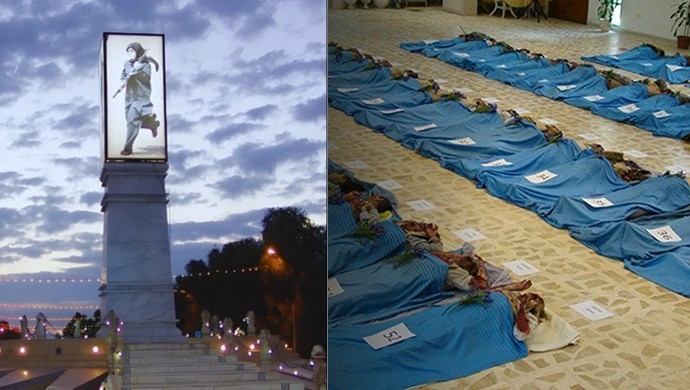

Today marks the 12th anniversary of the September 1, 2013, massacre at Camp Ashraf, a day of profound sorrow and enduring inspiration. On that day, the Iranian regime and its Iraqi proxies carried out a crime against humanity, murdering 52 unarmed members of the People’s Mojahedin Organization of Iran (PMOI/MEK) in a brutal attempt to destroy the Iranian Resistance.
This anniversary, falling just days before the 60th anniversary of the PMOI’s founding, serves as a powerful testament to two contrasting realities: the catastrophic failure of the international community to uphold its most basic obligations, and the incredible resilience of a resistance movement that refused to be broken. The regime believed it could end the story of Ashraf; instead, it turned its martyrs into legends whose legacy now fuels the struggle for freedom across Iran.
A crime foretold: The betrayal at Camp Ashraf
The massacre was not a spontaneous act of violence; it was a well-planned execution facilitated by global indifference. On September 1, 2013, Iraqi special forces under the direct command of then-Prime Minister Nouri al-Maliki stormed the camp. Acting in concert with the Iranian regime’s Quds Force commander, Qassem Soleimani, they systematically murdered 52 residents and abducted seven others, including six women. Al-Maliki, seeking to curry favor with Tehran to secure a third term in office, offered the residents of Ashraf as a sacrifice.
The victims were not combatants. They were officially designated as “Protected Persons” under the Fourth Geneva Convention and recognized as “persons of concern” by the United Nations High Commissioner for Refugees (UNHCR). Their safety was supposed to be guaranteed by explicit assurances from the United States and the United Nations. Yet, when the attack occurred, these international bodies abstained from any meaningful action. Despite undeniable evidence of the al-Maliki government’s direct involvement, the U.S. and UN allowed the perpetrators to investigate themselves. Predictably, twelve years later, not a single person has been held accountable, and the fate of the seven hostages remains unknown. This inaction was a green light for further persecution, creating a blueprint for impunity that has endangered Iranian dissidents ever since.
The regime’s “strategic victory”: A failed plot to annihilate the resistance
For the clerical regime in Iran, the Ashraf massacre was intended to be a final solution to the threat posed by its organized opposition. Top commanders of the Islamic Revolutionary Guard Corps (IRGC) immediately celebrated the slaughter. Six days after the attack, IRGC commander Hossein Salami appeared on state television to declare the massacre a “strategic victory” whose impact would be “far greater than the impact of Operation Mersad,” a reference to the “Operation Eternal Light” of the National Liberation Army (NLA) in 1988. This was a clear admission that the attack’s objective was the complete annihilation of the PMOI.
On the same day, the IRGC issued a statement, in which it described the terrorist attack as a “divine and revolutionary revenge” and said that the “inevitable fate of the PMOI is nothing but disgrace, displacement, and annihilation.”
The regime’s plan was to overwhelm the residents, kill them, and leave no trace, in a show of power and control. However, the unarmed PMOI members resisted with breathtaking courage, disrupting the plot. Enraged, the attackers resorted to point-blank executions, shooting residents in the temple. Some were murdered with their hands tied, while others were shot as they lay wounded on gurneys in the camp’s medical clinic. Supreme Leader Ali Khamenei believed that by eliminating the core of the resistance in Ashraf, he could secure his regime’s future. He was catastrophically wrong.
“A thousand Ashrafs”: How a massacre fueled a nationwide uprising
In the dark days following the massacre, Iranian Resistance leader Massoud Rajavi issued a historic message, vowing that the spirit of Ashraf would not be extinguished but would multiply into “a thousand Ashrafs.”
Twelve years later, that promise has been decisively fulfilled. The regime’s calculated act of terror backfired spectacularly. Instead of breaking the resistance, the sacrifice of the 52 martyrs became the seed for a new generation of activists inside Iran. The concept of “A Thousand Ashrafs” evolved from a defiant slogan into a nationwide network of Resistance Units. These brave men and women, inspired by the martyrs of Ashraf, are now the regime’s greatest nightmare. In the Persian year 1403 (March 2024–March 2025) alone, these units carried out more than 39,000 anti-regime activities across the country. The flag of the democratic alternative is now flying higher than ever, held aloft by thousands who carry the legacy of Ashraf in their hearts.
The massacre at Camp Ashraf will forever remain a dark chapter of the failure of the international community to stop a preventable crime against humanity. But for the Iranian people, its legacy is one of unwavering defiance. The 52 stars who fell that day did not die in vain. Their sacrifice ignited a movement that has proven to be as indestructible as the cause of freedom itself, demonstrating that a deeply rooted struggle for liberty can never be massacred into silence.