

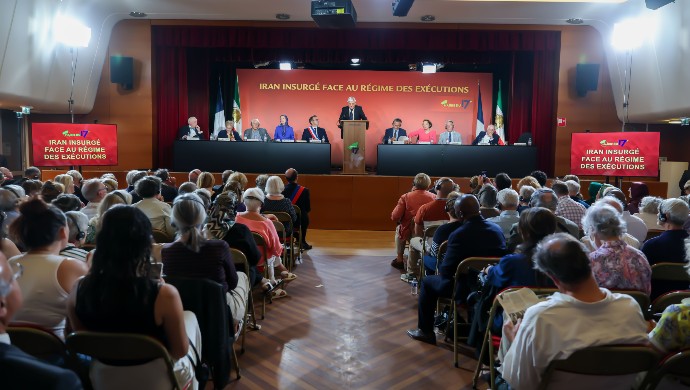

On August 26, 2025, the municipality of the 17th arrondissement of Paris hosted a significant conference titled “Iran’s Uprising in the Face of the Execution Regime.” The event brought together distinguished international figures, including politicians, jurists, and human rights advocates, alongside members of the Iranian diaspora. Hosted by Mayor Geoffroy Boulard, the conference featured a keynote address by Mrs. Maryam Rajavi, the president-elect of the National Council of Resistance of Iran (NCRI). Speakers condemned the Iranian regime’s escalating wave of executions and its systematic human rights abuses while voicing strong support for the Iranian people’s struggle for a democratic republic.
Maryam Rajavi: The solution is regime change by the Iranian people and their resistance
In her keynote address, Mrs. Maryam Rajavi painted a stark picture of the dire situation in Iran, beginning with the historical context of August 26, the anniversary of the 1789 French Declaration of the Rights of Man and of the Citizen. She questioned how modern governments could appease a regime that “violates every principle enshrined in that Declaration.” Mrs. Rajavi highlighted the recent executions of PMOI members Behrouz Ehsani and Mehdi Hassani and noted that at least 114 people were executed in July alone, with 1630 executions carried out during the first year of Masoud Pezeshkian’s presidency.
During the single year of Masoud Pezeshkian’s presidency—a man the regime paraded as a “moderate”—no fewer than 1630 executions were carried out.
Those who commit these crimes today are the very same individuals who carried out the mass killings of the 1980s, above all the… pic.twitter.com/RZRvqzWsEp— Maryam Rajavi (@Maryam_Rajavi) August 26, 2025
She identified two primary drivers for the regime’s “frenzied conduct”: fear of a popular uprising fueled by unbearable economic hardship, and the impunity enjoyed by officials responsible for past atrocities, particularly the 1988 massacre of 30,000 political prisoners. Mrs. Rajavi condemned the regime’s recent desecration of the graves of PMOI martyrs in Section 41 of Tehran’s Behesht-e Zahra Cemetery, calling it an attempt to “obliterate the evidence of genocide.” She emphasized that the West’s policy of appeasement has reached a dead end by ignoring the crucial factor of the Iranian people and their organized resistance.
Mrs. Rajavi reiterated the NCRI’s long-standing position, stating, “We have always insisted that the solution lies neither in foreign war nor in appeasement, but in the overthrow of the regime by the Iranian people and their resistance.” She outlined the Resistance’s vision for a future Iran based on the Universal Declaration of Human Rights, including the abolition of the death penalty, a ban on torture, full freedoms, and the establishment of an independent judiciary. Concluding on a note of resolve, she said, “What we seek—and what the people of Iran seek—is a society founded on human rights, freedom, democracy, and equality.”
A murderous machine of executions and impunity
A central theme of the conference was the international condemnation of the Iranian regime’s appalling human rights record, particularly its unparalleled use of the death penalty as a tool of political repression. Speakers detailed the shocking statistics and the systemic nature of the state-sponsored killing. Gilbert Mitterrand, President of France Libertés, stated that Iran “holds the grim record for the highest number of executions per capita,” with over 1,000 executions in 2024 and 650 in the first half of 2025.
Herta Däubler-Gmelin, Germany’s former Federal Minister of Justice, described the regime as a “murderous machine of execution,” demanding that its crimes “must be really loud and there must be consequences.” She stressed that the criminals responsible for the 1988 massacre have never been brought to justice and “belong” before a court.
#Breaking Iran News — Aug 26
Mrs. @Maryam_Rajavi addressed a major conference at Paris’s 17th District City Hall on Iran’s crisis.
Speakers included @geoffroyboulard, Gilbert Mitterrand, Jean-François Legaret, @MarkEllisIBA, Alain Vivien, @AttiasDominique, Wolfgang Schomburg,… pic.twitter.com/yttnp2Z7WS
— SIMAY AZADI TV (@en_simayazadi) August 26, 2025
Ambassador Joachim Rücker, former President of the UN Human Rights Council, observed a direct link between the regime’s weakening position abroad and its intensified repression at home. “We have seen a weakening of the external position; we see an increase in repression and terror inside,” he noted, calling the nearly 1,000 executions last year “absolutely terrible and must lead to yet another outcry from the international community.”
Erasing history and the warning of a new massacre
Several speakers raised alarms about the regime’s deliberate efforts to destroy evidence of past atrocities while simultaneously threatening to repeat them. Dominique Attias, former Vice-Dean of the Paris Bar, vehemently condemned the destruction of 9,500 graves at Behesht-e Zahra Cemetery to build a parking lot as “a total abjection” and a continuation of the regime’s crime against humanity.
Mark Ellis, Executive Director of the International Bar Association, framed these actions as a clear legal strategy. “These recent actions—the surge in executions and the demolition of mass graves—are two sides of the same legal coin,” he said. “Both are aimed at entrenching impunity.”
Even more chilling was the warning, echoed by multiple speakers, of the regime’s open incitement to repeat the 1988 massacre. Javaid Rehman, former UN Special Rapporteur on Iran, cited a July 7, 2025, editorial in the state-affiliated Fars News that praised the 1988 mass killings as a “successful historical experience” that should be repeated. He warned, “These state-sponsored statements constitute direct incitement to commit atrocity crimes.”
Sonja Biserko, a member of a past UN Commission of Inquiry, reinforced this point, stating, “This was not just revisionism. It was an open call for atrocity crimes, a warning that such horrors could happen again. We must take it seriously.”
International support for a democratic alternative
Amid the condemnation, there was powerful and unified support for the democratic alternative presented by Mrs. Rajavi and the NCRI. Mayor Geoffroy Boulard was unequivocal in his endorsement of Mrs. Rajavi’s Ten-Point Plan, which he said “represents a clear and democratic vision for the future in Iran.” He highlighted its core tenets: abolition of the death penalty, gender equality, separation of religion and state, and a non-nuclear Iran.
https://twitter.com/geoffroyboulard/status/1960692606918144307
Jacques Boutault, speaking for the Committee of French Mayors for a Democratic Iran, noted that 1,067 French mayors have signed a declaration affirming their solidarity with the Ten-Point Plan. He described the NCRI and its main component, the PMOI, as “the only legitimate alternative organization to the mullahs’ regime currently.”
This support was framed around the “Third Option,” which rejects both foreign military intervention and appeasement of the current regime. The speakers championed this path as the only viable solution, centered on empowering the Iranian people.
A clear rejection of all forms of dictatorship
The conference participants made a clear and repeated distinction: the struggle for a free Iran is a rejection of all forms of tyranny, past and present. The slogan “Neither Shah, nor mullahs” was a recurring message. Mayor Boulard stated his committee’s rejection of “the two dictatorships, that of the Shah and that of the mullahs.”
This sentiment was powerfully echoed in personal testimonies. Azadeh Alemi, an activist who was imprisoned as a child with her mother, spoke of a generation whose parents “faced two dictatorships—that of the monarchy and that of the mullahs.” Similarly, Niloufar Azimi recounted how her family suffered under both regimes, with one uncle killed by the Shah and a cousin killed by the mullahs’ agents.
Wolfgang Schomburg, a former judge at UN international criminal tribunals, dismissed the notion of a monarchist alternative, referring to the late Shah’s son as a “clown” whom the “Iranian people are intelligent enough to simply ignore.” He firmly endorsed the NCRI’s platform as the legitimate path forward.
The path forward: Resistance from within and accountability from without
The conference concluded with a unified call for action on two fronts: supporting the organized Resistance inside Iran and pursuing international legal accountability for the regime’s leaders. Azadeh Alemi called for strong support “for the courageous fight led by the Resistance Units on the ground, in the very heart of Iran.”
On the legal front, jurists outlined concrete steps to break the cycle of impunity. Mark Ellis announced that the International Bar Association would launch a program to highlight the regime’s atrocities and affirmed that cases based on universal jurisdiction are already being quietly investigated. Javaid Rehman called for the establishment of an “international accountability mechanism to investigate and prosecute crimes against humanity and genocide committed in Iran.” Both he and Ambassador Rücker urged the UN General Assembly to include specific references to the 1988 massacre in its annual resolution on Iran. The collective message was clear: the world failed to act in 1988, but it must not fail again.