

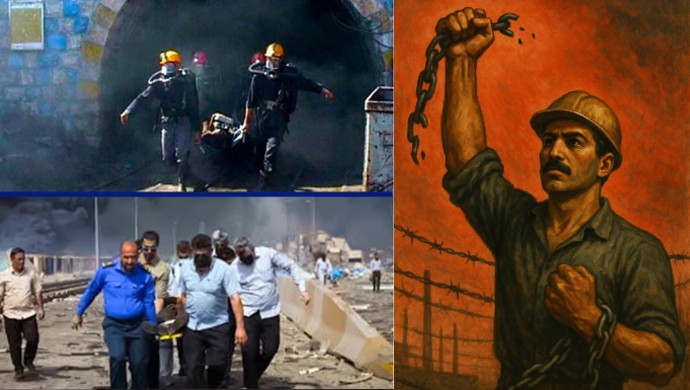

On the eve of International Workers’ Day, following a tragic incident in Bandar Abbas, Iran’s honorable protesting retirees expressed support and solidarity with the hardworking laborers, who are the primary victims of the clerical regime’s oppression and catastrophes. They chanted: “From the mine to the port, it’s a place for killing workers.”
The clarity of this oppression is such that after the Bandar Abbas port explosion, which left dozens dead and hundreds injured, the state-run Bahar newspaper wrote on April 27, “In all these incidents, which often become national crises and times of mourning, workers are unfortunately on the front line of victims. Whether during explosions, accidents, leaks, or during danger aversion and firefighting, it is always the workers who suffer the most harm.”
In the first 20 days of the Persian year 1404 (starting on March 20), three deadly accidents in mines located in Mahabad, Damghan, and Bajestan claimed the lives of several workers. In September 2024, over 50 workers were buried alive in the Madanjoo coal mine in Tabas. The Madanjoo mine is part of the Gol Gohar Mining and Industrial Holding Company, one of the largest mining and industrial firms in Iran and a subsidiary of Bank Sepah. This bank, in turn, belongs to the Foundation of the Oppressed (Bonyad Mostazafan), a powerful parastatal conglomerate controlled by regime Supreme Leader Ali Khamenei.
Following the Tabas coal mine disaster and the tragic deaths of over 50 miners, the head of the regime’s South Khorasan Provincial Labor Council stated: “We don’t have a single methane gas sensor. If we had one methane gas sensor, this incident wouldn’t have happened” (Chand Sanieh Telegram channel, September 24, 2024). However, the criminal employer, operating under the guise of the “Foundation of the Oppressed”—treating people like slaves and public resources, mines, and wealth as their personal inheritance—refused to provide even one methane gas sensor for the Madanjoo mine in Tabas.
These are just a few examples of the anti-human oppression faced by workers and laborers in Iran under the anti-labor regime of the mullahs. Workers are deprived of the most basic human rights, and their exploitation knows no bounds.
Hossein Rasouli, the executive secretary of the Workers’ House (a state-affiliated labor organization) in Khorasan Razavi province, comments on this, stating that the government, as the largest employer, shares common interests with private employers, and this alliance weakens the bargaining power of workers. Consequently, decisions made by the Supreme Labor Council—the body responsible for setting minimum wage—often favor employers at the expense of workers. This structural inequality is one reason why workers’ demands, including wage increases commensurate with the cost of living basket, are ignored.
While regime-affiliated media and experts estimate the necessary monthly living expense basket for a family at 350 million rials, the regime’s Minister of Labor recently announced the minimum wage for the Persian year 1404 (March 2025–March 2026) as 103.99 million rials. This means that, even in the best-case scenario where a worker has housing, this wage covers only about 10 days of living expenses. In other words, within this system, the worker effectively plays the role of a slave, and the ruling employer acts as a slave owner—a ruthless one who thinks of nothing but profit.
But the story of exploitation and overt slavery of workers does not end there. Workers under the mullahs’ regime lack any security even for the ten days their wages might cover. The plundering employer can dismiss them at any moment.
The head of the state-backed Workers’ Union stated in this regard: “More than 96 percent of the country’s workers are employed under temporary, short-term, and contract-based agreements in various workplaces. The absence of permanent contracts signifies instability and lack of job security, heightening the anxiety within the working community more than ever. This lack of job security, coupled with devastating inflation, has made the living conditions and livelihoods of working-class families more complex and critical” (Bahar newspaper, April 28, 2025).
On the occasion of International Workers’ Day, Mrs. Maryam Rajavi, the president-elect of the National Council of Resistance of Iran (NCRI), said, “The protests and strikes by workers across the year are sparks of a nationwide uprising in the making—an insurrection against the brutal ruler of Iran. Khamenei is the foremost exploiter and plunderer in Iran. He is the largest employer, the wealthiest capitalist, and the principal enemy of Iran’s working class.”
Message on #InternationalWorkersDay
The protests and strikes by workers across the year are sparks of a nationwide uprising in the making—an insurrection against the brutal ruler of Iran.
Khamenei is the foremost exploiter and plunderer in Iran. He is the largest employer, the… pic.twitter.com/ij995yT6Mq— Maryam Rajavi (@Maryam_Rajavi) April 30, 2025
The class divide between the ruling oppressive elite and the vast masses of the oppressed and deprived has pitted the Iranian people, workers, and laborers against the tyrannical regime. It is clear that Iran’s workers and laborers will only achieve their rights through uprising and the overthrow of the regime and by establishing a democratic republic.