

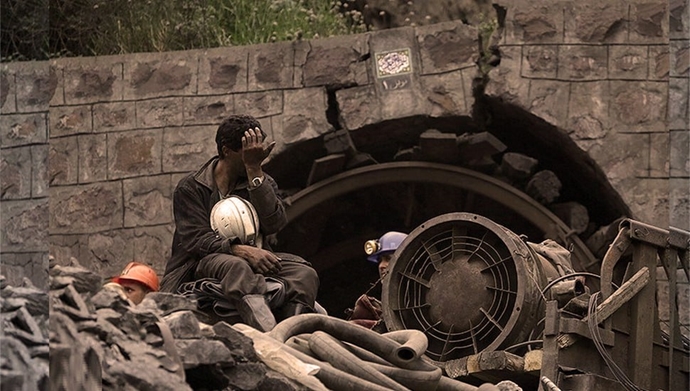

Forty days have passed since the tragic coal mine disaster in Tabas, in which 53 hardworking miners lost their lives deep underground.
Regarding the condition of the miners who survived this fatal incident, the government-affiliated newspaper Shargh wrote on October 31, “Forty days after the disaster that claimed the lives of 52 miners in the Tabas mine, the victims from Madanjo are now suffering from severe respiratory and lung pain. Young men who, due to constant headaches, cannot perform any work, not even simple driving; some still struggle with very low levels of consciousness and memory loss after 40 days.”
The condition of the victims’ families, who lost their breadwinners in the Tabas mine disaster, is clearly dire.
Under these circumstances, Mohammad Bagher Ghalibaf, the Speaker of Parliament, visited Tabas on the 40th day after the disaster. His remarks only deepened the pain of the bereaved and injured. Ghalibaf’s comments turned assurances of workers’ safety standards and job security into empty promises. He ambiguously stated: “I’m not saying we should close the mines so that our workers come and say ‘No, no! We’re willing to work in unsafe conditions, but don’t close the mine, we need work’… No mine should operate without economic benefit, but that doesn’t mean we close it!”
While these outrageous remarks reveal many truths, it is important to note that after the Tabas mine disaster, the mine officials, without facing any accountability or addressing the causes of the tragedy, forced workers back into the dangerous tunnels. When workers protested and went on strike, the mine was closed, and they were told to go and claim their pensions from workers’ insurance. In simple terms, they were given the choice between dying in the mine or dying from starvation. This was well understood since even if paid, the workers’ insurance was less than half of their wages—wages that were already less than a quarter of the poverty line. Thus, workers were compelled to return to the same deadly, dark, and toxic depths from which the crushed bodies of 53 of their brothers and loved ones had been retrieved just days earlier.
To grasp the deceit in the Speaker’s statements during the 40th-day commemoration, it is enough to remember that on October 22, in a parliamentary session, Ghalibaf admitted that the average death rate in coal mines worldwide is one per 10 million tons of extraction, while in Iran, it is 3.5 deaths per million tons—35 times the global average.
The Madanjo mine in Tabas is part of the economic holding “Madan and Sanati Gol Gohar,” one of the largest mining and industrial companies, which falls under Bank Sepah. This bank is owned by the Foundation of the Oppressed, overseen by Supreme Leader Ali Khamenei, and primarily comprised of members of the Revolutionary Guards (IRGC).
According to government sources, there are mines in the country with conditions “a hundred times worse and more dangerous than the Tabas mine.” Between 2017 and 2021, nearly 8,000 mining incidents were reported, highlighting the lack of oversight on mines and worker safety.
Indeed, under this regime, human life, especially the lives of the deprived and hardworking, holds no value; they are viewed solely as tools for producing “added value.” This inhumane treatment intensifies the anger of the oppressed and fuels the determination of the courageous people of Iran to rise up and overthrow the regime.