

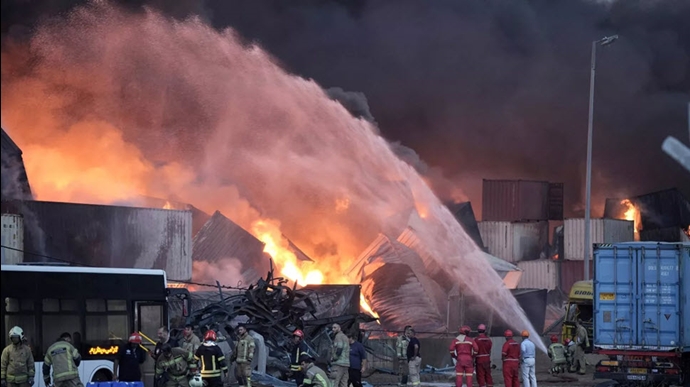

The deadly explosion in Bandar Abbas is another ominous consequence of the dominance of the Islamic Revolutionary Guards Corps (IRGC) over Iran’s ports. This consequence, along with a massive number of killed and injured, has dealt a devastating blow to Iran’s crisis-ridden economy. It’s a devastating blow that, above all, affects the lives and livelihoods of workers and deprived classes.
Rajaei Port, part of the Bandar Abbas port complex, which has always been a tool for the ruling mafia’s profiteering, has in recent decades become a base for transit and activities of the IRGC. An Associated Press report indicated that the explosion resulted from containers carrying solid fuel for ballistic missiles – a sign of the ruling regime’s actions, sacrificing the country’s vital infrastructure to advance its military programs.
Catastrophic explosions at Bandar Abbas Port have left devastation and chaos.
Casualties are rising by the hour as the regime hides the truth.
Eyewitnesses describe a "city turned into a mass grave."#BandarAbbasExplosion #FreeIran2025 pic.twitter.com/3jRry3UPdZ— SIMAY AZADI TV (@en_simayazadi) April 28, 2025
In describing the economic consequences of the April 25 explosion, experts and media outlets use phrases such as “The day the heart of Iran’s trade stopped beating” or an explosion that “pushed Iran’s economy to the brink of collapse.” Among other things, they write:
- Rajaei Port, which handled 85% of container traffic, 55% of total trade, and 70% of the country’s goods transit, has now been reduced to ashes, and the effects of this disaster will be irreparable for years.
- This port, covering 2,400 hectares with an annual capacity of 6.2 million TEU (container units), was Iran’s largest commercial port. With 40 active quays and connections to 80 international ports, it supplied a high percentage of essential goods imports such as wheat, rice, and medicine.
- Between 80 to 100 million tons of goods were handled annually at this port, with 60 to 70 percent allocated to regional transit. Now, the destruction of key infrastructure such as 18 gantry cranes, warehouses, and internal railway lines has completely halted commercial activities.
- The halt of 70% of essential goods imports has drastically reduced supply and increased transportation costs by up to 30% due to shifting cargo to smaller, less efficient ports. This means rampant inflation, with prices of essential goods like wheat and rice potentially increasing by up to 50%.
- Regarding transit and foreign trade, following the irreparable damage caused by the explosion at Rajaei Port, regional countries could absorb at least 40% of Iran’s regional transit, thus significantly reducing foreign currency revenues.
- The halt in oil exports from the Strait of Hormuz, 30% of which depended on Rajaei Port’s infrastructure, could reduce oil revenues by up to 20%. This means a larger budget deficit, a potential 15% devaluation of the rial in the coming months, and increased poverty for more than 60% of Iran’s population already living below the poverty line.
But the people of Iran are not standing idly by. The wicked clerical dictatorship – which has surpassed the corrupt royal dictatorship in destroying Iran – now faces the explosive anger, fury, and fiery resistance of a people who refuse to live under oppression and tyranny. They are determined to establish a free and prosperous Iran of tomorrow through a new democratic revolution.