


On November 7, 2026, Reza Pahlavi, the son of Iran’s deposed Shah, stood at a ceremony in Frankfurt as the designated trustee of a Freedom Prize presented to the Iranian people. Two days later, a very different Iranian was announced as the recipient of the prestigious Magnitsky Human Rights Award: Mohammad Javad Vafaei Sani, a political prisoner facing execution in Iran.
The contrast raises a fundamental question: Who truly embodies the Iranian people’s struggle for freedom?
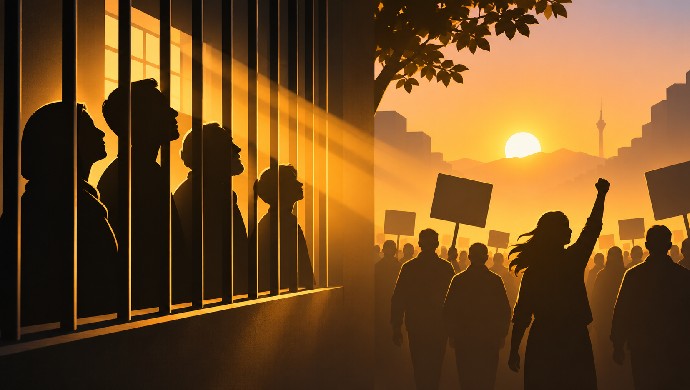
The answer is not found in royal titles or international ceremonies. It is found in Iran’s prisons, where political prisoners representing different generations and walks of life continue to challenge dictatorship at enormous personal cost. It is also found in the streets, where organized Resistance Units confront the regime despite the threat of imprisonment and death.
Mohammad Javad Vafaei Sani: A voice that the gallows cannot silence
A boxing champion and coach from Mashhad, Vafaei Sani has spent nearly seven years behind bars for his support of the People’s Mojahedin Organization of Iran (PMOI/MEK). Subjected to torture, solitary confinement, and repeated death sentences, he remains under the imminent threat of execution.
Yet his September 2026 message from Vakilabad Prison was not a plea for personal salvation. It was a declaration of responsibility toward his compatriots.
“But this is no reason for us to remain silent,” he wrote. “Under all circumstances, we have a duty to be the voice of our oppressed people.”
His determination earned international recognition through the Magnitsky Award. But his moral authority comes from something more fundamental: his willingness to sacrifice his own freedom and potentially his life to defend his convictions.
Arghavan Fallahi and Forough Taghipour: A generation rejecting both dictatorships
The resistance spans generations, including young women who have known nothing but the clerical regime yet refuse to accept a return to the monarchy.
Arghavan Fallahi, 25, was sentenced to death in July 2026 after months of solitary confinement and interrogation. Her fellow political prisoner Forough Taghipour has faced additional punishment for expressing her political convictions.
In September, the two women issued a joint statement from Evin Prison, declaring:
“We are Generation Z, against dictatorship and dependency, against the Shah and the mullahs.”
Their message also expressed a determination to continue resisting even under the threat of execution. They identified themselves with earlier generations of political prisoners and those executed for their convictions.
Their defiance challenges the assumption that opposition to the mullahs’ regime translates into support for restoring the monarchy. For these young women, freedom means breaking with both forms of dictatorship.
Parisa Kamali and Ali Moezzi: Different generations, the same struggle
The voices of resistance are not confined to one generation or social background.
Parisa Kamali Ardakani, serving an eight-and-a-half-year prison sentence in Yazd, has endured imprisonment and internal exile for her political activities and support for the PMOI.
In a message smuggled from prison in June 2026, she challenged the regime’s campaign of executions, declaring: “You execute in the hope of our end. You are gravely mistaken.”
“We are grains of wheat. One by one, we become a thousand,” she added.
Her words captured a conviction shared by generations of Iranian political prisoners: executions may claim individual lives, but they cannot extinguish the determination to achieve freedom.
Ali Moezzi represents an older generation. First imprisoned in 1981, he has endured decades of persecution, torture, and repeated arrests. In March 2026, he was again subjected to solitary confinement.
Yet in his September message from Ghezel Hesar Prison, Moezzi focused not on his suffering but on the necessity of organized resistance.
“Let us not allow others to write our destiny,” he urged.
For Moezzi, popular anger and organized resistance must come together to create political change. His words connect the prisoners’ struggle directly to the question of who should determine Iran’s future.
Vahid Bani Amerian and Shahrokh Daneshvarkar: The ultimate sacrifice for freedom
For some, the struggle for freedom has demanded the ultimate sacrifice.
On March 30, 2026, the Iranian regime executed Ali Akbar (Shahrokh) Daneshvarkar, a 59-year-old civil engineer. Five days later, it executed Vahid Bani Amerian, a 33-year-old political prisoner with a master’s degree in management. Both were members of the PMOI Resistance Units.
Months before his execution, Bani Amerian explained his convictions in a message smuggled from prison to his mother:
“I found the meaning of life in rebelling against oppression, in sacrificing myself for the ideals of freedom and justice.”
Facing execution, he also warned the regime: “Even if you execute me and people like me, we will multiply.”
Daneshvarkar’s life followed a different path. Having once participated in institutions associated with the clerical regime, he gradually rejected its ideology and repression. His final letters reflected a conscious commitment to freedom and an unequivocal rejection of both dictatorships.
“My commitment is a clear boundary with the anti-popular front, manifested in rejecting both the mullahs and the Shah, rejecting tyranny and exploitation,” he wrote from prison.
In another testament, Daneshvarkar declared: “I will give my life once again for the freedom of my people.”
Their different backgrounds and generations, and their shared willingness to sacrifice everything, embody a struggle that seeks not to replace one dictatorship with another, but to establish freedom.
Resistance Units: Turning the demand for freedom into action
The prisoners’ resistance is echoed beyond prison walls by PMOI Resistance Units operating across Iran.
On November 2, Resistance Units carried out 30 operations targeting regime institutions and symbols of repression, alongside dozens of other activities commemorating the November 2019 uprising.
On November 4, they conducted another 30 operations in response to the execution of two young protesters arrested during the January 2026 uprising.
And on November 10, Resistance Units in seven cities publicly supported the 146th week of the No to Executions Tuesdays campaign, demanding freedom for political prisoners and an end to executions.
These activities, undertaken under the threat of severe repression, demonstrate the persistence, geographic reach, and organizational capacity of the resistance inside Iran.
They also connect the prisoners’ demands for freedom with continuing action beyond the prison walls.
The operational dimension of Iran’s organized resistance was demonstrated most dramatically on February 23, 2026.
On that day, according to PMOI reports, 250 fighters affiliated with the National Liberation Army launched an assault on the heavily fortified Motahari Complex in Tehran, which housed Ali Khamenei’s headquarters and other senior state offices.
The operation illustrated the willingness of organized opposition fighters to challenge the regime’s security apparatus directly inside Iran.
It also challenged the notion that Iranians must await an external military force to confront their rulers.
Iran’s freedom will be decided by Iranians
This is the fundamental distinction between the organized resistance inside Iran and Reza Pahlavi’s appeals for foreign military intervention.
In February 2026, Pahlavi openly advocated American military intervention, arguing that attacks could accelerate the regime’s downfall.
The Iranian Resistance, by contrast, has consistently maintained that democratic change must come through the Iranian people and their organized resistance.
The political prisoners who reject both the Shah and the mullahs, and the Resistance Units challenging the regime across Iran, demonstrate that Iranians are not passive spectators awaiting liberation.
No foreign government, international prize, or royal inheritance can confer the right to determine Iran’s political future. That right belongs exclusively to the Iranian people.
And their demands for freedom are already being expressed through the courage of prisoners, the sacrifices of those executed, and the activities of a resistance determined to bring change from within.