

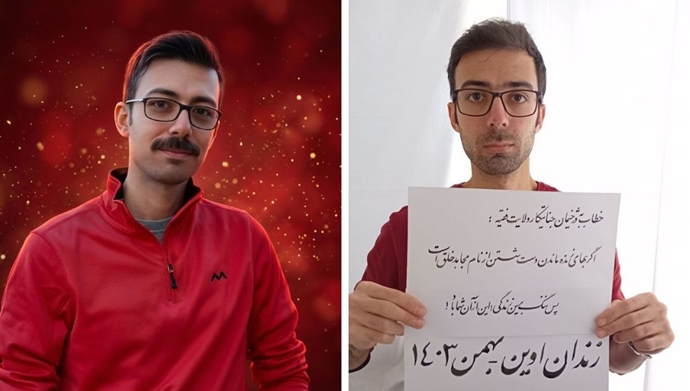

On April 4, 2026, the Iranian regime executed Vahid Bani Amerian, a 33-year-old political prisoner and member of the People’s Mojahedin Organization of Iran (PMOI/MEK). Months before his death, in September 2025, Vahid managed to send a clandestine audio message from Ghezel Hesar prison to his mother.
He recorded this poignant message shortly after the regime executed two other PMOI members, Behrouz Ehsani and Mehdi Hassani, acknowledging with profound clarity that he and his cellmates were also on death row. The letter serves as a powerful testament to the dedication of the more than 100,000 PMOI martyrs who knowingly abandoned the comforts of a normal life to fight for a democratic Iran. It reveals the deep empathy and unwavering resolve that fuels the Iranian Resistance—a force the clerical regime can never destroy.
Awakening to systemic injustice
Vahid’s path to the gallows began with a childhood awakening to the stark inequalities of Iranian society. In his message, he reminds his mother of a day he asked her to exchange a nice pair of shoes for simpler ones because he felt the “innocent and longing looks” of his impoverished classmates, Sharifi, Mohammadi, and Karami. He recounted how he would secretly hide good food in his school bag to bring to them, just to see “the spark in their eyes.”
As a bright student, Vahid could have easily chosen the “most honorable and prescribed form of life” available to him: going to university, getting a comfortable job, and starting a family. However, as he witnessed the deeper systemic crises ravaging Iran—homelessness, addicted youth, and the brutal suppression of women—he realized that individual acts of charity were not enough.
“Could I ease my conscience simply by sharing a piece of bread or wearing simpler shoes?” he asked. This quest led him to the PMOI, where he found activists whose approach to politics was not about seeking power, but about “honesty and sacrifice to eliminate oppression.” He described feeling an unbreakable bond with the 30,000 martyrs of the 1988 massacre buried in the unmarked graves of Khavaran.
The weaponization of love and the expansion of empathy
Throughout his imprisonment, Ministry of Intelligence interrogators attempted to weaponize Vahid’s deep love for his mother against him. They urged him to abandon his cause for her sake, engaging in psychological torture designed to break his spirit.
Vahid admitted to his mother that he was constantly at war with his own affections. “Many times in solitary confinement, away from the eyes of the executioners, I choked back tears thinking of you,” he confessed, recalling their final goodbye in Karaj.
#Iran News Alert, Simay Azadi Exclusive
Message in English by PMOI member Vahid Baniamerian (“Commander Vahid”), recorded in November 2025 from Ghezel Hesar Prison.
Supporting @Maryam_Rajavi’s Ten-Point Plan, he said: “It is time for the world to correct the failed and… https://t.co/9BFaFntZd6 pic.twitter.com/asbLik56oY
— SIMAY AZADI TV (@en_simayazadi) April 4, 2026
Yet, he explained how the heart of a freedom fighter transforms. “A revolutionary, a supporter of the Mojahedin, his emotions expand to encompass all destitute orphans, all mourning mothers, all suppressed women, and all hardworking laborers,” he declared. He assured his mother that anyone who has experienced the humane relations within the Resistance “can never go back to being the person they once were.”
A final pact and an unbreakable resolve
Staring down the gallows, Vahid’s courage remained absolute. Instead of mourning, he asked his mother to pray that he would remain loyal to his pact with the oppressed people, with the Iranian Resistance, and with God.
“Pray that I do not fear death, and if the price of this loyalty is my humble life, that I pay it eagerly,” he said. Vahid’s letter captures the indestructible spirit of a generation that has chosen to joyfully pay the ultimate price to ensure a free Iran, ending with a poem of defiance: “The claimant sought to pull us up by the roots, unaware that God is in our thoughts.”
Simay Azadi Exclusive | #Iran News Alert
PMOI member Vahid Baniamerian takes an oath as part of the MEK Resistance Units in 2018, vowing to fight the regime until the end—something he ultimately carried out.Baniamerian, 33, was executed on April 4, 2026, in Ghezel Hesar Prison… pic.twitter.com/Idrgr9wSuy
— SIMAY AZADI TV (@en_simayazadi) April 4, 2026
Full text of Vahid Bani Amerian’s audio message to his mother from Ghezel Hesar Prison (September 2025)
Hello, mother.
I am sending you this message in a situation where Behrouz [Ehsani] and Mehdi [Hassani] have been executed, and we are also on death row, waiting for whatever God wills. As Behrouz reminded us of the Quranic verse and wrote at the bottom of his indictment: “Every soul will taste death.” Sooner or later, every soul experiences death. Blessed are those who, as Imam Ali described in Sermon 64 of the Nahj al-Balagha, are ready for death as it casts its shadow upon them—like people who have been awakened by a loud cry, realizing that the world is not an eternal home, and exchanging it for the afterlife. God Almighty did not create you in vain and has not left you to your own devices; there is only the short distance of death between you and heaven or hell.
Yes, death is destined for all of us. In the Quran, we have learned to view the world as a testing ground, and death as merely a passageway to another world where we will be held accountable. From Imam Hussein, we have learned that “Life is but belief and struggle.” The true meaning of life is the conscious choice of an ideal and belief aligned with the monotheistic path of creation, followed by a glorious—though painful—struggle on that path.
Let me go back to my childhood, when the poverty of my classmates wounded my childish conscience. One day, I asked you to exchange the nice shoes Haji Baba had bought for me for a simpler pair, because I could feel the innocent, longing looks of Sharifi, Mohammadi, and Karami, with their torn shoes and worn-out clothes, staring at me. That pain bonded me to them. You accepted my request and bought me simpler shoes. From that moment, I knew I was doing the right thing. I knew I couldn’t only think of myself. After that, whenever we had good food, I would secretly wrap up a portion, hide it in my bag, and take it to them during the afternoon shift at school just to see the spark in their eyes. How fortunate I am to have been raised by a pure mother like you.
As I grew older and stepped into society, I saw even greater suffering, and I needed to understand its root causes. While my young soul was tormented by the pain of my oppressed fellow human beings, I was searching for the meaning of life. What could life be? Studying, going to university, getting a job, marrying, and perhaps doing some service for society? This was the most honorable and prescribed form of life available to me, especially as a student who did quite well in school. But what about the homeless sleeping in cardboard boxes, the street peddlers, the millions of families living below the poverty line? What about the hundreds of thousands of youth falling into addiction, the millions of perishing talents, and the discrimination and suppression of women? Could I ease my conscience simply by sharing a piece of bread or wearing simpler shoes, like I did in my childhood?
In response to the call of my conscience, I was drawn into the realm of politics. In this search, I met guiding stars whose pain was the same as mine, and whose approach to politics was not about seeking power or playing games, but about honesty and sacrifice to eliminate oppression. I re-read the unmarked graves of Khavaran—the story of your friend Masoumeh, of Mansour, and thirty thousand heroes like them. It felt as if I knew them, as if an unbreakable bond had formed between us.
All of this did not happen overnight; it took years. It took hundreds of lashes to my conscience to distance myself from my own selfishness and eventually join this turbulent, rocky path. A path full of anxiety, suffering, and separation, yet undeniably passionate and beautiful. Beautiful because you see your humanity freed from the captivity of oppressors; you become free, bonding with brothers and sisters who share your ideals.
Mom, the enemies, the murderers of the Iranian people, and the Ministry of Intelligence interrogators repeatedly tried to stimulate my emotions for you in the interrogation rooms to break me. They pretended to care, telling me to “give up for your mother’s sake.” To be honest, I was constantly at war with my affections for you. Many times in solitary confinement, away from the eyes of the executioners, I choked back tears thinking of you. When I said goodbye to you in Karaj, not knowing what lay ahead—I mean our last meeting—I wept for hours.
But for a revolutionary, a supporter of the Mojahedin, his emotions expand to encompass all destitute orphans, all mourning mothers, all suppressed women, and all hardworking laborers. Mom, I found the meaning of life in rebelling against oppression, in sacrificing myself for the ideals of freedom and justice. Someone who has known the Mojahedin and felt their humane relations can never go back to being the person they once were. Know that your steadfastness and patience on this path as a mother is a part of our struggle against tyranny.
Today, our death sentence is a great test for both you and me. God is watching us. I ask you to pray for me to remain loyal to the pact I have made with our oppressed people, with Massoud [Rajavi] and Maryam [Rajavi], and with my God. Pray that I do not fear death, and if the price of this loyalty is my humble life, that I pay it eagerly. Pray that my love for my family and all the brothers and sisters I now love just as much does not weaken my steps.
I pray for you, too. I pray that you remain firm, patient, and resilient, as you have always been. Think of the thousands of mothers who lost their sick children because they couldn’t afford medical treatment, and the thousands of mothers whose beloved children were martyred in the streets and prisons simply for demanding their rights. What greater honor is there than for you and me to pay the price of standing firm, to endure this pain, and to have made an impact on the blessed destiny of our people?
The claimant sought to pull us up by the roots,
Unaware that God is in our thoughts.