

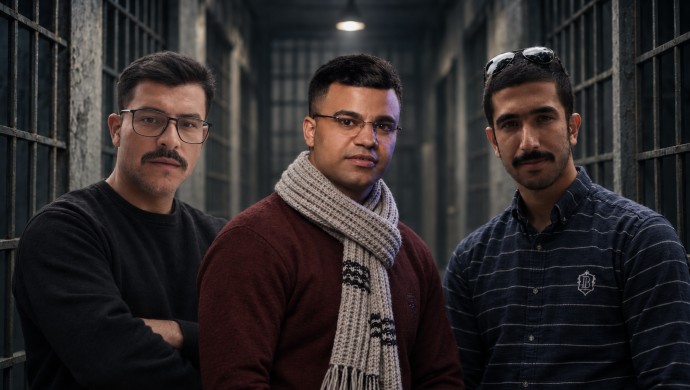

On September 4, three more political prisoners sent messages marking the 61st anniversary of the founding of the People’s Mojahedin Organization of Iran (PMOI/MEK): Mohammad Javad Vafaei Sani from Vakilabad Prison in Mashhad, Meysam Dehbanzadeh from Ghezel Hesar Prison, and Mohammad Hassani from Karaj Central Prison.
Their messages come as part of a growing wave of anniversary statements from inside Iran’s prisons.
The latest letters take different forms, but carry the same theme. Mohammad Javad Vafaei Sani writes that the PMOI has become a forest that “no winter and no axe” can destroy. Dehbanzadeh turns 61 years of struggle into a chain of historical salutations asking, “Can the sun be killed?” Hassani reaches back to the Persian legend of Zahhak and Kaveh to describe dictatorship changing form while resistance multiplies.
Together, the messages convey a central point on the PMOI’s 61st anniversary: even imprisonment, torture, prolonged sentences and the threat of execution have failed to suppress the spirit of resistance inside the regime’s own prisons.
Mohammad Javad Vafaei Sani: “We have become a forest”
For Mohammad Javad Vafaei Sani, the anniversary message comes with the threat of execution hanging over him.
The boxing champion and coach has been imprisoned since 2020 and subjected to severe physical and psychological torture. After two earlier death sentences were overturned, he was sentenced to death for a third time in September 2024. On October 4, 2025, the Supreme Court upheld that sentence. In December, his retrial request was rejected and his case was forwarded to the department responsible for implementing sentences in Mashhad.
Yet Vafaei Sani begins his September message not with his own fate but with those struggling for freedom outside prison. “The fact that our conditions in prison are difficult, like those of all the people of this land, is no reason for us to remain silent,” he writes. “We have a duty under all circumstances to be the voice of our oppressed people.”
His most striking image is that of a tree planted by PMOI founder Mohammad Hanifnejad and his comrades more than six decades ago.
“This tree has taken root, and we have become a forest that no winter and no axe can destroy or silence,” he writes. “Every time they cut off our heads, we grew again and again and multiplied.”
The metaphor is especially powerful coming from a prisoner whose own sentence has reached the execution stage. Vafaei Sani looks beyond his own survival, writing that “whether we are there or not,” the Iranian people will ultimately celebrate the fruits of these sacrifices in freedom. Those who were sent to the gallows, he writes, became stars that will remain in the hearts of the people.
Meysam Dehbanzadeh: “Can the sun be killed?”
Meysam Dehbanzadeh’s message takes the form of a sweeping salute to 61 years of PMOI history.
From what he calls the “killing ground of Ghezel Hesar,” he invokes the organization’s founders, the first martyr Ahmad Rezai, the overthrow of the Shah regime, the June 20, 1981 uprising, the resistance led by Ashraf Rajavi and Mousa Khiabani, the 1988 massacre, the years of resistance in Camps Ashraf and Liberty, and the Resistance Units of today.
His description of the PMOI founders captures the central theme: they were “lives that were not an end, but the beginning of a flood.”
At another historical turning point, Dehbanzadeh salutes those who walked “through hot lead” to ask:
“Can the sun be killed?”
His own history gives those words additional meaning.
During the regime’s October 15, 2022 assault on Evin Prison, Dehbanzadeh was shot and seriously wounded. He was transferred to Gohardasht Prison four days later without receiving treatment and was subsequently taken back to Evin for interrogation under the pretext of receiving hospital care.
The authorities then accused prisoners, including Dehbanzadeh, in connection with the very Evin fire during which security forces had attacked them. In November 2024, Dehbanzadeh received an additional eight years and eight months in prison and 148 lashes, bringing his reported total sentence to 17 years and four months plus 148 lashes.
His anniversary message contains no appeal for sympathy. Instead, it situates those years of imprisonment inside a historical continuum and ends: “Salute to the organization of love, salute to freedom, salute to steadfastness.”
Mohammad Hassani: “But Kaveh became thousands”
Mohammad Hassani expresses the same message through poetry and one of Iran’s oldest political myths: the story of Zahhak and Kaveh the Blacksmith.
In the Shahnameh, Zahhak is the tyrant whose serpents consume the brains of the young, while Kaveh becomes the symbol of popular revolt against him. Hassani uses that imagery to link dictatorship under the Shah and the clerical regime.
In his poem, one form of tyranny hides behind the grandeur of ancient kings, while another cloaks itself in religion. The critical transition comes in one terse image:
“The turban became that crown.”
But the transformation of dictatorship fails to extinguish its adversary:
“But Kaveh became thousands.”
The poem then imagines Iran itself being transformed by sacrifice: “The plain of Iran has filled with the springtime of cypresses.”
Hassani has been imprisoned since his arrest in January 2020. A master’s student, he was initially sentenced to three years. After he refused to cooperate with the Ministry of Intelligence, his case was reopened and his sentence increased to 12 years in prison and internal exile.
He has nevertheless continued to speak from prison. During the February 2026 student protests, Hassani sent another message supporting organized resistance and rejecting both monarchical and clerical dictatorship.
His anniversary poem ends in the opposite imagery of the dungeon from which it was written: winter becomes spring and darkness gives way to light.
Taken together with the messages from Vakilabad, Ghezel Hesar, Evin and Yazd over the past several days, Hassani’s poem underscores the broader meaning of these anniversary statements. The regime has been able to imprison individuals, extend their sentences, torture them, threaten them with execution and target their families. But even in the darkest corners of its dungeons, it has not been able to extinguish the spirit of resistance.
Full messages from political prisoners on the PMOI’s 61st anniversary
Mohammad Javad Vafaei Sani — Vakilabad Prison, Mashhad
September 2026
Greetings.
Greetings and congratulations on the anniversary of the founding of the proud People’s Mojahedin Organization of Iran to all fighters and Mojahedin, and also to the heroic people of Iran, who cry out for freedom with their entire being and pay its price with their lives and everything they have.
In these difficult days that this bloodthirsty and inhuman regime has created for the people of Iran and the region, naturally our conditions in prison, like those of all the people of this land, are hard and difficult. But this is no reason for us to remain silent. Under all circumstances, we have a duty to be the voice of our oppressed people and to cry out their pain and suffering.
I often think that if Hanif [Mohammad Hanifnejad] and his comrades had not founded this organization and watered its roots with their blood, what would the people of Iran have today?
I thank God that I too sprouted on the green branches of this tree and was granted the blessing of awareness and the choice of this ever-green path. Today, more than sixty years after this growth began, this tree has taken root and we have become a forest that no winter and no axe can destroy or silence. Every time they cut off our heads, we grew again and again and multiplied.
And God willing, in the near future, whether we are there or not, the honorable people of Iran will celebrate in freedom the fruits of the struggles, resistance, honesty and sacrifice of this blessed tree. We call the stars, the moon and the sun as witnesses: when our comrades were taken to the gallows, they saw how they roared, and they know that they too were stars who went to the heavens before us. On that day, they will shine alongside the Iranian people and within their hearts, and they will sing the song of joy.
Over these years, we have passed through many trials together. We blossomed with Maryam Rajavi and Massoud Rajavi’s leadership we drew the maps of our path. God willing, future generations will appreciate the result of this path and will bring it to fruition better than we and those before us did.
Now that we have come to the heights,
Wash me with the wine of the waves.
Do not let me go again;
Do not separate me from these stars.
Seyed Mohammad Javad Vafaei Sani
September 2026
Vakilabad Prison, Mashhad
Meysam Dehbanzadeh — Ghezel Hesar Prison
Message from the killing ground of Ghezel Hesar — September 2026
Salute to the day when love, from the dark heart of a harsh winter, sent a truth called freedom flowing through the veins of history.
Salute to Ahmad Rezai, your first blood and your first flame.
Salute to Hanif, Saeid and Badizadegan—lives that were not an end, but the beginning of a flood that passed through blood and faith and heralded the coming of tomorrow.
Salute to the crown-toppling February and the collapse of the old wall of monarchs with the cry of freedom.
Salute to your June 20, 1981, which exposed the face of the anti-human charlatan [Khomeini].
Salute to the fiery September 27, 1981, and to the footsteps that passed through hot lead to declare: “Can the sun be killed?”
Salute to Ashraf [Rajavi] and Mousa [Khiabani], to your bloody dawn of February 8, 1982, which remained in memory and song.
Salute to that profound transformation in the revolution of emancipation, born with Maryam Rajavi, creating different human beings to break the hidden chains.
Salute to an army of heroic women and lionhearted men, like steel and fire, who turned the pages of the history of human freedom with women at the forefront.
Salute to [NLA operations] Aftab, Chelcheragh and Forough (Eternal Light); to the assaults of the ever-vigilant lion that forced the bloodthirsty hyena to drink from the chalice of poison.
Salute to the most living lovers without gravestones of 1988, “in an unaware world.”
Salute to “your tall and iron wall confronting the enemy’s puny stature.”
Salute to the butterflies bearing the color of your fire during the coup of colonialism and reaction [on June 17, 2003].
Salute to fourteen years of steadfastness by lions without shields, armed with the ideal of Massoud and Maryam, who challenged the storms to come at them [in Camps Ashraf and Liberty].
Salute to your migrations along the path of Tawhid toward freedom.
Salute to the red pulse of every uprising, to your rebellious panthers and your fiery hammer.
Salute to Behrouz [Ehsani] and Mehdi [Hassani], to Vahid [Bani Amerian] and his comrades.
Salute to the bright horizon of Iran’s sky, which is moving toward shining the radiant sun of the Resistance upon the most beautiful homeland.
Salute to the Organization of Love. Salute to freedom. Salute to steadfastness. Salute to Rajavi. Salute to liberation. Salute to the blessed founding of the People’s Mojahedin Organization of Iran.
Meysam Dehbanzadeh
September 1, 2026
Mohammad Hassani — Karaj Central Prison
A poem for September 6, 2026
The following is a literary rendering intended to preserve Hassani’s political allegory, imagery and contrast between the Shah and the clerical regime rather than force every line into a mechanically literal English translation.
In the drunken secrecy of night, Zahhak arose,
Thirsty dragons set upon the pure,
Their two fangs drinking the minds and brains of spring’s young shoots.
His shame and disgrace hidden beneath a fashioned mask:
One immersed in boasts of mighty ancestors,
The other cloaked in religion, making a mockery of God.
His army: servile, flattering mullahs.
His justice: the whistle of bullets at Chitgar.
His palace of justice: Qasr, the dwelling place of the pure.
Kaveh sits among his comrades.
Hanif kindles the flame of awareness and anger.
Badizadegan gives voice to the people’s cry;
Mohsen inscribes it upon the black wall.
Kaveh is now the candle of the gathering,
A sea of stars surrounding him.
And this sea spoke:
They drag from above our city
The days, the moon and the stars beneath the earth.
Alas, a sky filled with stars—
Our soil drenched in light.
Zahhak became dejected and weak.
His serpent—the mullah—
Set its sights on his brain.
Then Zahhak’s coin turned over:
The turban became that crown and its voice.
But Kaveh became thousands.
Zahhak’s fangs grew thirstier;
Our soil became more deeply watered.
The plain of Iran filled with the springtime of cypresses.
The hammers of Kaveh strike his head;
Freedom’s blade will cut through the throat of his disgrace.
At our dawns,
Love and light rain down.
In winter, spring.
Light rains, and light.
On the occasion of September 6, 2026
Political prisoner and PMOI supporter Mohammad Hassani
Karaj Central Prison