

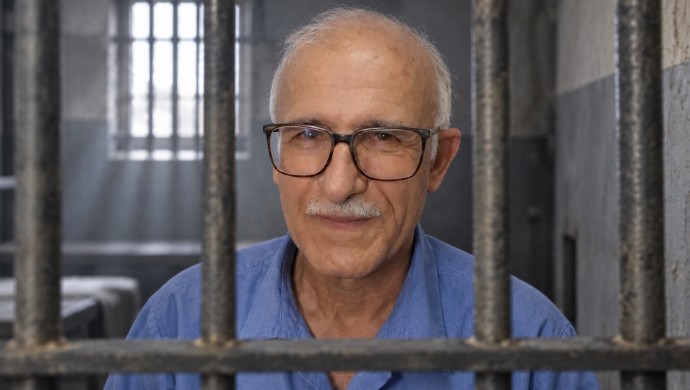

Veteran political prisoner Ali Moezzi has marked the 61st anniversary of the founding of the People’s Mojahedin Organization of Iran (PMOI/MEK) with a message from Ghezel Hesar Prison declaring that decades of repression have failed to halt the organization’s growth or extinguish resistance inside Iran.
Moezzi’s confrontation with the regime stretches back more than four decades. He was imprisoned from 1981 to 1984 in Ghezel Hesar, Evin, and Gohardasht and suffered physical and psychological torture whose effects persisted long afterward. He has subsequently been repeatedly arrested over his support for the PMOI.
Most recently, in March 2026, Moezzi was among political prisoners forced into solitary confinement during the violent Ghezel Hesar raid that immediately preceded a succession of executions of six imprisoned PMOI members.
Yet his anniversary message focuses not on his own suffering but on what he describes as the PMOI’s “61 years of evolutionary life,” built around enduring principles of “unity, emancipation, and freedom” and opposition to dictatorship and dependence.
From a sapling to a “mighty tree”
Moezzi describes the organization founded in September 1965 as a sapling that survived successive “bloody tsunamis” and was watered by the blood of Iran’s “best children.”
After 61 years, he writes, it has become “a mighty tree and a steadfast support for the people of Iran,” with branches spreading around the world.
He traces that development through different generations and forms of struggle: opposition to the Shah, the post-revolution militia movement, resistance during the 1980s, the National Council of Resistance of Iran, the National Liberation Army, Ashraf, the rise of women in leadership, and today’s Resistance Units.
Despite those transformations, he argues, the underlying principles remained fixed.
His description of the PMOI’s method is equally emphatic: “They create, discover, break deadlocks, and advance.”
Four decades of imprisonment have failed to silence him
Moezzi’s own history provides a measure of the price behind those words.
After his imprisonment in the 1980s, he was arrested again in November 2008 after visiting his children at Camp Ashraf. In June 2011, shortly after cancer surgery, he was arrested again after participating in the memorial for political prisoner and PMOI supporter Mohsen Dogmechi, executed .
In 2015, when Moezzi refused to recognize a regime court, guards beat him, dragged him in shackles before the court, and an additional year was added to his sentence. His brother Mohammad had been executed in 1981 over his support for the PMOI.
Moezzi was arrested again during the 2022 uprising. In August 2023, Judge Abolghasem Salavati sentenced him to 75 months in prison, with accusations including his continued support for the PMOI and issuing statements against the regime.
On February 15, 2025, he was beaten and forcibly transferred from Evin to Ghezel Hesar despite prostate cancer, kidney problems, hearing loss, and severe arthritis.
Then, on the night of March 29, 2026, anti-riot guards stormed Unit 4 of Ghezel Hesar, beat political prisoners, and transferred them to solitary confinement. Among those targeted were PMOI death-row prisoners Vahid Bani-Amerian, Abolhassan Montazer, Babak Alipour, and Pouya Ghobadi, who were executed in the following days. Despite his serious illnesses, Moezzi was also forced into solitary confinement.
Moezzi’s anniversary message therefore comes only months after he was swept into the same prison operation that preceded the execution of six fellow PMOI prisoners.
“Do not let others write our destiny”
The most forward-looking part of Moezzi’s anniversary message shifts from the PMOI’s history to Iran’s present political struggle.
“Let us not allow others to write our destiny,” he writes.
He then draws a direct relationship between popular anger and organized resistance:
“Organized resistance needs the masses, and the unorganized masses need this organized resistance.”
Moezzi describes Iranians facing hardship, desperation, hunger, and blocked livelihoods, and argues that the missing element is an organized political alternative capable of turning that anger into change.
“Supporting and joining the independent and democratic alternative,” he writes, “guarantees freedom, democracy, and equality for tomorrow’s Iran.”
He closes that argument with a slogan rejecting both forms of dictatorship that have ruled Iran:
“Death to the oppressor, whether the Shah or the Supreme Leader.”
Another voice from inside the regime’s prisons
Moezzi’s statement joins a growing series of messages issued around the PMOI’s 61st anniversary by political prisoners in Evin, Yazd, Ghezel Hesar, Vakilabad, and Karaj.
Parisa Kamali, Arghavan Fallahi, Forough Taghipour, Mehdi Vafaei Sani, Mohammad Javad Vafaei Sani, Meysam Dehbanzadeh, and Mohammad Hassani have all sent anniversary messages from prison in recent days.
The prisoners span different generations and circumstances—from Fallahi under an upheld death sentence to Moezzi, whose prison history reaches back to the early 1980s.
Taken together, their messages underscore the same conclusion: the regime can imprison resistance supporters, torture them, extend their sentences, deny them treatment, and threaten them with execution. But even in the darkest corners of its dungeons, it has failed to suppress the spirit of resistance.
Full text of Ali Moezzi’s message from Ghezel Hesar Prison
Message from the killing ground of Ghezel Hesar — Ali Moezzi — September 2026
In the name of God and in the name of the heroic people of Iran.
Happy 61st anniversary of the evolutionary life of the People’s Mojahedin Organization of Iran to dear Maryam Rajavi, and to the heroic people of Iran.
The structure of this organization rests upon the enduring principles of the pure ideals of unity, emancipation, and freedom—against colonialism, against reaction, and against dictatorship and dependence. Salute, salute, salute.
The PMOI has cleared the dust from the face of religion. The People’s Mojahedin love God and the people. They struggle in the path of God and the people, and they have no fear of the reproaches and obstruction of critics, those who put sticks in the wheels, censors, demonizers, those who create smoke and commotion, those who build roadblocks, and those who spread despair. With the conviction that “we can and we must,” they create, discover, break deadlocks, and advance. This is the grace of God….
“They strive in the way of God and fear not the reproach of any critic….”
The sapling planted in September 1965, after 61 years—from Hanif to Massoud and to Maryam—has passed through ups and downs and bloody tsunamis and has been watered by the roaring river of blood of the finest children of this land. It has now become a mighty tree and a steadfast support for the people of Iran, its branches extending to the farthest reaches of the world.
Through decades of relentless struggle against the Shah and the mullahs—from urban guerrilla fighters to the militias after the revolution; from the heroes of the armed resistance of the 1980s to the National Council of Resistance of Iran (NCRI); from the National Liberation Army at Ashraf 1 to the internal revolution and the emergence of a generation of revolutionary and qualified women of the People’s Mojahedin; and onward to the Resistance Units, the units of the Liberation Army, and the supporters of PMOI across the world—are these not all examples of the fruits and products of this blessed tree, each fulfilling its role at every stage? “Its roots are firm and its branches are in the sky, yielding its fruit at all times by permission of its Lord….”
Looking back, we realize that without doubt the glorious future of Iran and the Iranian people depends on the connection and solidarity of the people of our homeland with this treasure that they themselves have nurtured—and nothing else. The roads, wrong paths, and side roads have already been tested.
So in this critical situation, let us not allow others to write our destiny. Let us not leave this national asset and treasure idle; let us hold fast to this steadfast rock. Organized resistance needs the masses, and the unorganized masses need this organized resistance—the angry, desperate masses trapped in hardship and hunger, whose means of livelihood have been blocked.
Supporting and joining the independent and democratic alternative is the guarantee of freedom, democracy, and equality for tomorrow’s Iran.
What things will happen, what fires will rise!
Do not be still for even a moment, lest the blood of the people be wasted.
Death to the oppressor, whether the Shah or the Supreme Leader.
Long live the democratic revolution of the Iranian people.
Ali Moezzi — September 2026 — Ghezel Hesar Prison