

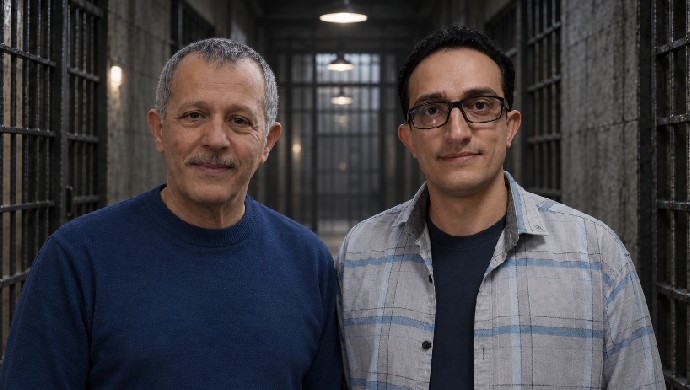

Political prisoners Khosrow Rahnama and Sepehr Emamjomeh have sent messages from Ghezel Hesar Prison marking the 61st anniversary of the founding of the People’s Mojahedin Organization of Iran (PMOI/MEK), emphasizing organized resistance as the force capable of confronting dictatorship and safeguarding Iran’s future.
Their messages add to a growing series of statements issued from political prisoners in Evin, Yazd, Vakilabad, Karaj, and Ghezel Hesar prisons, marking the September 6 anniversary of PMOI’s founding.
Their circumstances range from lengthy imprisonment to torture, medical deprivation, and death sentences. Yet their messages repeatedly return to the same theme: prison and execution have failed to sever the political and organizational continuity of resistance.
Khosrow Rahnama: “Only organized revolutionary resistance can confront the mullahs’ inhuman regime”
Rahnama begins his message by “renewing his pledge” to the PMOI and places its 61-year history within more than a century of Iranian struggles—from the Constitutional Revolution and the Jungle Movement to Mohammad Mossadegh’s national movement and the 1979 revolution.
His conclusion is categorical: “The experience of the past hundred years with the two dictatorships of the monarchy and the mullahs has proven that only organized revolutionary resistance can confront the mullahs’ inhuman regime.”
He identifies the PMOI’s organization and the Resistance Units as the embodiment of that principle, pointing to their expansion and attraction among Iranian youth.
Then comes the message’s sharpest line:
“For the Iranian regime, no name is redder and more terrifying than ‘Mojahed-e Khalq.’”
Rahnama’s words come after decades of personal experience with imprisonment. PMOI reported in December 2025 that he had spent seven years imprisoned during the 1980s and 11.5 years behind bars in total, and that he had been rearrested in Tehran on March 12, 2023. That December, from Ghezel Hesar, he also appealed for the lives of fellow prisoners facing execution.
His anniversary message therefore presents organized resistance not as an abstract theory but as the conclusion of a political prisoner who has witnessed different phases of repression firsthand.
He ends: “Death to reactionary regimes, whether the mullahs or the Shah. Salute to the Resistance Units and the National Liberation Army.”
Sepehr Emamjomeh: “Who would write the future and destiny?”
Emamjomeh takes a different approach. His letter revolves around one recurring question: “What would have happened if it had not existed?”
He applies it to key turning points in PMOI history: its opposition to Khomeini after the 1979 revolution, the National Liberation Army and the end of the Iran-Iraq war, women’s leadership under Maryam Rajavi, the PMOI’s internal revolution, the Resistance’s political alternative, and today’s Resistance Units.
The argument culminates in two questions:
“If organized resistance and its steel organization did not exist, who would write the future and destiny?”
And:
“If its victorious strategy and Resistance Units did not exist, how would the uprisings ignite?”
Emamjomeh’s prison experience provides the backdrop. He was among PMOI supporters arrested during the regime’s 2020 crackdown. During the October 15, 2022 assault on Evin Prison, he was injured by the regime’s security forces.
In January 2026, beginning his seventh year in prison, Emamjomeh wrote that one of the central lessons of his incarceration was that freedom would never be “presented to us on a golden tray” and had to be fought for.
His anniversary letter turns that personal experience into a historical argument: without organization, leadership, and accumulated experience, popular anger alone cannot guarantee freedom.
He closes by asking where he himself would be without “61 years of history and experience of relentless struggle,” before congratulating the PMOI on its anniversary.
Prison has failed to break the chain
Rahnama represents a generation whose prison experience reaches back to the 1980s. Emamjomeh belongs to a later generation arrested four decades afterward. Yet both arrive at the same conclusion on the PMOI’s 61st anniversary: organized resistance has survived successive dictatorships because one generation has passed its experience to another.
That conclusion echoes the messages emerging from Iran’s prisons throughout the anniversary period. The regime has imprisoned, beaten, shot, exiled, and executed PMOI supporters. But from Evin and Yazd to Vakilabad and Ghezel Hesar, the messages themselves demonstrate what those measures have failed to achieve.
Even in the darkest corners of its dungeons, the regime has not extinguished the spirit of resistance.
Full messages from Khosrow Rahnama and Sepehr Emamjomeh
Khosrow Rahnama — Ghezel Hesar Prison
Message from the killing ground of Ghezel Hesar — September 2026
Renewing my pledge to my Organization on the anniversary of its blessed birth: We commemorate the 61st anniversary of the founding of the proud People’s Mojahedin Organization of Iran at a time when, over these 61 years, it has passed through tremendous storms in its struggle against the two dictatorships—the monarchy and the mullahs—and has proven its competence and legitimacy to take the helm of the ship of liberation of the Iranian people.
The history of the struggles of the past hundred years—from the Constitutional Revolution and the sacrifices of Sattar Khan and Bagher Khan, to the Jungle Movement led by Mirza Kuchak Khan, the national movement led by the great Mossadegh, and finally the 1979 revolution that was stolen by Khomeini, the great thief of the century—all demonstrate the necessity of a powerful, self-sacrificing, national and revolutionary organization capable of creating the arena for struggle against every form of dictatorship, whether the Shah or the mullahs.
The experience of the struggles of the past hundred years against the two dictatorships of the monarchy and the mullahs has proven that only organized revolutionary resistance is capable of confronting the mullahs’ inhuman system. This organized resistance is embodied in the steel-strong organization of the Mojahedin and the heroic Resistance Units.
The ever-growing spread of the Resistance Units, the embrace of them by the fighting youth of this homeland, and the enemy’s fear of them testify to the righteousness of this path. For the Iranian regime, no name is redder and more terrifying than “Mojahed-e Khalq.” This precious asset guarantees the inevitable victory of our people and heralds the rising sun of peace and freedom in our country, Iran.
Death to reactionary regimes, whether the mullahs or the Shah. Salute to the Resistance Units and the Army of Peace and Freedom.
Khosrow Rahnama — Ghezel Hesar Prison — September 2026
For publication by Simay-e Azadi, the Resistance, and Resistance media
Sepehr Emamjomeh — Ghezel Hesar Prison
Message from the killing ground of Ghezel Hesar — September 2026
Every time this question runs through my mind, I think: “What would have happened if it had not existed?” There are turning points in the hundred-year history of the Iranian people’s struggle against the two dictatorships of the Shah and the mullahs whose magnitude and importance only become clear with the passage of time.
If Massoud [Rajavi] and his revolutionary stance against the reactionary regime had not existed, Khomeini would have swallowed the anti-monarchical revolution within a few days instead of two and a half years!
If the National Liberation Army and the Mojahedin’s peace slogan had not existed to force Khomeini to drink the chalice of the ceasefire, how many more years would the anti-patriotic war have continued? How many millions more would have had to be thrown into the furnace of war?
If Maryam Rajavi had not existed, what historical position would women have held in an age of misogyny? Would the qualified revolutionary woman, with such brilliance, radiance, and ability to break deadlocks, have emerged in Iran’s history?
If the Mojahedin’s glorious internal revolution against gender-based thinking and individualism had not hardened the organized revolutionary force like tempered steel against the regime and its foreign allies, would these Mojahedin have developed the human capacity and responsibility to confront the ruling reaction and its bourgeois allies?
If organized resistance and its steel-strong organization had not existed, who would write the future and destiny? Could the people overcome the bloodthirsty IRGC and its repression and killings?
If its victorious strategy and Resistance Units had not existed, how would the uprisings ignite? If the strategic center of battle—with its lionhearted women and mountain-like men of Ashraf carrying decades of struggle and experience—had not existed, what would guarantee the dawn of the people’s victory?
If the self-sacrificing leadership of this great organized resistance had not existed, who and what would safeguard the revolution, freedom, and the people’s right to sovereignty? If there were no revolutionary and popular alternative and provisional government to return sovereignty to the people, what force would safeguard Iran’s political future amid fake and counterfeit alternatives?
And where would we be, where would I be, and what would I really be doing if there were no 61 years of history and experience of relentless struggle and a hundredfold battle? If the great Hanif [Mohammad Hanifnejad] had not planted this sapling and this blessed tree, now bearing such fruit, who, what people, and what currents would have written Iran’s history?
So blessed and auspicious be the 61st year of your existence, my beloved Organization, the proud People’s Mojahedin Organization of Iran.
Sepehr Emamjomeh — September 2026
Long live the new democratic revolution of the Iranian people.
For publication in Resistance media